You’re watching your umbrella lizard press itself into the corner of a 40-gallon breeder tank, frill half-raised, eyes locked on you — and you’re not sure if that’s normal or a warning sign. The umbrella lizard, better known as the frilled-neck lizard (Chlamydosaurus kingii), is one of the most striking reptiles you can keep, but it’s also one of the most commonly failed. Most keepers get the temperature numbers close enough, then wonder why their animal stops eating at six months.
The real problem isn’t heat. It’s stress. These lizards die slowly in enclosures that look fine on paper but feel like a trap.
What the Umbrella Lizard Actually Is (and Why Most Setups Fail It)
The umbrella lizard is a large agamid from the tropical and subtropical woodlands of northern Australia and southern New Guinea. Adults reach 24 to 36 inches from snout to tail tip. They spend most of their time up in the trees, not on the ground, which is exactly where most enclosures fail them.
The frill isn’t just a display feature. It’s a stress indicator. When your lizard fans it out at you during a routine feeding, that’s fear, not personality. Most captive specimens are kept in enclosures that are too short, too open, and too unpredictable — and the result is chronic stress that suppresses the immune system before you ever see a visible symptom.
Enclosure Size and Orientation: Vertical Space Is Non-Negotiable
A frilled-neck lizard needs height before it needs floor space. The minimum enclosure for a single adult is 4 feet tall, 2 feet wide, and 2 feet deep — and that’s the floor, not the goal. Many experienced keepers build or buy enclosures closer to 5 or 6 feet tall. A horizontal 75-gallon tank is not a substitute, no matter how much you decorate it.
Life Stage
Minimum Height
Minimum Footprint
Notes
Juvenile (under 12 in.)
3 ft
18 x 18 in.
Upgrade within 6-8 months
Subadult (12-24 in.)
4 ft
24 x 24 in.
Add climbing branches now
Adult (24+ in.)
5 ft
24 x 36 in.
More height always wins
Minimum Dimensions and Why Floor Space Isn’t the Priority
Floor space matters for most lizards. For Chlamydosaurus kingii, it’s almost secondary. These animals climb to regulate temperature, escape perceived threats, and feel secure. A lizard stuck at ground level is a lizard under constant low-grade stress. Enclosures from brands like Zen Habitats or custom PVC builds from local fabricators hit these dimensions without costing a fortune. A 4x2x4 PVC panel enclosure runs roughly $350 to $500 depending on the supplier.
The one thing you can’t compromise on is vertical clearance. If your basking branch sits less than 18 inches from the top of the enclosure, the lizard can’t thermoregulate properly without feeling exposed at the ceiling.
Sight-Line Breaks and Vertical Escape Routes
An open enclosure with nothing to hide behind is a stressful enclosure. Frilled-neck lizards need visual barriers at multiple height levels, not just ground cover. Think diagonal branches that let the animal move up and across without ever being fully visible from one angle. Cork bark panels mounted on the back wall give both a climbing surface and a hide.
Add at least two distinct escape routes: paths the lizard can take to move from low to high without crossing open space. This mimics how they move through trees in the wild and dramatically reduces frill displays triggered by your presence near the enclosure.
Building the Thermal Gradient and Lighting Your Umbrella Lizard Needs
Get this wrong and nothing else you do matters. Frilled-neck lizards need a genuine temperature gradient with a hot basking spot, a cool retreat, and a stable nighttime drop. Hitting all three is what keeps digestion, immune function, and appetite working correctly.
Basking Spot, Cool Side, and Nighttime Temps
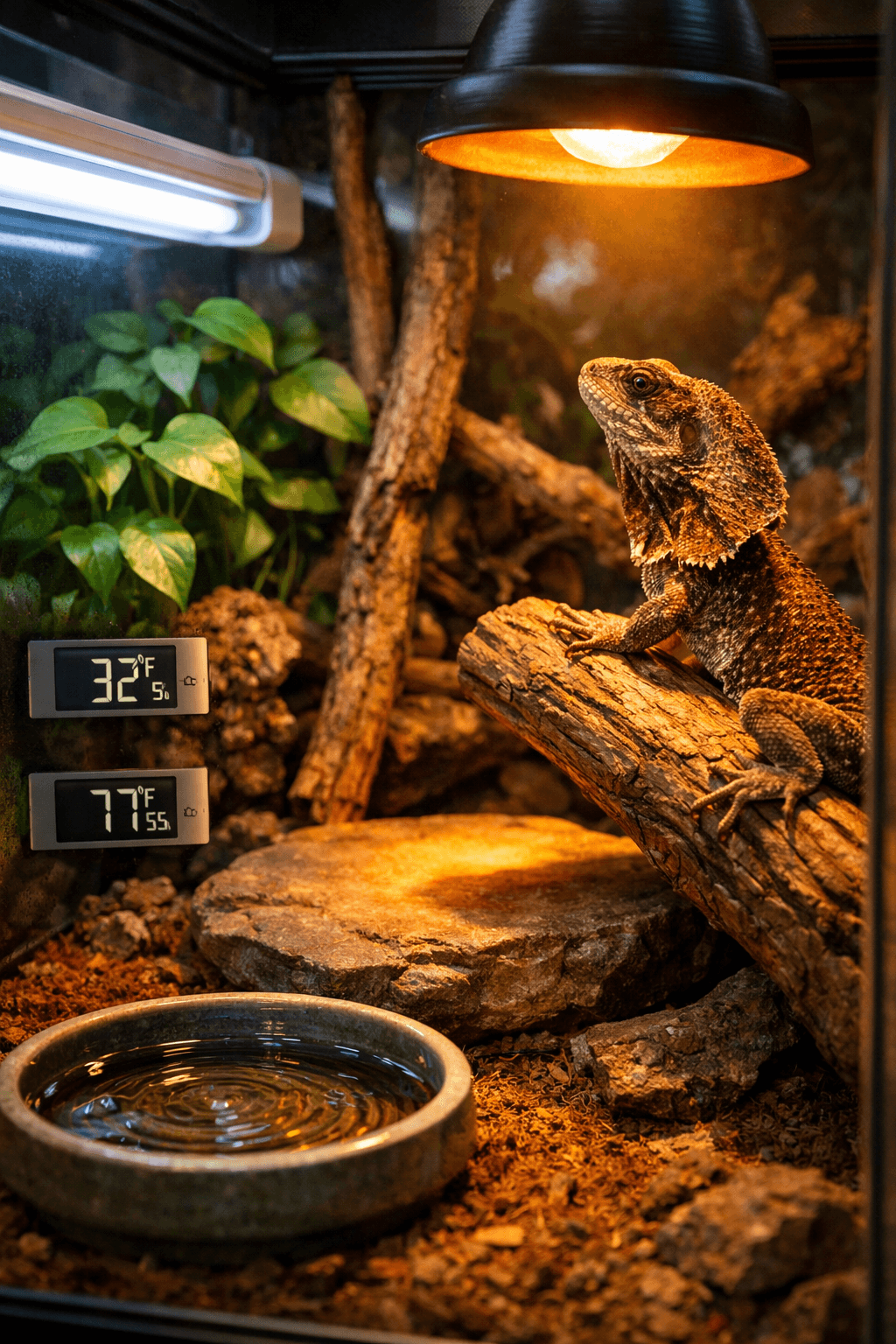
The basking surface should hit 105 to 115°F, measured at the branch or platform surface with an infrared temperature gun, not the ambient air. Cool side ambient should sit between 78 and 82°F. At night, dropping to 68 to 72°F is fine and actually beneficial. It mimics their native subtropical environment in northern Australia where nights cool noticeably.
Use a halogen flood bulb (a standard PAR38 halogen from any hardware store works) over the basking branch. Avoid ceramic heat emitters as your primary basking source. They produce no light, which disrupts the lizard’s light-temperature association.
UVB Bulb Selection and Placement
Frilled-neck lizards need strong UVB exposure. The Arcadia T5 HO 12% or the Arcadia Dragon 14% are the two most-used options among experienced keepers, and for good reason. They produce a UV Index (UVI) of 4 to 6 at basking distance, which matches what this species gets in the wild. Place the UVB tube directly over the basking branch, no more than 10 to 12 inches away if using a T5 HO without a reflector.
Never put mesh between the bulb and the lizard if you can help it. Standard aluminum window screen blocks roughly 30 to 50% of UVB output, which can push your UVI below the threshold needed to prevent metabolic bone disease.
Photoperiod and Seasonal Cycling
Run your lights 12 to 14 hours per day in summer months and drop to 10 to 11 hours in winter. This seasonal cycling isn’t optional for long-term health. It regulates appetite, reproductive cycling, and behavior. A basic plug-in digital timer from any hardware store handles this automatically for under $15.
Humidity, Substrate, and the Subtropical Conditions That Keep Them Healthy
Frilled-neck lizards are not desert animals. They come from subtropical woodlands where humidity runs between 60 and 80% for much of the year. Treating them like a bearded dragon, with dry substrate and low ambient moisture, is one of the fastest ways to cause respiratory problems and failed sheds.
Your target ambient humidity is 60 to 70%, with brief spikes up to 80% after misting. A digital hygrometer like the Govee H5101 gives you accurate readings for under $15 and takes the guesswork out.
Substrate Depth and Moisture Retention
Use a moisture-retaining substrate that holds humidity without going soggy. A mix of coconut fiber (coir) and organic topsoil at a 50/50 ratio works well and costs very little. Lay it at least 3 to 4 inches deep so the lower layer stays slightly damp while the surface dries between mistings.
Avoid reptile carpet, paper towels, or dry sand. These kill surface humidity fast and give you no buffer between mistings. If you’re going bioactive, a drainage layer of lava rock or hydroballs under your substrate mix keeps the moisture level stable for days at a time.
Here are the substrate options ranked by moisture retention and practicality:
Coir and organic topsoil mix (50/50) — best balance of cost and performance
Bioactive mix with drainage layer — most stable long-term, higher setup cost
Pure coconut fiber — works but compacts quickly and needs more frequent replacement
Cypress mulch — decent retention, widely available, easy to spot-clean
Organic potting mix (no perlite, no fertilizer) — good for bioactive builds
Misting Schedule and Ventilation Balance
Mist the enclosure once in the morning and once in the evening. Each session should wet the walls and substrate surface without pooling water at the bottom. An automatic misting system like the Mist King Starter or Zoo Med Repti Rain handles this on a timer if you’re not home during those windows.
Good ventilation is just as important as the misting itself. Stagnant humid air causes bacterial growth and respiratory infections faster than low humidity does. Aim for cross-ventilation, with screen panels on two sides of the enclosure rather than just the top. Humidity should drop back toward 55% between misting cycles, then climb again after the next session.
Climbing Structures, Live Plants, and Bioactive Setup Options
The interior of the enclosure does more work than most keepers expect. A bare enclosure with one branch is a stressful enclosure, even if the temperatures are perfect. The goal is a space where the umbrella lizard can move vertically, feel hidden, and make choices about where to go.
Building a Climbable Interior That Reduces Stress
Use diagonal branches at multiple heights so the lizard can travel from floor to basking spot without crossing open air. Cork bark rounds and flat cork panels are the most practical choice. They’re lightweight, easy to mount with silicone or zip ties, and naturally textured for grip. Manzanita branches are another solid option and hold up well in humid conditions without rotting.
Aim for at least three distinct height zones: a low hide near the substrate, a mid-level perch, and a basking branch near the top. That structure alone reduces frill displays significantly in newly introduced animals.
Safe Plant Species for a Frilled-Neck Enclosure
Live plants add humidity, visual cover, and a more natural feel. Pothos (Epipremnum aureum) is the easiest starting point. It tolerates low light, handles high humidity, and grows fast enough to recover from the occasional lizard trampling. Bromeliads work well as ground-level cover and hold small water reservoirs in their cups. Avoid any plant treated with pesticides, and skip succulents entirely. They don’t survive the humidity levels this species needs.
Feeding Your Umbrella Lizard: Diet, Supplements, and Hydration
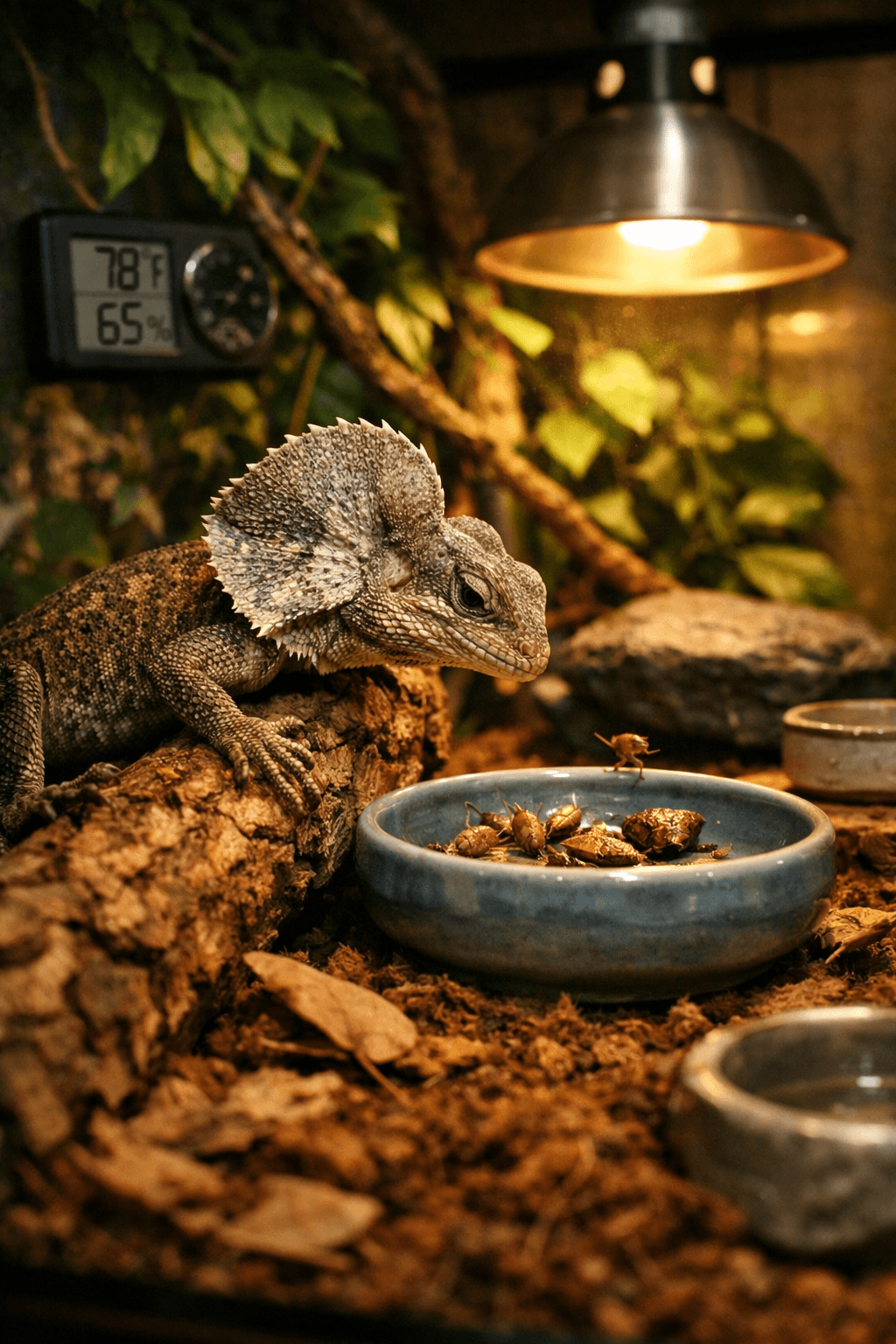
Umbrella lizards are primarily insectivores, with juveniles eating almost exclusively insects and adults occasionally taking small vertebrate prey. Variety in the feeder insect rotation matters more than volume. A lizard eating only crickets for months will develop nutritional gaps that supplements alone can’t fully fix.
Feeder Item
Feeding Frequency
Notes
Dubia roaches
3-4x per week (juveniles daily)
Best staple; high protein, low fat
Crickets
2-3x per week
Gut-load 24 hrs before feeding
Black soldier fly larvae
1-2x per week
Naturally high calcium
Hornworms
Occasional treat
High water content; good for hydration
Pinky mice (adults only)
Once a month max
Avoid overuse — too fatty
Prey Items, Feeding Frequency, and Gut-Loading
Juveniles eat daily. Adults do well on feeding 4 to 5 times per week. Gut-loading means feeding your feeder insects nutritious food for 24 to 48 hours before offering them, and it’s not optional. Crickets and roaches fed on plain oats pass almost no nutrition to your lizard. Use a commercial gut-load like Repashy Bug Burger or fresh vegetables like collard greens and squash.
Calcium, D3, and When to Supplement
Dust feeders with a plain calcium powder (no D3) at every feeding for juveniles, and every other feeding for adults. Use a calcium-plus-D3 supplement just twice a month. More than that risks hypervitaminosis D, which causes calcification in soft tissue. A multivitamin like Repashy Supervite once every two weeks rounds out the routine for adults.
Handling, Acclimation, and Reducing Chronic Stress
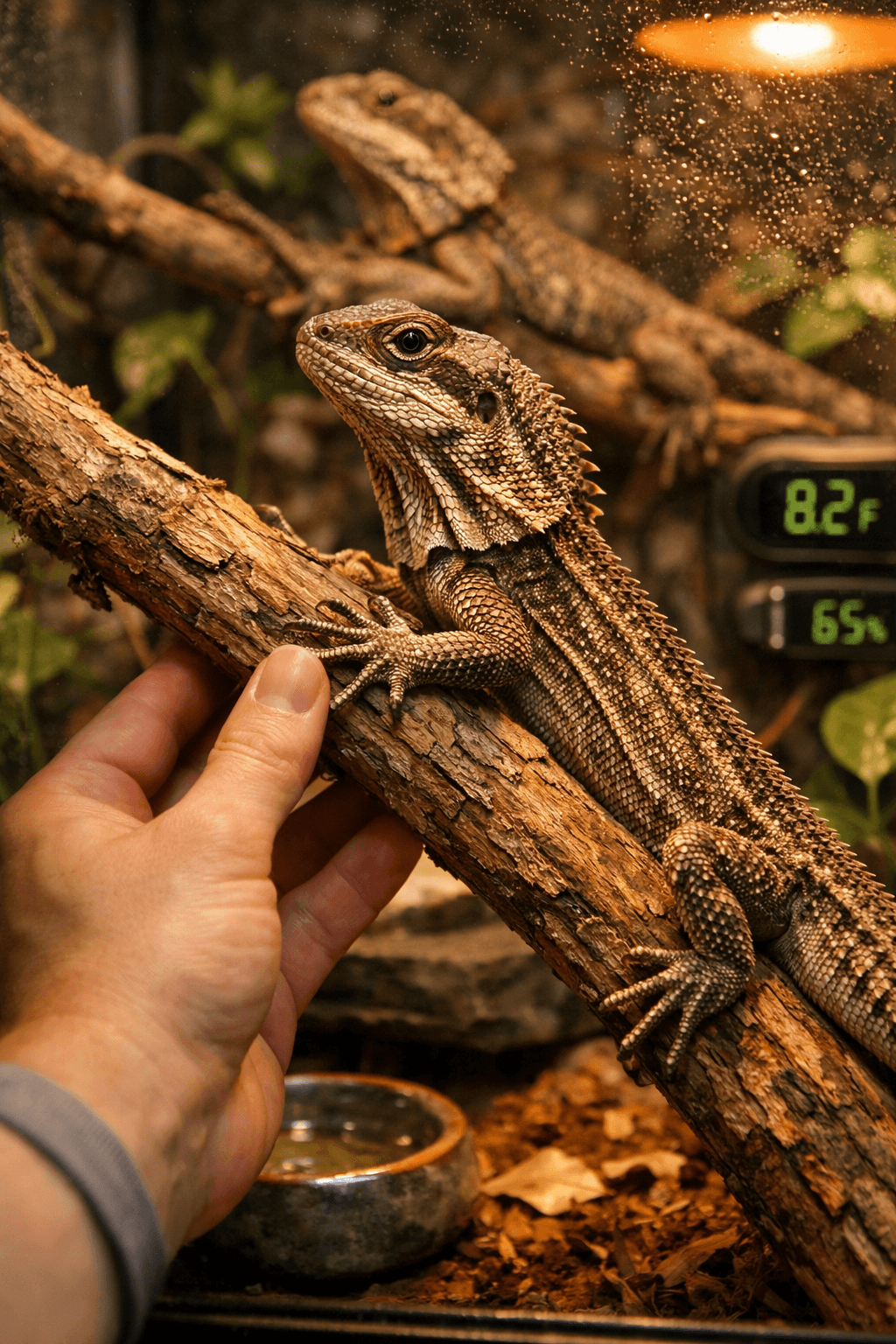
New umbrella lizards need at least 4 to 6 weeks of minimal contact before you attempt regular handling. During that window, limit interactions to feeding and necessary enclosure maintenance only. The frill is a fear response first. If you’re seeing it every time you open the door, the lizard is not comfortable yet.
Reading Frill Displays Correctly
A frill display means the lizard feels cornered or threatened. It’s not aggression in the attack sense. It’s a bluff. If your umbrella lizard gapes (open mouth alongside the frill), back off completely and give it space. Repeated displays during keeper interactions are a sign the acclimation period needs more time, not less.
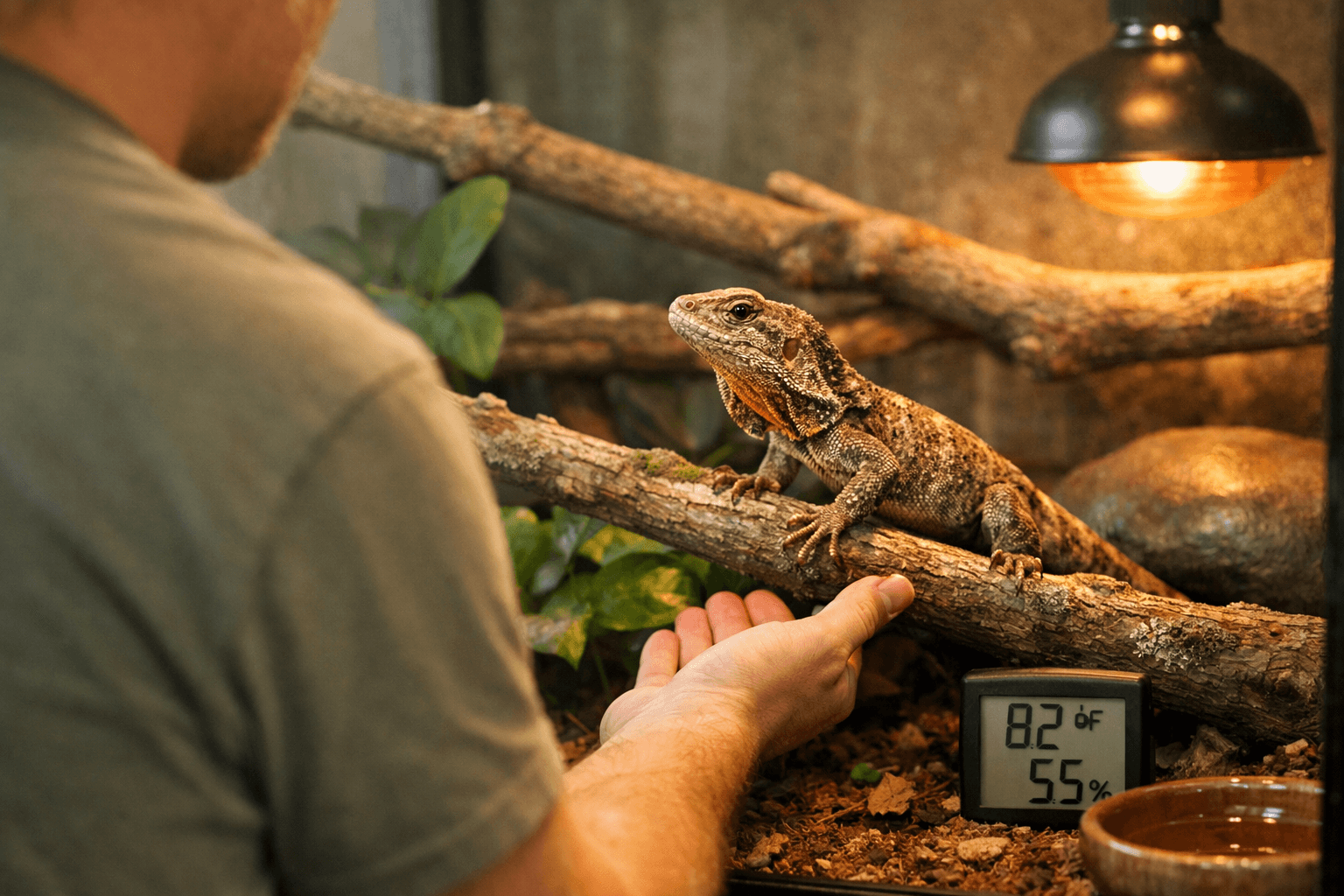
Watch for calm, relaxed posture instead: a lizard that moves slowly around the enclosure, basks without bolting when you walk by, and doesn’t puff up when you open the door. That’s your green light to start short, low-pressure handling sessions of 5 to 10 minutes.
Building a Predictable Keeper Routine
Consistency lowers stress more than gentleness alone. Feed at the same time each day, approach the enclosure from the same angle, and avoid sudden movements. Predictable keeper behavior is what builds tolerance over weeks. Unpredictable contact resets that progress fast.
Common Health Problems and How to Spot Them Early
Most health problems in captive umbrella lizards trace back to setup errors, not bad luck. Catching issues early gives you a real shot at fixing them without a vet visit turning into an emergency.
**Metabolic bone disease (MBD)** is the most common and preventable problem. Early signs are subtle — a slight tremor in the limbs, soft jaw tissue, or a curved spine. If you see any of those, check your UVB output and calcium supplementation schedule before anything else.
Respiratory infections show up as wheezing, mucus around the nostrils, or open-mouth breathing at rest. These usually follow a stretch of stagnant humid air or temps that dropped too low at night. A vet visit is the right call here — respiratory infections move fast in lizards.
Retained shed (dysecdysis) happens when humidity drops below 55% for extended periods. You’ll see patches of old skin stuck around the toes or tail tip. Soak the affected area in shallow warm water for 15 to 20 minutes and gently loosen the skin — never pull. Fix the humidity before the next shed cycle.
Watch for sudden appetite loss lasting more than 10 days, visible weight loss along the spine and hips, or lethargy during normal basking hours. Any of those warrants a vet check with a reptile-experienced practice.
Frequently Asked Questions
Can umbrella lizards be kept together?
No. Frilled-neck lizards are solitary and territorial. Cohousing two adults almost always leads to chronic stress, competition for basking spots, and injury. Keep one lizard per enclosure.
How long does it take for an umbrella lizard to tame down?
Expect 2 to 4 months of consistent, low-pressure routine before most individuals tolerate regular handling without frill displays. Some take longer. Juveniles acclimate faster than wild-caught adults, which may never fully settle.
What’s the minimum enclosure size for an adult umbrella lizard?
A 4 feet tall by 2 feet wide by 2 feet deep enclosure is the practical minimum for a single adult. Bigger is better, and height matters more than floor space for this species.
Do umbrella lizards need a water dish?
Yes, but they don’t always drink from standing water. Many prefer to lap droplets off enclosure walls after misting. Keep a shallow dish available and change it daily — still water grows bacteria fast at the humidity levels this species needs. If you want more detailed guidance on naturalistic water features for enclosures like this, petterrarium.com has build guides that cover drainage and water integration in bioactive setups.