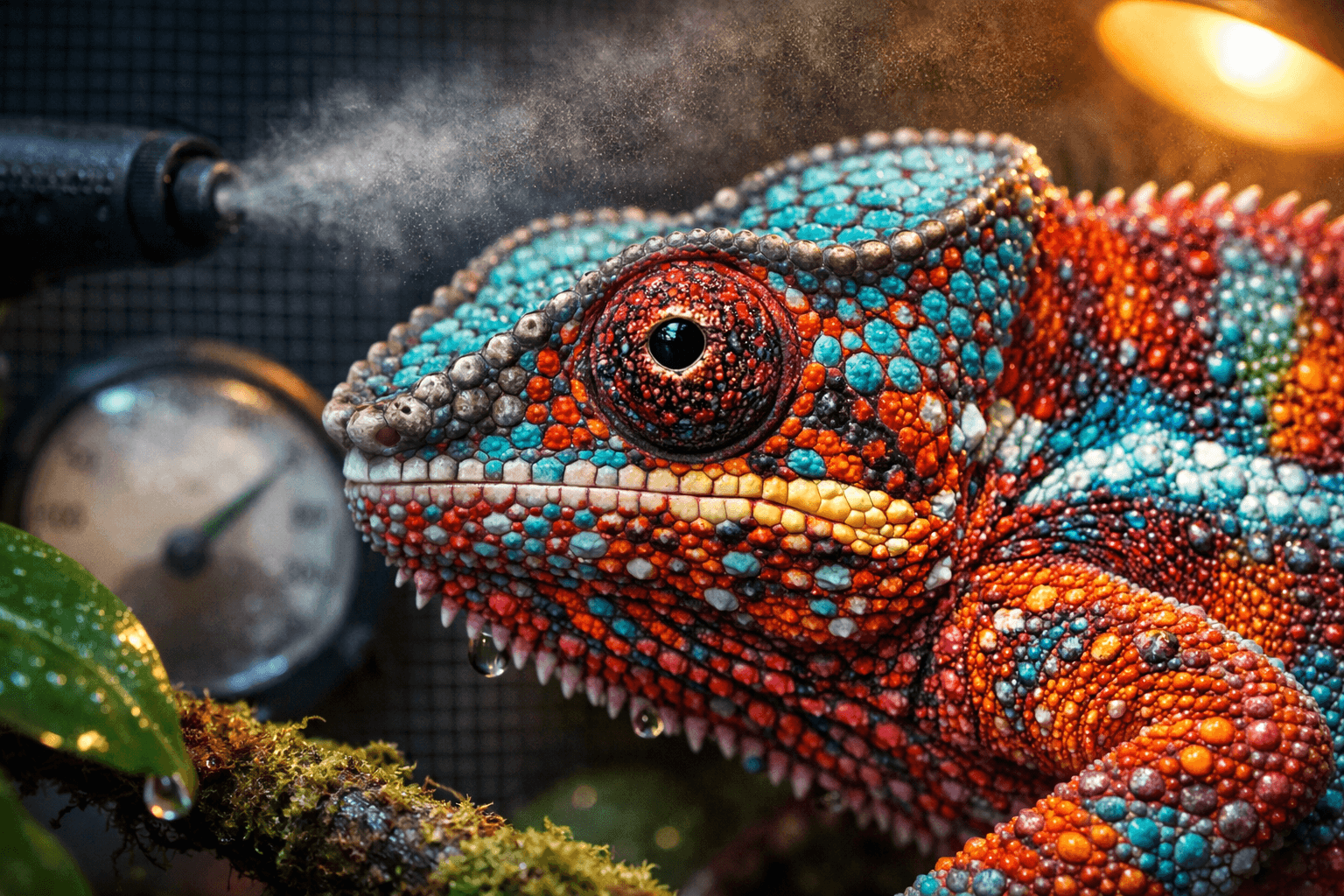
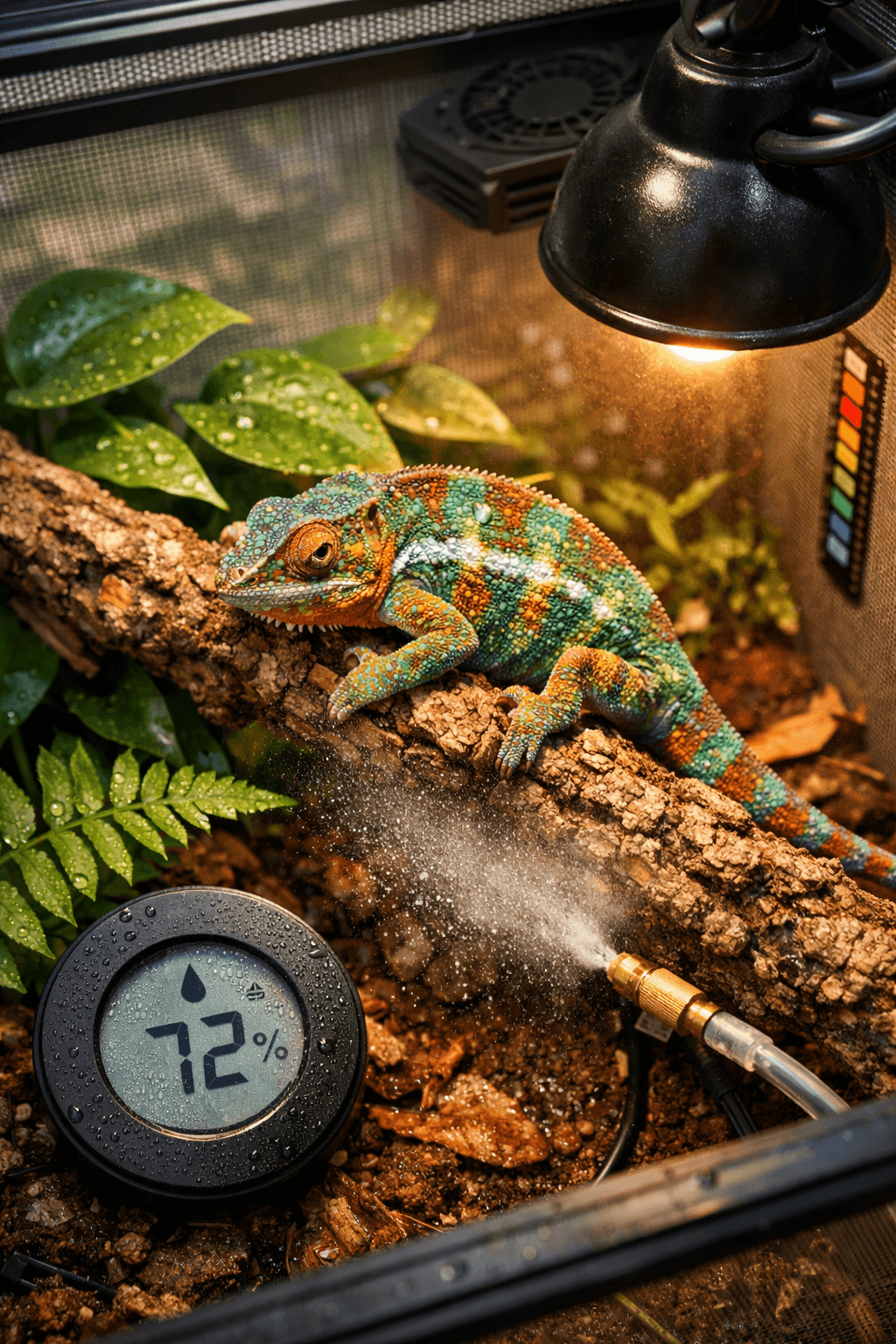
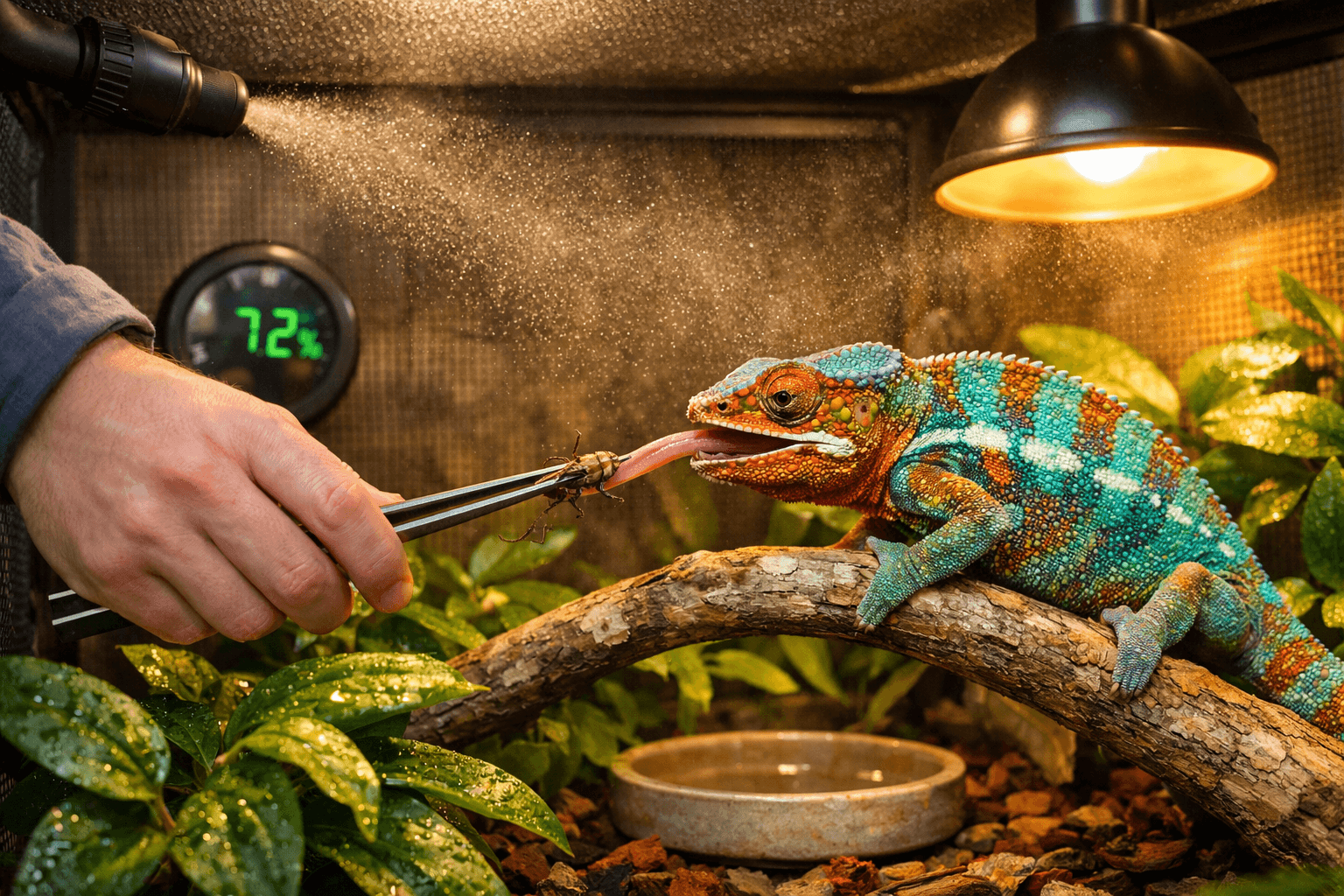
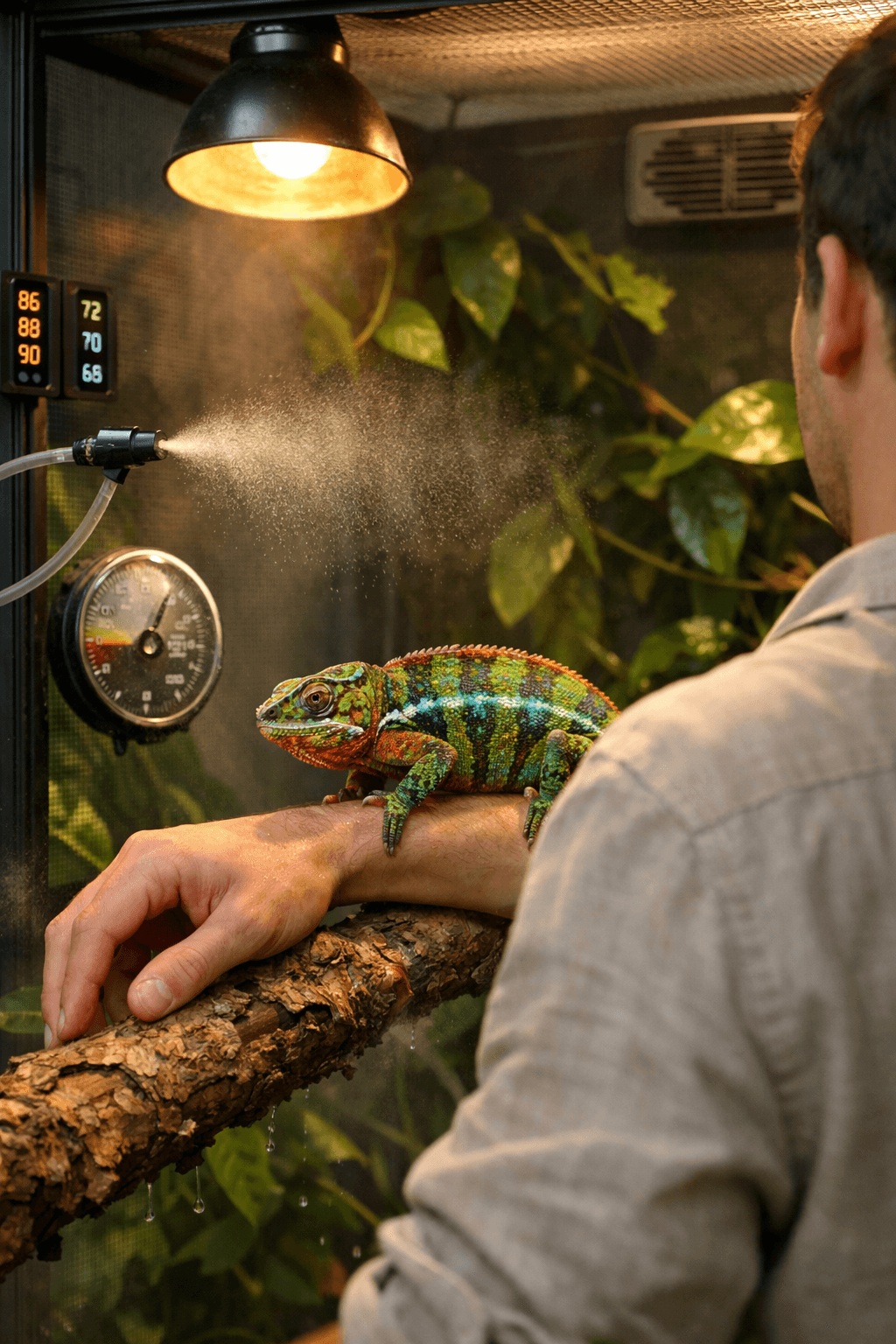
You’re standing in front of a new screen enclosure, misting system in hand, wondering why your panther chameleon keeps sitting with eyes half-closed despite a setup that looks perfect on paper. That gap between “looks right” and “works right” is where most keepers struggle. A panther chameleon doesn’t just need food and a warm spot — it needs a fully engineered microclimate where airflow, humidity, light, and plant life all work together.
Getting that balance right is what separates a chameleon that thrives from one that slowly declines. The good news: once you understand how the variables connect, the setup becomes much more logical.
A Panther Chameleon Habitat Is a Living System, Not Just a Cage
Think of your panther chameleon’s enclosure as an ecosystem, not a box with a heat lamp. Every element (the plants, the misting schedule, the airflow, the light spectrum) affects every other element. Adjust one thing and you’ll feel the ripple across the rest.
The biggest mistake new keepers make is treating each variable in isolation. They dial in humidity without thinking about ventilation, or add a basking light without accounting for how it dries out the canopy. Arboreal species like panther chameleons are especially sensitive to these imbalances because they live in the upper zone of the enclosure where all those forces converge.
Enclosure Size and Ventilation: The 24x24x48 Minimum Is Non-Negotiable
A 24x24x48-inch screen enclosure is the floor for an adult male panther chameleon — not a starting point you’ll upgrade from later. Go smaller and you’ll fight temperature gradients, humidity swings, and stress-related color loss constantly. Females are smaller and can work in a 18x18x36, but males need that full vertical column.
Enclosure Spec
Male Panther Chameleon
Female Panther Chameleon
Minimum footprint
24 x 24 inches
18 x 18 inches
Minimum height
48 inches
36 inches
Recommended material
Screen (all four sides)
Screen (all four sides)
Acceptable glass use
Front panel only, optional
Front panel only, optional
Upgrade recommended
Yes, 24x24x72 if possible
Not typically needed
The Reptibreeze line from Zoo Med is a common starting point, and the 24x24x48 model runs around $120 to $150 at most reptile retailers. It’s not the only option, but it’s widely available and easy to modify with drainage trays.
Why Screen Beats Glass Every Time
Glass tanks trap heat and stagnant air. For a panther chameleon, that stagnant air is a direct path to upper respiratory infection — one of the most common vet visits for this species. Screen on all four sides lets air move through the enclosure constantly, which keeps the humidity from becoming suffocating and prevents bacterial buildup on surfaces.
Full screen ventilation is non-negotiable if you’re running a misting system that fires two or three times a day. Glass simply can’t shed that moisture fast enough. Some keepers use hybrid enclosures with a glass front panel for visibility, which works fine as long as the top and at least two sides are screen.
Vertical Space Matters More Than Floor Space
Panther chameleons almost never touch the ground voluntarily. They spend their entire active day climbing through branches and resting in the upper canopy. A 48-inch height gives you room to build a real gradient — basking branches near the top, cooler mid-level perches, and a plant-heavy lower zone that holds humidity.
Floor space matters far less than height here. A 24×24 footprint is genuinely enough if you use the vertical space well with diagonal branches and layered foliage at different levels.
Building the Microclimate: Light, Heat, and Humidity Working Together
Lighting, heat, and humidity are interdependent. Set up your UVB light first, then position your basking spot relative to it, then build your misting schedule around how fast the enclosure dries out at that heat level. Doing it in any other order creates problems you’ll spend weeks chasing.
UVB and Basking Light Setup
A T5 HO UVB bulb rated at 6% or 10% output is the right call for panther chameleons. The Arcadia 6% Forest or the Zoo Med Reptisun 10.0 T5 HO are both proven options. Mount the UVB tube across the top of the enclosure and position your main basking branch 6 to 8 inches below it. That distance gives the chameleon a usable UV Index of around 2 to 3, which matches the dappled canopy light of their native Madagascar habitat.
Run lights on a 12-hour on/off cycle year-round. Panther chameleons don’t need seasonal variation the way some temperate species do.
Temperature Gradient From Basking Spot to Floor
Your basking spot should sit between 90°F and 95°F. The ambient mid-level temperature should stay in the low-to-mid 80s°F, and the floor can drop into the mid-70s°F. That cool floor zone matters because it’s where your plants root and where humidity lingers longest after misting.
Use a 50- to 75-watt incandescent or halogen flood bulb for basking, not a ceramic heat emitter. Panther chameleons thermoregulate visually, meaning they move toward or away from visible light sources. A ceramic emitter gives heat without the light cue, which can throw off their natural behavior. Measure the basking spot with an infrared temperature gun, not a stick-on thermometer. Stick-ons are notoriously inaccurate for spot temps.
Humidity, Misting Frequency, and Drainage Layers
Target 60% to 80% ambient humidity during the day, with a drop to around 40% to 50% at night. That nighttime drop is important. It mimics the natural drying cycle of Madagascar’s coastal forests and helps prevent bacterial dermatitis on the skin.
A programmable misting system like the Mist King Starter or Aquazamp RainMaker fires for 30 to 60 seconds, two to four times a day depending on your enclosure’s drying speed. Never rely on a standing water dish for hydration. Panther chameleons drink water droplets off leaves, not from bowls. A dripper running for a couple of hours mid-morning gives them a reliable drinking window they’ll actually use.
Build a false bottom or drainage layer under your substrate. A 2- to 3-inch layer of hydroballs or lava rock topped with a mesh screen keeps water from pooling at the root level and turning your soil anaerobic. Without it, daily misting turns your substrate into a bacterial swamp within a few weeks.
Plants, Foliage, and Substrate: What Goes Inside the Enclosure
Live plants do real work inside a panther chameleon enclosure. They hold humidity between misting cycles, provide cover that reduces stress, and give the chameleon natural perching surfaces. Fake plants can supplement, but they can’t replace the humidity-buffering effect of live foliage with actual transpiration happening at the leaf surface.
Here are the four layers worth building into every panther chameleon enclosure:
A tall canopy anchor like a Ficus benjamina or Schefflera arboricola in the upper two-thirds, giving the chameleon its main climbing structure.
Mid-level filler with Pothos (Epipremnum aureum) — it grows fast, handles low light, and trails naturally across branches.
Broad-leaf ground cover like Philodendron species to catch and hold water droplets at the lower level.
A hanging vine or two of Tradescantia to fill gaps and give the chameleon extra grip points along the walls.
Safe Plant Species That Actually Work
Pothos is the single most useful plant in a chameleon build. It tolerates the humidity swings, grows back fast when the chameleon snaps a stem, and is non-toxic if accidentally ingested. Ficus is a close second for structural value, though it drops leaves when first moved — give it two weeks to acclimate before judging it.
Avoid Dracaena and any plant in the Euphorbia family. Both show up in general terrarium lists but are toxic to chameleons. Stick to plants confirmed safe on resources like the American Chameleon Society’s plant list.
Substrate and False Bottom to Handle Daily Misting
Skipping a false bottom is the fastest way to wreck your enclosure. Lay 2 to 3 inches of hydroballs (expanded clay aggregate) at the base, cover with fiberglass window screen mesh, then add 2 to 3 inches of organic topsoil or a coconut coir and sand mix on top. That separation keeps water draining away from plant roots instead of sitting stagnant.
The top substrate layer supports your potted plants and gives the enclosure a natural floor appearance. Keep pots elevated on small risers inside the substrate layer so roots never sit in the drainage zone.
Feeding Your Panther Chameleon and Keeping Colors Bright
What Panther Chameleons Eat in Captivity
Crickets and Dubia roaches form the backbone of most panther chameleon diets, but variety matters. Rotate in black soldier fly larvae (sold as Phoenix Worms or Calci-Worms), hornworms, and silkworms every few days. Adults eat every other day, roughly 8 to 12 appropriately sized feeders per meal.
Gut-loading and dusting are non-negotiable steps. Feed your insects a quality gut-load diet for 24 to 48 hours before offering them. Dust with calcium (no D3) at nearly every feeding. Rotate in a vitamin supplement with D3 twice a month. Over-supplementing D3 causes toxicity, so twice monthly is the ceiling, not a starting point.
Why Dull Colors Don’t Always Mean Illness
A panther chameleon showing muted or dark colors isn’t automatically sick. Cooler temperatures, low light in the morning, and even mild stress from seeing their own reflection can flatten coloration fast. Males often go dark brown when they’re cold and haven’t warmed up at the basking spot yet.
Cryptic coloration (the instinct to blend in) also kicks in when a chameleon feels exposed or watched. Give the enclosure dense foliage and back off handling for a few days. If colors stay dull alongside other symptoms like closed eyes or sunken casque, then a vet visit makes sense.
Color Morphs, Locale Variants, and Male vs. Female Housing
Panther chameleons (Furcifer pardalis) are native to Madagascar, and their color patterns vary dramatically by geographic origin. These regional populations are called locales, and they’re the main reason panther chameleons are one of the most collected reptiles in the hobby.
Locale
Dominant Male Colors
Female Coloration
Typical Price Range
Ambilobe
Red, blue, green, yellow
Peach to pink
$200 – $400
Nosy Be
Electric blue, teal
Tan to light brown
$250 – $450
Tamatave
Red and green banded
Peach, orange
$180 – $350
Ambanja
Blue and green with red bars
Pink to salmon
$200 – $400
Nosy Mitsio
Orange and blue
Light tan
$300 – $500
Never house two panther chameleons in the same enclosure, even a male-female pair outside of brief, supervised breeding attempts. Males fight, and females stressed by a male’s constant visual presence stop eating and decline quickly. Each animal gets its own enclosure, full stop.
Females are less colorful but still show stress and receptivity signals through color shifts. A gravid female ready to lay eggs turns dark with bright pink or blue spots. That’s a clear signal she needs a laying bin, not a cage mate.
Handling, Stress Reduction, and Long-Term Keeper Habits
Panther chameleons are not social animals. They don’t warm up to handling the way a bearded dragon might, and pushing daily interaction does real damage over time. Limit handling to two or three times per week, keeping sessions under five minutes, especially in the first few months after you bring the animal home.
Watch body language before you reach in. A chameleon that gapes, hisses, or turns sideways to look larger is telling you to back off. Habituation (the gradual process of an animal lowering its stress response to a repeated non-threatening stimulus) takes weeks, not days. Forcing it faster raises cortisol levels chronically, which suppresses immune function and shortens the animal’s lifespan.
Approach from the side, not from above. Top-down grabs trigger the same fear response as a bird of prey attack. Let the chameleon walk onto your hand rather than closing your fingers around it.
Long-term, the keepers who get the most out of panther chameleons spend time near the enclosure without interacting. Reading nearby, working at a desk, letting the animal learn that your presence doesn’t signal a threat. Over months, most panther chameleons will voluntarily walk to the door of the enclosure when it opens.
Frequently Asked Questions
How long do panther chameleons live in captivity?
Males typically live 5 to 7 years with good husbandry. Females have shorter lifespans, often 3 to 5 years, largely because egg production (even without a male present) puts significant physical strain on their bodies.
Can a panther chameleon share an enclosure with another reptile?
No. Panther chameleons are obligate solitary animals and will not tolerate cage mates of any species. Even a gecko housed in the same enclosure creates a chronic visual stressor. Each panther chameleon needs its own dedicated setup.
How do I know if my panther chameleon is dehydrated?
Check the eyes first. Sunken or partially closed eyes during the day are the clearest early sign of dehydration. Urates (the white part of the droppings) should be white to pale yellow. Orange or yellow urates mean the animal needs more water immediately. Increase misting frequency and run a dripper for a longer window.
Do female panther chameleons need UVB lighting?
Yes, females need the same UVB setup as males: a linear T5 HO bulb rated at 6% UVB output, replaced every 12 months even if it still appears to emit light. Skipping UVB for females leads to metabolic bone disease just as fast as it does in males.