You’re setting up your blue tongue skink’s enclosure and wondering if that 40-gallon tank in the garage will work for now. It won’t. Blue tongue skinks are bigger, more active, and more humidity-sensitive than most beginners expect, and getting the setup wrong from day one leads to real health problems.
The good news is that a proper setup isn’t complicated once you understand the basics. The biggest thing most guides skip is subspecies. Northern and Indonesian blue tongue skinks have genuinely different needs, and the wrong humidity or temperature range can stress your animal for months before you figure out why.
Subspecies First: Northern vs. Indonesian Blue Tongue Skinks Need Different Setups
Knowing your subspecies before you build anything saves you from redoing the whole setup later. Tiliqua scincoides intermedia (Northern blue tongue skink) comes from dry Australian savannas. Indonesian subspecies like Tiliqua gigas come from humid tropical forests. Same blue tongue, very different requirements.
Feature
Northern BTS
Indonesian BTS
Humidity range
40–60%
60–80%
Basking temp
100–110°F
95–105°F
Substrate preference
Dry, loose-mix
Moist, moisture-retaining
Common availability
Very common
Moderate
Most pet stores don’t label subspecies clearly, so ask specifically or research the seller before you buy.
Tank Size: Adults Need at Least 120 Gallons to Thrive
An adult blue tongue skink needs a minimum of 120 gallons, and that’s not a luxury recommendation. It’s the floor. Adult Northern blue tongue skinks regularly reach 20–24 inches long and weigh over 400 grams. They need space to move, thermoregulate, and express normal behavior. A cramped enclosure leads to stress, which leads to reduced appetite and immune problems over time.
A 120-gallon enclosure runs roughly 48–72 inches long, depending on the brand. That gives you enough room for a proper temperature gradient, two or three hides, and a feeding station without everything crowding together.
Why a 40-Gallon Tank Falls Short
A 40-gallon tank is about 36 inches long. That’s barely longer than the skink itself. There’s no room for a real thermal gradient (the range from cool side to basking spot that lets your skink regulate its own body temperature). Without that gradient, your skink can’t thermoregulate properly, which affects digestion and immune function directly.
Forty gallons also makes humidity control harder. You end up with uneven moisture pockets and no good spot to place hides away from the basking zone.
Floor Space Matters More Than Height
Blue tongue skinks are ground dwellers. They don’t climb. A tall enclosure wastes vertical space your skink will never use. What matters is footprint, meaning the length and width of the floor.
Aim for at least 4 feet long by 2 feet wide as your absolute minimum floor size for an adult. A 120-gallon tank at 48×24 inches hits that mark. Going to 60×24 inches (some custom builds or larger commercial tanks) gives your skink noticeably more room to patrol and explore. If you’re building a custom enclosure, prioritize floor space over everything else.
Substrate, Depth, and Why Loose Sand Alone Causes Impaction
Loose sand looks natural, but using sand as your only substrate is one of the most common mistakes new blue tongue skink owners make. When skinks eat, they pick up substrate. Sand particles accumulate in the gut and can cause impaction — a blockage that requires a vet visit and can be fatal if missed. Don’t use pure sand, no matter how natural it looks.
Best Substrate Mixes for Northern and Indonesian Subspecies
For Northern blue tongue skinks, a dry mix works best. Combine topsoil (no fertilizers or additives) with play sand at roughly a 70/30 ratio. This holds a burrow shape without staying damp.
For Indonesian subspecies, you need moisture retention. Use a mix of coconut fiber (coco coir) and organic topsoil, roughly 60/40. Some keepers add a layer of sphagnum moss under hides to create a humid microclimate without soaking the whole enclosure.
How Deep to Go and Where to Place Hides
Go at least 4 inches deep across the whole enclosure floor. Blue tongue skinks like to partially bury themselves, especially when shedding. Four inches gives them that option without requiring a massive substrate bill.
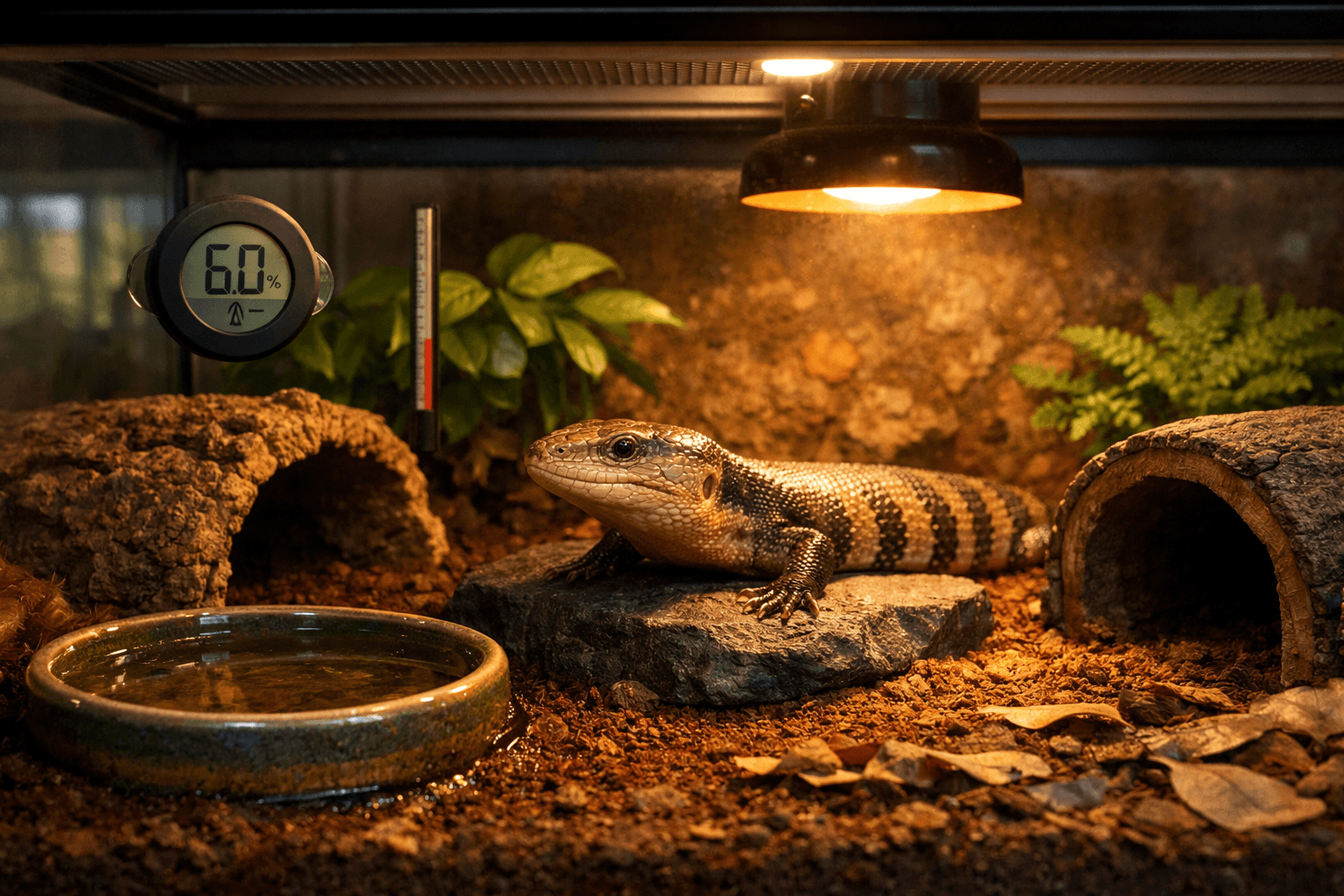
Place hides at both ends of the enclosure — one on the warm side, one on the cool side. The warm-side hide sits near (but not directly under) the basking spot. Your skink needs to feel secure while warming up, and a hide that’s too far from the heat source won’t get used.
Temperature Gradient, Basking Spots, and the Right Heating Equipment
A proper temperature gradient lets your blue tongue skink choose its own body temperature throughout the day. Without one, digestion slows, appetite drops, and your skink sits in one spot looking miserable. The target range is 75°F on the cool end and 100–110°F on the basking spot, depending on subspecies.
Here’s the equipment setup that actually works:
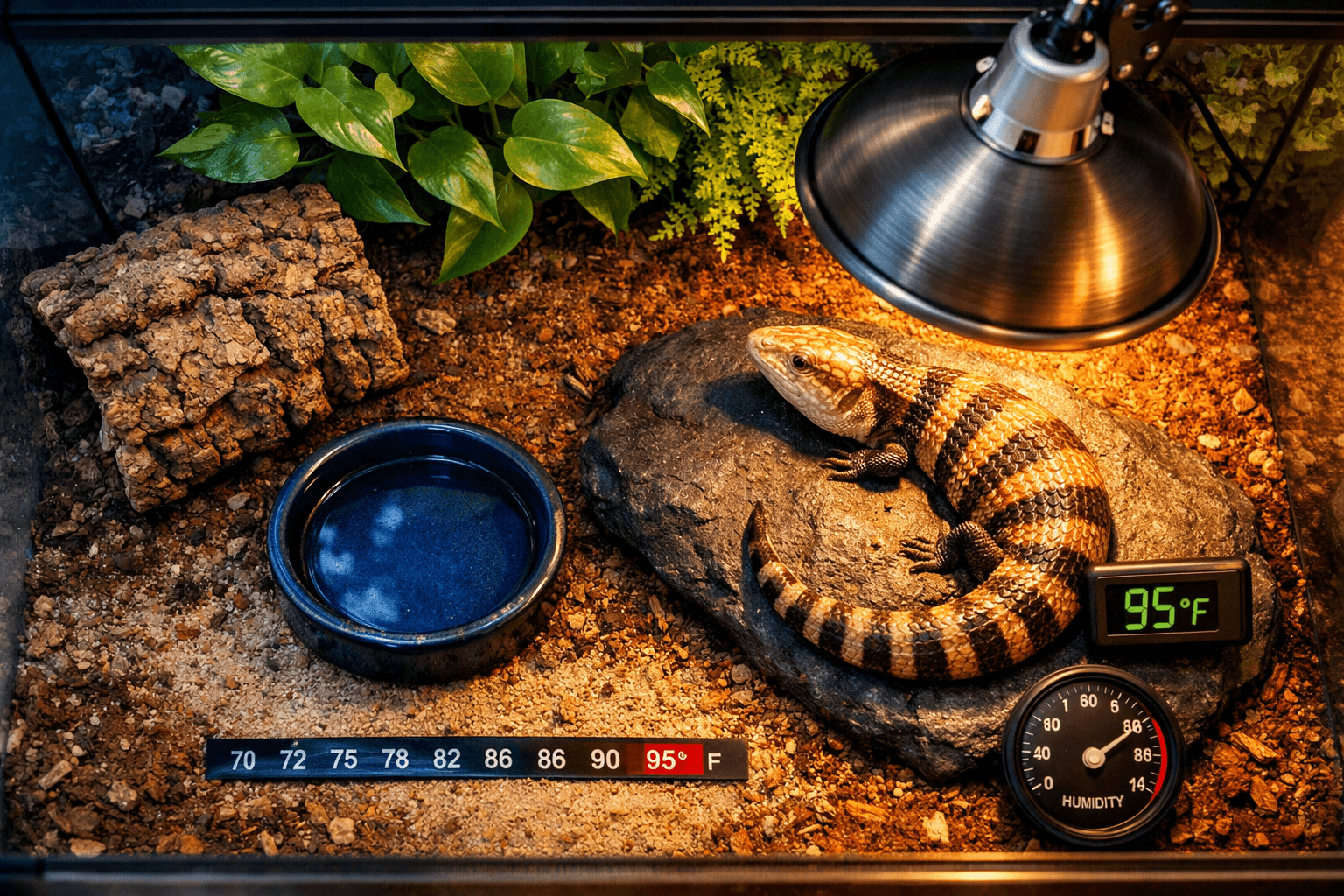
A halogen flood bulb (50–75 watts) mounted above a flat basking stone on the warm end
A deep heat projector (DHP) for overnight ambient warmth without light disruption
A digital thermostat wired to your basking bulb to prevent overheating
Two thermometers — one probe on the cool side floor, one directly on the basking surface
A ceramic heat emitter as a backup if nighttime temps drop below 65°F
Setting Up a 75–100°F Gradient That Actually Works
Position your basking bulb at one end of the enclosure, not the center. This naturally creates the warm-to-cool gradient across the full length of the tank. The basking surface itself — a flat slate tile works well and holds heat — should read 100–105°F for Indonesians and up to 110°F for Northerns. Check with an infrared temperature gun, not just an ambient thermometer.
The cool end should stay between 75–80°F during the day. If it creeps above 82°F, you’re losing the gradient and your skink can’t cool down properly.
Thermostats, Heat Mats, and What to Skip
Always run your basking bulb through a dimming thermostat. A dimmer-style thermostat like the Herpstat 1 keeps surface temps stable without constant cycling. On/off thermostats work but cause temperature swings that stress the animal over time.
Skip heat mats under the enclosure for blue tongue skinks. Skinks read substrate temperature with their bellies, and an underfloor mat can overheat them from below without triggering a move to the cool side. Stick with overhead heat sources only.
UVB Lighting: Skinks Still Need It Even If They’re Not Strictly Diurnal
Blue tongue skinks are crepuscular, most active at dawn and dusk, but that doesn’t mean they skip UVB exposure in the wild. Providing UVB lighting directly supports calcium metabolism and bone health, and skinks kept without it over months can develop metabolic bone disease even with calcium supplementation. Don’t skip UVB thinking it’s optional.
Which UVB Bulbs Work and How Long to Run Them
Use a T5 HO (high-output) linear UVB bulb rated at 6–10% UVB output. The Arcadia 6% T5 HO and the Reptisun 5.0 T5 HO are both reliable options that have been widely used in the hobby. For a 48-inch enclosure, go with a 46-inch T5 HO fixture to cover most of the enclosure length.
Run UVB for 10–12 hours per day on a timer. Replace the bulb every 12 months even if it still produces visible light, because UVB output degrades well before the bulb burns out.
Positioning the Fixture to Avoid Hotspots
Mount the UVB fixture inside the enclosure or directly on top of a mesh lid. Glass and most plastic block UVB completely, so placement matters. If the bulb sits on top of a glass lid, your skink gets almost no benefit.
Position the fixture over the middle-to-warm third of the enclosure, not directly over the basking spot. That way your skink gets UVB exposure while basking and while moving around, without the UVB source and the heat source stacking heat in one corner. Keep the basking surface 10–12 inches below a T5 HO fixture for adequate UV Index exposure without overdoing it.
Humidity, Ventilation, and Water Dish Placement Done Right
Get humidity wrong and you’ll either see stuck sheds (too dry) or respiratory infections (too wet). Northern blue tongue skinks need 40–60% relative humidity; Indonesian subspecies need 60–80%. A digital hygrometer with a probe placed mid-enclosure gives you an accurate reading.
Matching Humidity to Your Subspecies
For Northerns, a screen top with minimal coverage is enough ventilation to keep humidity in range. For Indonesians, partially cover the screen top with aluminum foil or a humidity-retaining panel, roughly 50–60% coverage, to trap moisture without cutting off airflow entirely. Mist the substrate (not the skink) every 1–2 days for Indonesian setups.
Why the Water Dish Doesn’t Belong Under the Basking Spot
Placing a water dish under or near the basking spot causes the water to evaporate fast, which spikes localized humidity and promotes bacterial growth in the dish. Put the water dish on the cool end of the enclosure. It stays cleaner, evaporates slower, and keeps your overall humidity more predictable.
Bioactive Setups, Enrichment Décor, and Feeding Station Placement
A bioactive setup uses live plants, leaf litter, and a cleanup crew of isopods and springtails to break down waste naturally. It’s aesthetically nice, and it also keeps humidity more stable and reduces how often you do full substrate changes. For Indonesian subspecies, bioactive works especially well because the higher humidity supports both the plants and the microfauna.
Don’t place the feeding station near the basking spot or the water dish. Food left near heat spoils fast, and wet substrate around the dish creates a bacterial mess. Pick a fixed spot on the cool-to-mid section of the enclosure and always feed there so your skink learns where to expect food.
For enrichment, add a flat cork bark piece for climbing, a low-profile hide, and a rough rock or brick near the basking area for passive nail wear. Avoid tall structures. Blue tongue skinks are ground dwellers and a fall from 8 inches can injure them. Keep décor flat and stable.
Cleaning Schedule and Maintenance That Keeps Your Skink Healthy
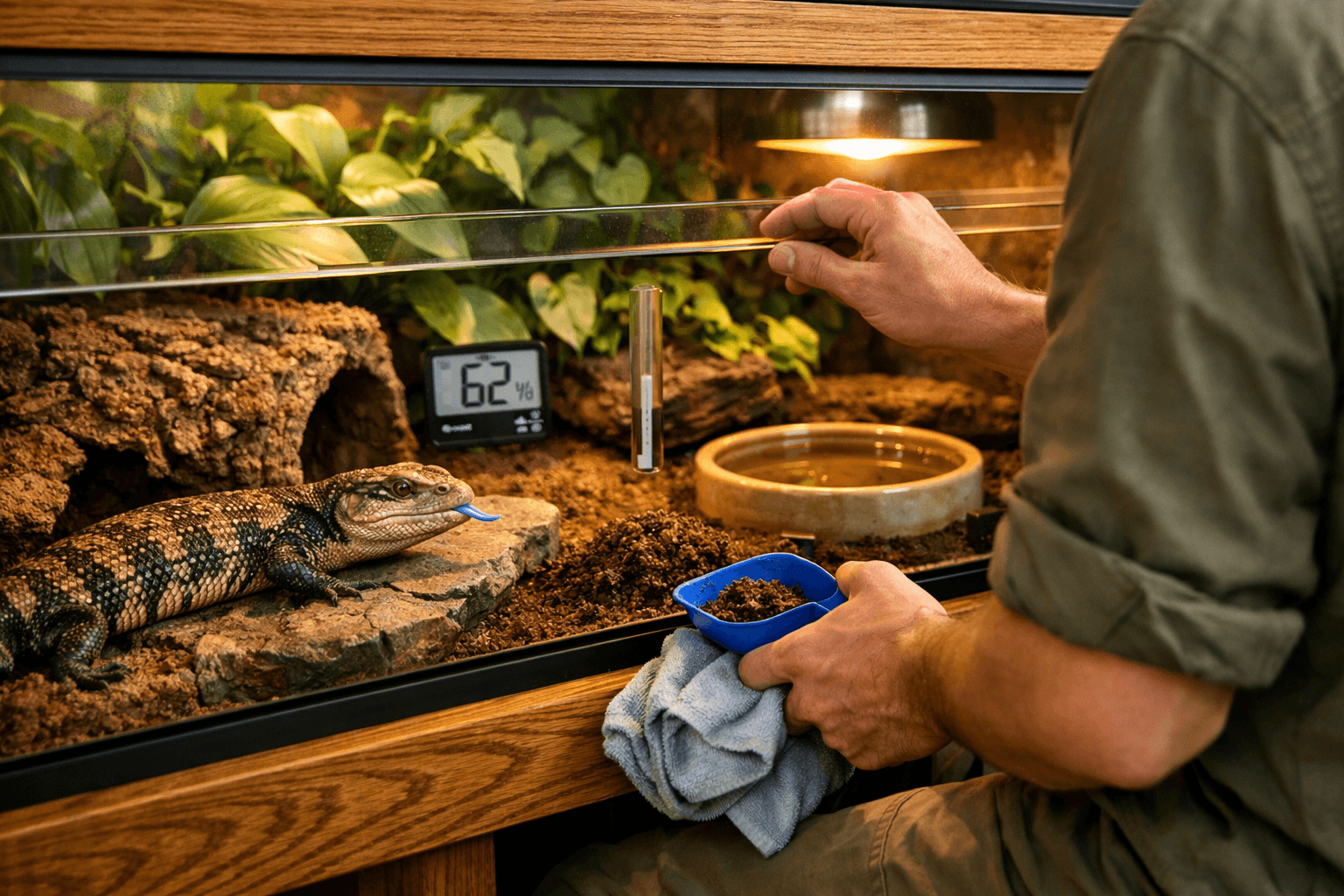
Spot-clean the enclosure every 2–3 days. Remove urates, feces, and any uneaten food before it grows mold or bacteria. This single habit does more for your skink’s health than almost any equipment upgrade.
Do a full substrate replacement every 3–4 months in a standard setup, or every 6–9 months in a well-established bioactive enclosure where the cleanup crew is active. Scrub hides and décor with a reptile-safe disinfectant like F10SC diluted per label instructions, then rinse thoroughly and dry before returning them.
Wash the water dish with hot water and dish soap every 3–4 days minimum. Blue tongue skinks sometimes soak and defecate in their dish, so check it daily. Wipe down enclosure walls monthly with a damp cloth to clear mineral deposits and condensation residue.
Replace your UVB bulb on a 12-month schedule regardless of visible output, and check thermostat probe placement every few weeks to confirm it hasn’t shifted off the basking surface.
Frequently Asked Questions
Can a blue tongue skink live in a 40-gallon tank long-term?
No. A 40-gallon tank is too small for an adult blue tongue skink. Adults need a minimum 120-gallon enclosure, roughly 48 x 24 inches of floor space, to maintain a proper temperature gradient and move freely. A 40-gallon is fine temporarily for a juvenile under 6 inches but plan to upgrade within the first year.
How do I know which subspecies I have?
Check with your breeder or the store receipt. Tiliqua scincoides intermedia is the Northern; Tiliqua gigas covers most Indonesian variants. If you bought from a general pet store without documentation, post a clear photo to a blue tongue skink community forum. Experienced keepers can usually identify subspecies from scale pattern and coloring.
Do blue tongue skinks need a companion or can they live alone?
Keep them alone. Blue tongue skinks are solitary and will fight if housed together, even same-sex pairs. Two adults in one enclosure will compete for hides and basking spots, which causes chronic stress and injuries.
How often should a blue tongue skink eat?
Juveniles eat every day; adults eat every 2–3 days. A typical adult meal is roughly 1–2 tablespoons of food, a mix of protein, vegetables, and occasional fruit. Overfeeding is a common problem that leads to obesity, which stresses the liver over time.