You’re measuring the wall space above your frill dragons’ basking branch, and something feels off. There’s just not enough room to climb. That instinct is right. Chlamydosaurus kingii, the frilled dragon, is a strongly arboreal species that spends most of its time off the ground. A standard 40-gallon breeder tank won’t cut it.
Most off-the-shelf enclosures are built wide, not tall. That works fine for bearded dragons, but frill dragons need vertical room to thrive.
Frill Dragons Need Vertical Space — Here’s How Much and Why
Frill dragons need at least 4 feet of vertical height in their enclosure. Adults regularly reach 2.5 to 3 feet in total length, and they use height the same way ground lizards use floor space: for thermoregulation, security, and daily movement. A short enclosure forces them to stay low, which causes stress and poor basking behavior.
In the wild, frill dragons perch on tree trunks and vertical surfaces for most of the day. Their frill (the large skin flap around the neck used for display and thermoregulation) works best when the animal can orient itself vertically against a surface. A horizontal setup actively works against how they’re built. It wastes space and limits natural behavior at the same time.
Minimum Enclosure Dimensions and Why Bigger Pays Off Faster
The minimum recommended enclosure for a single adult frilled dragon is 4 feet wide by 2 feet deep by 4 feet tall. That’s 32 cubic feet of space. Juveniles can start smaller, but building to adult dimensions from the start saves you a full rebuild within 18 months.
A custom build costs roughly $200 to $400 in materials depending on what you use. Buying a juvenile enclosure and then upgrading typically costs more in total than building once at the right size. Go big the first time.
Floor Space vs. Climbing Height: What Actually Limits Your Dragon
Height limits frill dragons faster than floor space. A 4×2 footprint gives them room to move laterally, but if the ceiling sits at 24 inches, they can’t establish a proper thermal gradient — the temperature difference between a hot basking zone up high and a cooler retreat lower down. Without that gradient, digestion and immune function suffer.
Floor space still matters for feeding and enrichment zones. A 2-foot depth gives you room to place a feeding dish at ground level without crowding the climbing structures. But if you have to choose between adding floor space or adding height, add height every time.
How Growth Rate Affects Your Build Timeline
Frill dragons grow fast. A hatchling at 6 inches can reach 18 inches within the first year under good husbandry. By month 18 to 24, many males hit their full length of around 30 inches. That growth rate means a “starter” enclosure becomes undersized before most keepers expect it to.
Building at adult dimensions from the start means your dragon can grow into the space rather than out of it. The climbing structures, lighting positions, and thermostat placements you set up on day one stay relevant for the animal’s entire life.
PVC, Wood, or Glass: Picking the Right Material for a Custom Build
PVC is the best all-around material for a custom frilled dragon enclosure. It handles humidity without warping, it’s light enough to move solo, and it holds heat well. Wood and glass each have a place, but for a species that needs both warmth and moderate humidity, PVC wins the long game.
Here’s a direct comparison:
Material
Humidity Resistance
Weight (4x2x4 ft build)
Approx. Material Cost
Lifespan
PVC
Excellent
~40–55 lbs
$180–$260
10+ years
Plywood (sealed)
Moderate
~70–90 lbs
$100–$160
5–8 years
Glass (aluminum frame)
Good
~120–160 lbs
$300–$500
10+ years
Why PVC Outperforms the Others for Long-Term Humidity Control
PVC foam board (commonly sold under brands like Forex or Palram) doesn’t absorb moisture the way wood does. You can mist the interior daily and wipe it down without worrying about swelling, rot, or mold working into the walls. Sealed plywood holds up for a few years, but the sealant eventually breaks down at seams and corners — and that’s where mold starts.
PVC also retains ambient heat better than glass, which means your heating equipment works less hard to maintain a stable temperature range. That adds up over years of electricity costs.
When Glass or Wood Still Makes Sense
Glass enclosures make sense if visibility is your top priority — for a display build in a shop or a living room where aesthetics matter. The clarity is unmatched. The downside is weight and cost; a glass build at 4x2x4 feet runs $300 to $500 in materials and takes two people to move.
Sealed plywood works well for keepers on a tight budget who plan to reseal every two to three years. It’s the cheapest starting point, and many hobbyists build their first enclosure this way before upgrading to PVC later. Petterrarium.com has detailed build guides for both plywood and PVC if you want to compare construction steps side by side.
Building the Custom Enclosure: A Step-by-Step Process
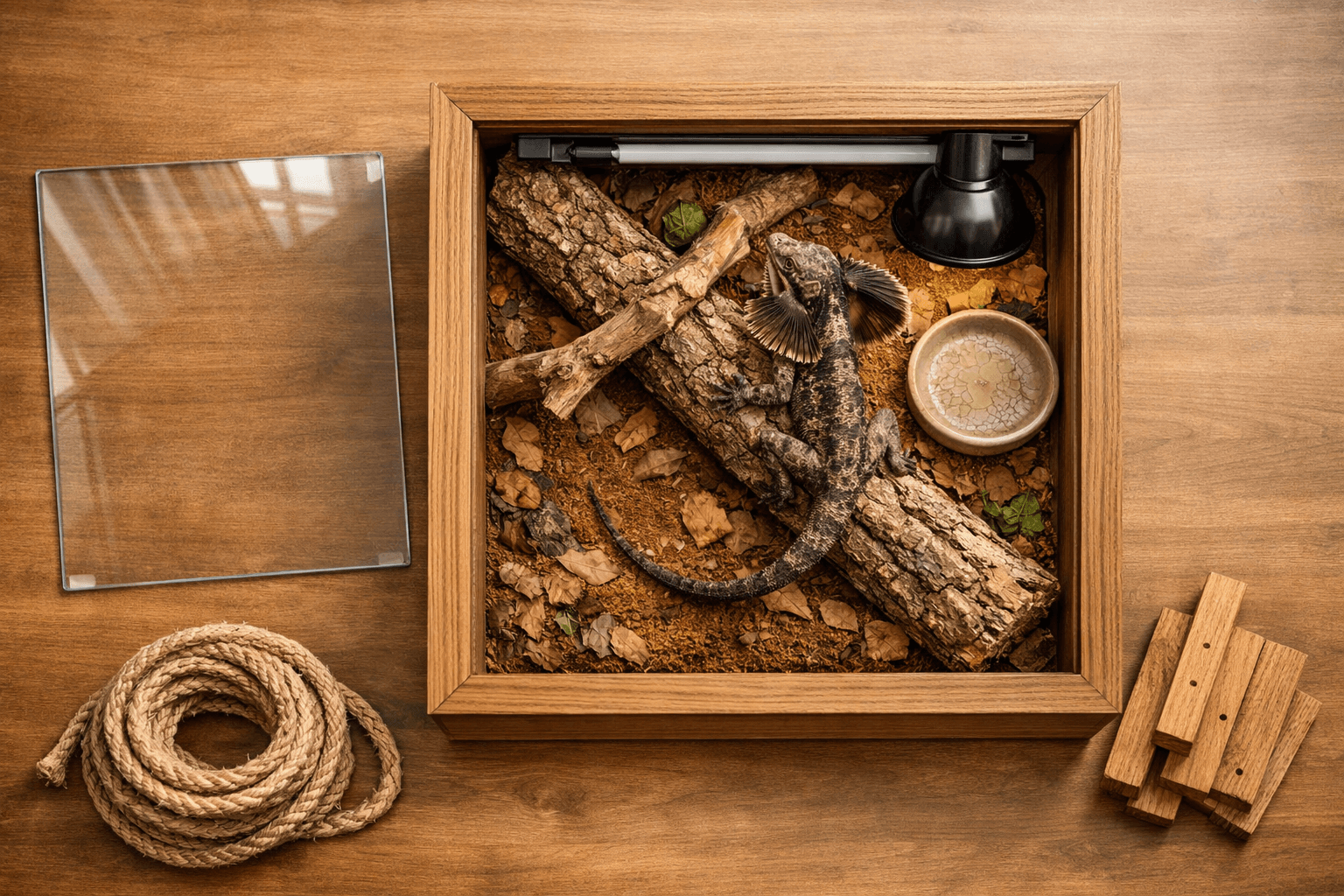
A custom frill dragon enclosure takes roughly a weekend to build if you have your materials cut ahead of time. The process isn’t complicated, but the order matters. Skip ventilation planning early, and you’ll face problems you can’t easily fix after the panels are glued.
Cut all PVC panels to dimension before assembly. For a 4x2x4 ft build, you’ll need panels for two sides, a back, a top, a bottom, and a front frame. Get cuts done at the hardware store if you don’t have a table saw.
Dry-fit the entire enclosure without adhesive first. Check that corners are square and panels sit flush.
Mark and cut ventilation panel openings before gluing anything. Front lower vents and top rear vents need to be sized before the frame goes together.
Glue and screw panels using PVC-compatible adhesive and stainless steel screws. Standard wood screws rust in humid enclosures.
Install aluminum mesh (18×16 gauge works well) over ventilation openings using a staple gun or trim strips pressed into the frame.
Attach door hinges and a sliding bolt latch. Frill dragons push hard on doors, so a single magnetic closure isn’t enough. Use a positive-locking latch.
Seal all interior seams with aquarium-safe silicone. Let it cure 24 hours before adding anything inside.
Framing, Ventilation Panels, and Door Placement
The front opening should be full-height or at minimum 36 inches tall to give you clean access for cleaning and rearranging climbing structures. Two doors split at the midpoint work better than one large door. It lets you open the bottom half for feeding without disturbing the basking zone up top.
Place your lower ventilation vents at the front bottom and your upper vents at the rear top. Cool air enters low, warm air exits high, which keeps the thermal gradient stable without a powered fan in most setups.
Installing Climbing Structures and Feeding Zones
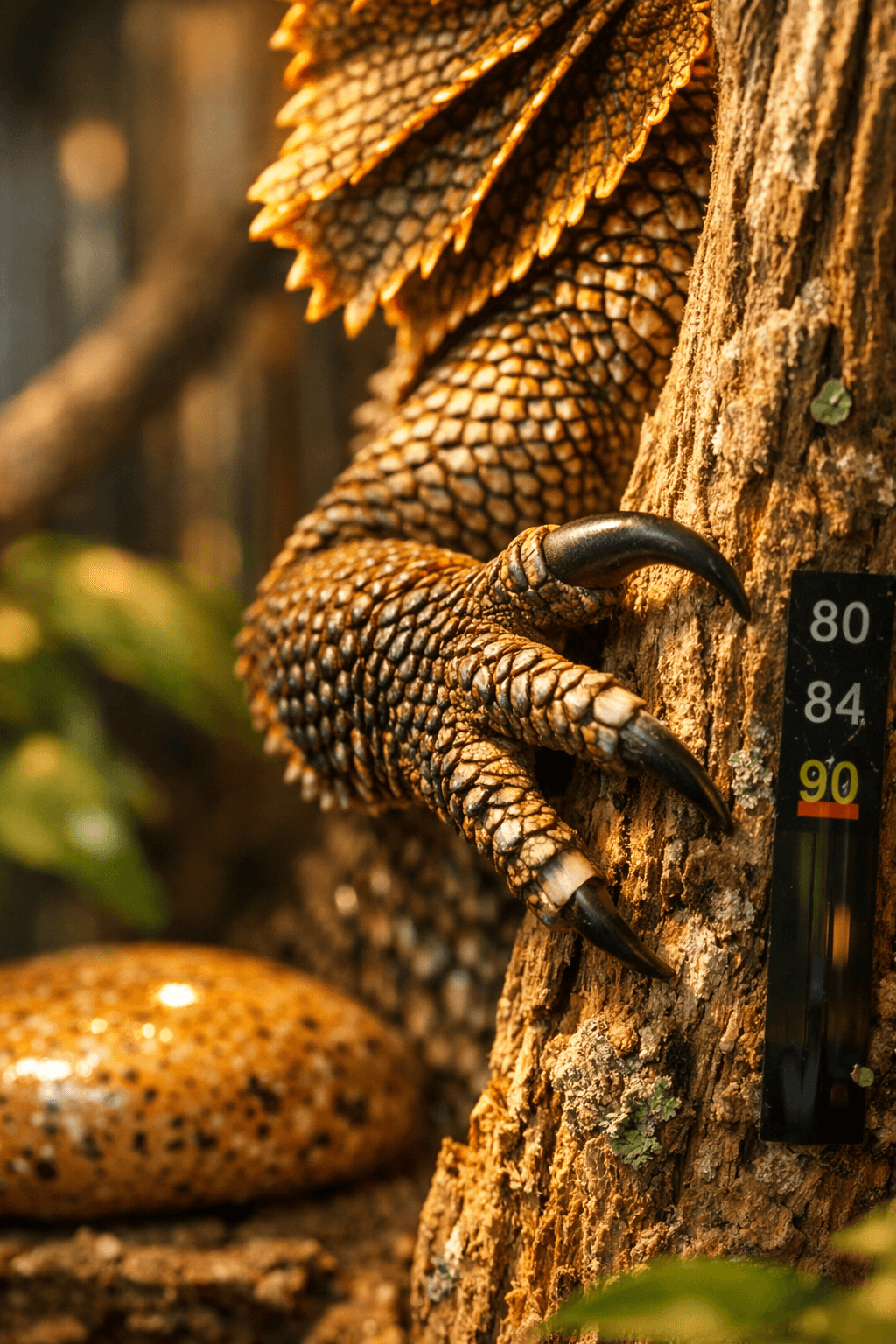
Cork bark rounds and thick Manzanita branches are the two best climbing materials for frill dragons. Cork is lightweight, holds humidity well, and gives the dragon’s claws real grip. Anchor large branches with L-brackets screwed into the back wall so they don’t shift under the animal’s weight.
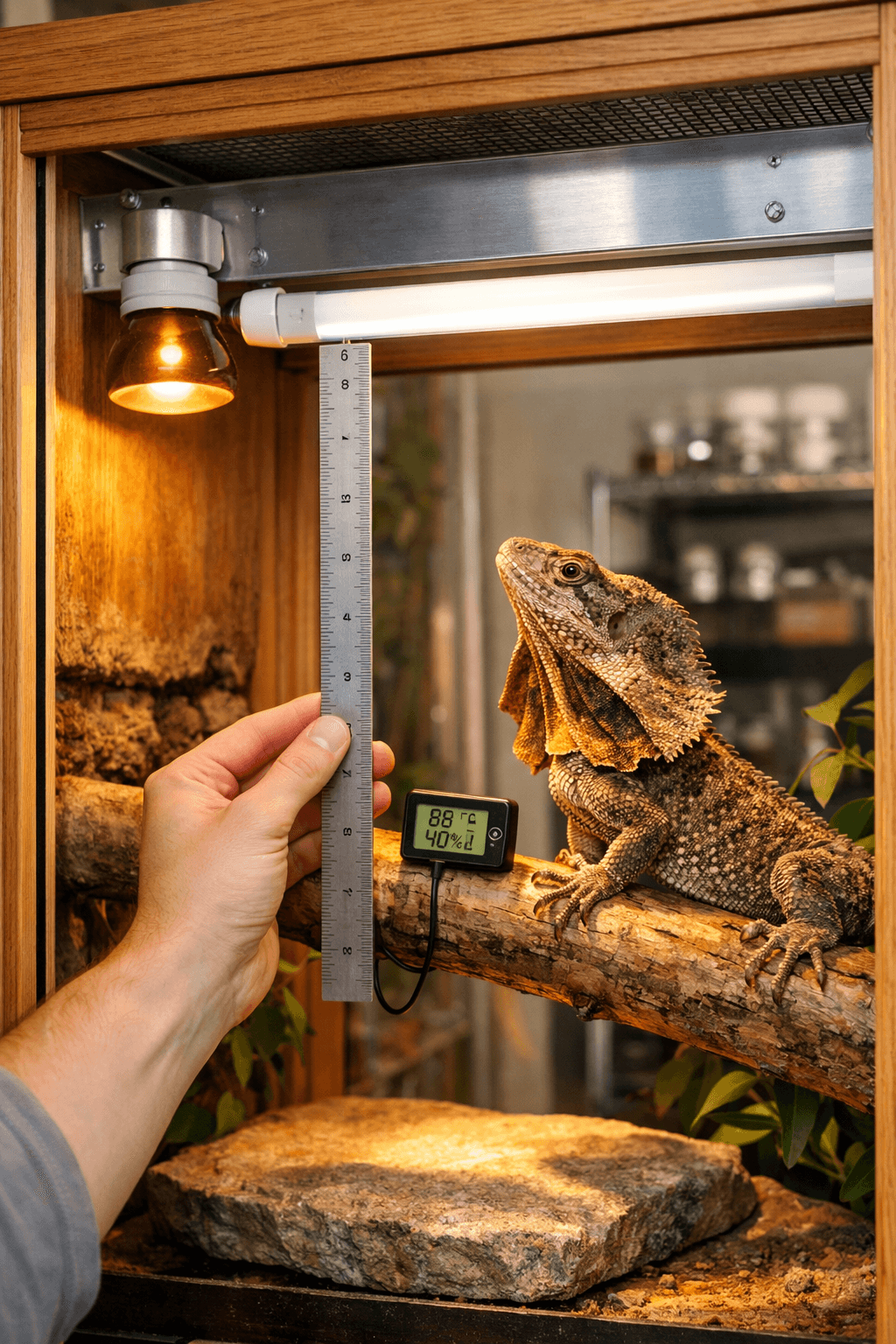
Set your primary basking branch 8 to 10 inches below the basking bulb. Place a second horizontal branch about halfway down the enclosure for a mid-level retreat. Keep the feeding dish at ground level in a front corner. That separation between feeding zone and climbing zone makes it easier to spot-clean without tearing down the whole setup.
Lighting and Heat: UVB Setup, Basking Temperatures, and Thermal Gradients
Frill dragons need a basking spot at 110 to 120°F and a cool side that stays around 80°F. That 30- to 40-degree spread is the thermal gradient your dragon uses to self-regulate. Get that range right and digestion, activity, and immune function all follow.
A T5 HO UVB bulb paired with a separate halogen or deep heat projector is the most reliable combination. Avoid all-in-one mercury vapor bulbs in a PVC build — they run extremely hot and can warp panels if mounted too close.
Hitting 120°F at the Basking Spot Without Cooking the Cool Side
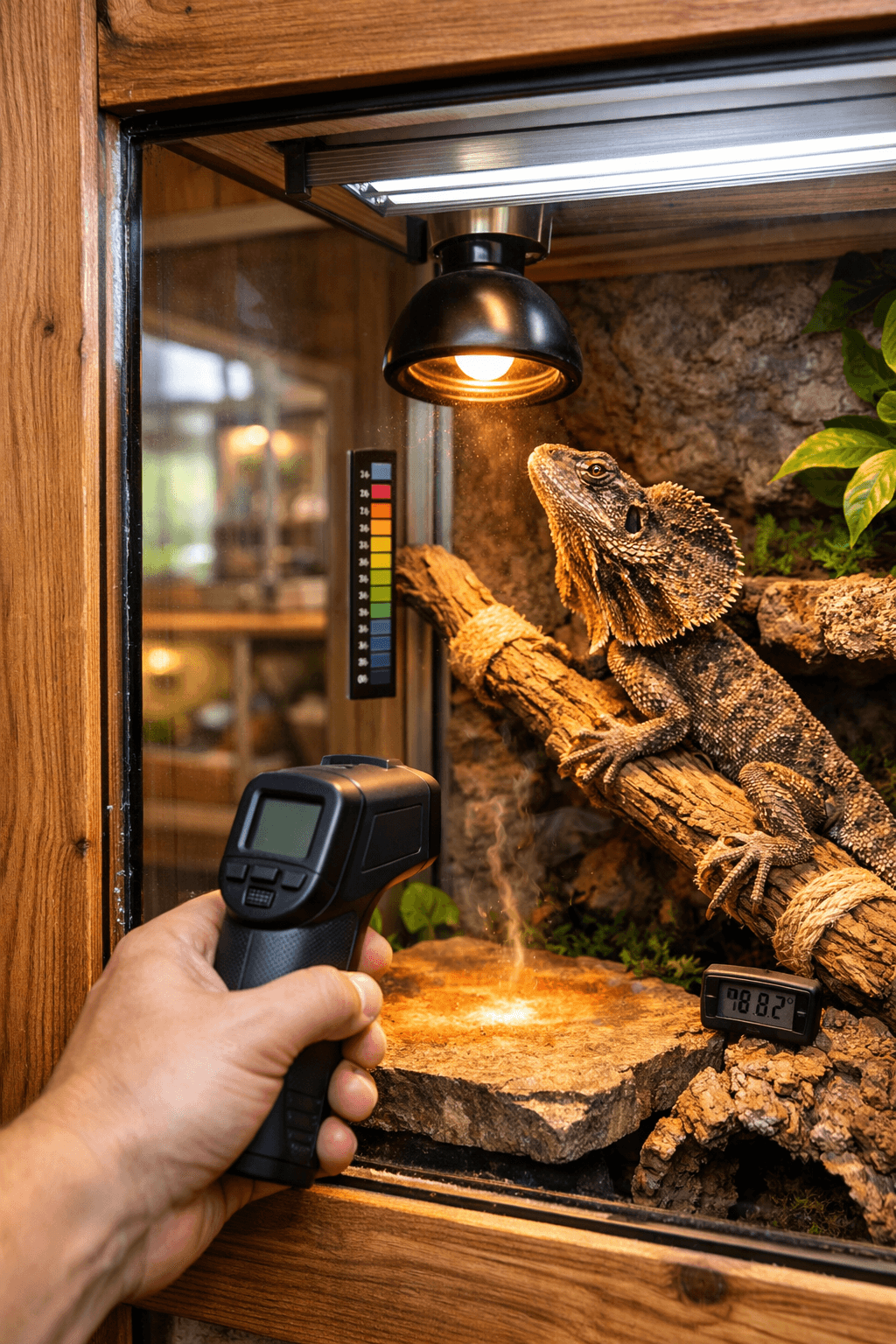
Use a 75- to 100-watt halogen flood bulb aimed at your primary basking branch. Measure the actual surface temperature of the branch with an infrared temperature gun, not just the ambient air. Air temperature reads 15 to 20 degrees lower than surface temp, so ambient readings alone will mislead you.
Keep the cool side completely free of supplemental heat sources. No under-tank heaters, no radiant heat panels on the cool wall. The temperature drop needs to happen naturally across the enclosure’s length. In a 4-foot-wide build, that distance is usually enough.
UVB Placement and Bulb Strength for Frilled Lizards
Use a Arcadia 12% T5 HO UVB bulb for frill dragons. Mount it inside the enclosure, running the full length of the top, positioned above and slightly toward the basking end. The bulb should sit 10 to 14 inches above the basking branch for effective UV Index exposure.
Replace the UVB bulb every 12 months even if it still produces visible light. The UV output degrades well before the light stops glowing, and a depleted bulb is one of the most common causes of metabolic bone disease in captive lizards.
Humidity, Ventilation, and Why You Need Both at the Same Time
Frill dragons need 60 to 70% humidity during the day, with a drop to around 50% overnight. The mistake most keepers make is chasing humidity by sealing up ventilation. That traps stagnant moist air, and stagnant moisture causes respiratory infections and mold on surfaces within weeks.
You need airflow and humidity running together. The cross-ventilation setup described in the framing section (low front vents, high rear vents) lets you mist the enclosure once or twice daily without trapping moisture. Place a digital hygrometer at mid-enclosure for the most accurate reading, not at the basking end, where heat skews the number low.
If your ambient room humidity is already high (above 55%), you may only need one misting session per day. In dryer climates, a small automatic misting system on a 12-hour timer handles the consistency without daily manual effort. Monitor for condensation sitting on walls more than 30 minutes after misting. That’s a sign airflow needs to increase.
Going Bioactive: What to Set Up First Before Adding Live Plants
Get your temperature and humidity baselines stable for at least two weeks before you add a single plant. A bioactive setup depends on living soil and microfauna to break down waste, and none of that works if the enclosure is still swinging 20 degrees between day and night or drying out unpredictably.
Start with the drainage layer first. A 2- to 3-inch base of leca (lightweight expanded clay aggregate) keeps water from pooling in the substrate above it. On top of that, add 4 to 6 inches of a bioactive mix — a 60/40 blend of organic topsoil and play sand works well for frill dragons and drains fast enough to prevent rot.
Introduce a cleanup crew before any plants go in. Tropical springtails and isopods (a mix of Porcellio scaber and springtails is a solid starting pair) need a few weeks to establish a population before they’re actually useful. Add them, wait, then plant.
Choose plants that tolerate both high heat near the top and moderate humidity lower down. Pothos (Epipremnum aureum) is nearly indestructible and handles the thermal variation well. Avoid plants with fine root systems in areas where the dragon regularly digs or repositions.
Don’t add live plants directly under the basking spot — the heat desiccates them within days.
Frequently Asked Questions
How big does a frill dragon enclosure really need to be for an adult?
An adult frill dragon needs a minimum of 4 feet wide by 2 feet deep by 4 feet tall. That’s the floor. Bigger is better, and a 5x2x5 build gives a full-grown animal real room to move vertically without constantly hitting the ceiling near the basking bulb.
Can I use a standard glass aquarium for a frill dragon?
Not long-term. A standard aquarium is horizontal and has almost no vertical height, which cuts off the arboreal behavior frill dragons rely on for thermoregulation. Glass also traps humidity without proper cross-ventilation, which raises the risk of respiratory infections. A custom vertical build is the practical choice once your dragon hits 18 inches.
How often do frill dragons eat, and does the enclosure layout affect feeding?
Juveniles eat daily; adults eat every 2 to 3 days. Keeping the feeding dish at ground level in a front corner, separate from climbing structures, makes it easy to drop in feeders without disturbing the basking zone and reduces stress during feeding time.
What’s the biggest mistake new frill dragon keepers make with their setup?
Setting the basking spot too low. Many keepers aim for 95 to 100°F based on general lizard advice, but frill dragons need a surface temperature of 110 to 120°F at the basking branch. Too cool and the animal sits lethargic, digests poorly, and stops eating. Those problems look like illness but are actually an enclosure issue.