You’re holding a snail the size of your fist, and you’re wondering if you can legally keep it. The African giant land snail is one of the most popular exotic gastropods in the world. But where you live changes everything about whether that’s even an option. This guide is written for hobbyists outside the US, or for US readers who want to understand their legal alternatives before setting up any enclosure.
African Giant Land Snails Are Federally Banned in the US — Here’s What That Means for You
Owning an african giant land snail in the US without a USDA permit is a federal offense. Species like Achatina fulica (Giant African Snail) are classified as agricultural pests and are banned under the Plant Protection Act. If you’re in the US, that’s not a gray area.
The penalties are real. Violations can result in fines up to $10,000 per offense, and USDA Animal and Plant Health Inspection Service (APHIS) has the authority to seize and destroy animals. Florida has dealt with multiple Achatina fulica infestations, including a major eradication effort that ran from 2011 into the early 2020s and cost millions of dollars in state and federal resources. That history is exactly why enforcement stays strict.
Species
Legal in US?
Common in Hobby
Achatina fulica
No (federal ban)
Yes, widely kept abroad
Achatina achatina
No (federal ban)
Yes, especially in Europe
Archachatina marginata
No (federal ban)
Yes, popular in UK hobby
Mystery snails (Pomacea spp.)
Yes (most states)
Yes
Hobbyists in the UK, much of Europe, and parts of Asia can legally keep all three banned species above. If you’re outside the US, this guide applies directly to your setup. US readers: check your state laws for legal giant snail alternatives before buying anything.
Even importing shells or empty enclosures that previously housed banned species can trigger customs issues at the US border. When in doubt, contact APHIS directly before ordering anything shipped internationally.
Setting Up the Terrarium: Size, Substrate, and Ventilation
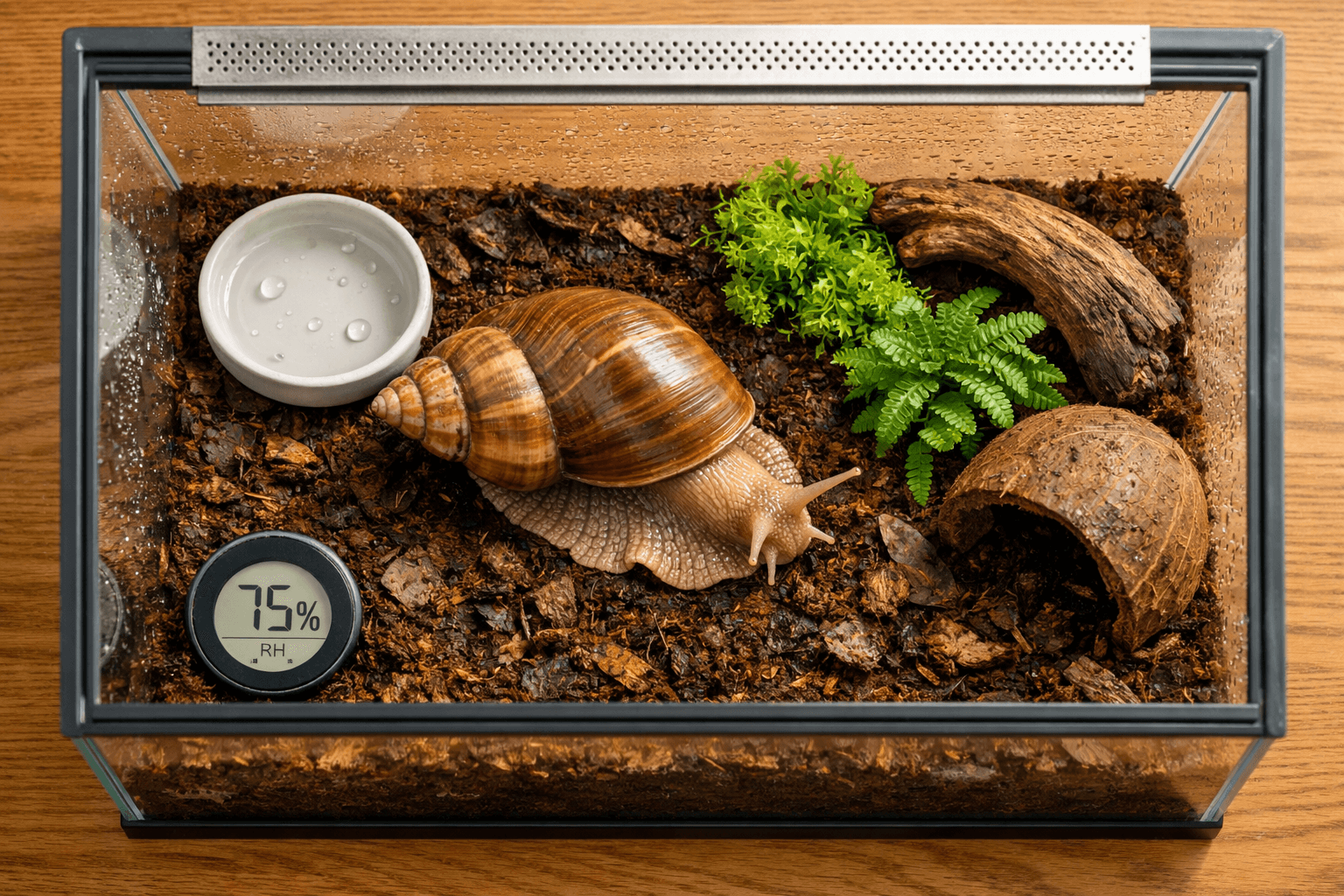
Getting the enclosure right from day one saves you a lot of headaches. African giant land snails are active, burrowing animals. They need real space and real depth, not just a glass box with some dirt.
Tank Size by Species
The three species most common in the hobby vary quite a bit in adult size, so your tank choice matters.
Achatina fulica adults reach roughly 3-4 inches shell length and need at minimum a 10-gallon tank, though a 20-gallon gives them room to actually move.
Achatina achatina is the largest of the three, with shells sometimes hitting 7-8 inches. Go with at least a 30-gallon for adults.
Archachatina marginata sits in the middle, around 4-5 inches, and does well in a 20-gallon enclosure.
If you’re keeping two snails together, add at least 10 gallons per additional animal to avoid competition for food and space.
Plastic storage tubs with lids work well and cost a fraction of glass tanks. A 30-gallon Sterilite tub runs around $15-20 at most hardware stores.
Substrate Depth and Material
Substrate depth is the most commonly skipped requirement in beginner setups. Snails burrow to lay eggs, regulate moisture, and reduce stress. Too shallow and they’ll spend their time scraping at the bottom of the tank.
Aim for at least 3-4 inches of substrate for smaller species, and 5-6 inches for A. achatina. Coconut coir (also called coco peat) is the go-to material. It holds moisture without compacting into a brick, and it’s cheap. A compressed brick of coconut coir expands to fill roughly 8-10 liters of substrate and costs around $5-8.
You can mix in some organic topsoil (no added fertilizers or pesticides) to improve texture. Avoid sand, gravel, or anything with sharp particles.
Ventilation Without Losing Humidity
This is the balance that trips up most beginners. Snails need fresh air, but they also need high humidity. A fully sealed tank turns into a soggy, bacteria-filled mess fast.
Cross-ventilation works better than a single vent. Drill or cut mesh panels on two opposite sides of the lid or tank walls. Use fine mesh (like fiberglass window screen) to keep the snails from escaping. They can squeeze through gaps you’d never expect. A mesh area totaling roughly 10-15% of the tank’s surface area gives enough airflow without drying things out too fast.
If your climate is dry, mist one side of the tank daily and leave the other side drier. That gradient lets the snail choose its preferred humidity zone.
Humidity and Temperature: The Two Numbers That Matter Most
Nail these two and your snail will thrive. Get them wrong consistently and you’ll see shell damage, inactivity, and estivation (a dormant state snails enter to survive harsh conditions) that stretches for weeks.
Hitting 70-90% Humidity Without Flooding the Tank
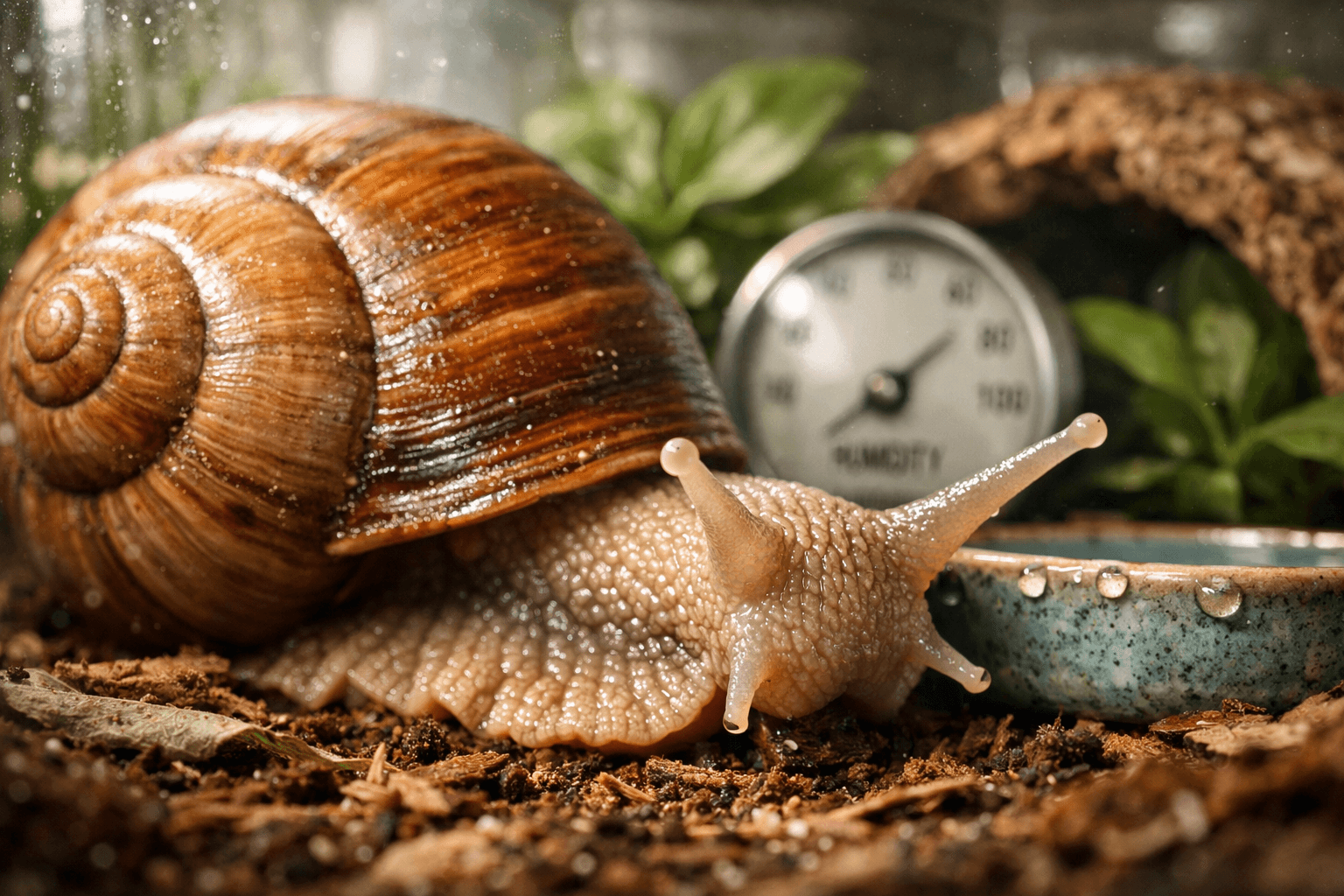
Keep humidity between 70-90% at all times. Below 70% and the snail’s body dries out. Above 95% with poor airflow and you’re growing mold. A digital hygrometer takes the guesswork out completely. The Govee brand makes reliable ones for around $10-12.
Misting with dechlorinated or distilled water is non-negotiable. Chlorinated tap water can irritate the snail’s body and damage the mucus layer it relies on for movement. Let tap water sit out for 24 hours to off-gas chlorine, or use a basic aquarium dechlorinator like Seachem Prime.
Mist once daily in most setups, or twice if your home runs dry. Focus the spray on the substrate and walls, not directly on the snail.
Keeping Temps Between 65-80°F Year-Round
Most African giant land snail species do best at 70-77°F. They tolerate a drop to 65°F at night without problems, but anything below 60°F triggers estivation. Above 85°F and you risk heat stress.
In most homes, room temperature handles this without extra equipment. If your space dips below 65°F in winter, a low-wattage reptile heat mat placed under one side of the tank works well. The Zoo Med Repti Therm under-tank heater is a solid option and runs about $20. Put it under one end only so the snail can move away from the heat if it wants.
Never place the tank in direct sunlight. Glass and plastic trap heat fast, and a tank in a sunny window can spike past 90°F in under an hour.
What to Feed Your Giant Snail (and What to Keep Away From It)
Diet is straightforward once you know the rules. African giant land snails are herbivores — they eat plant matter almost exclusively, and they need a reliable calcium source on top of that to keep their shells growing strong. Get both right and you’ll rarely deal with shell problems.
Fresh Vegetables and Safe Foods
Leafy greens are your foundation. Romaine lettuce, kale, cucumber, zucchini, and carrots all work well and are easy to find year-round. Snails also enjoy mushrooms and cooked plain pasta or rice as an occasional treat — both are safe and add some variety.
Avoid acidic foods entirely. Citrus fruits, tomatoes, and pineapple all damage the shell over time by interfering with calcium absorption. Onion, garlic, and anything salty or processed are also off the table. Processed human food with added salt is one of the fastest ways to harm a snail.
Wash everything before offering it. Pesticide residue on store-bought produce is a real risk for animals this small. Organic produce is worth the extra cost here, or rinse thoroughly under running water for at least 30 seconds.
Feed every 1-2 days and remove uneaten food within 24 hours. Rotting vegetables inside a humid enclosure breed bacteria fast.
Calcium Sources for Shell Health
Calcium is non-negotiable for shell integrity. Without enough of it, shells grow thin, crack, or develop pitting. The simplest fix is a piece of cuttlebone — the same kind sold for pet birds at any pet shop, usually $3-5 for a two-pack. Leave a piece in the enclosure at all times and let the snail rasp at it whenever it wants.
Crushed eggshell is a free alternative. Bake empty shells at 250°F for about 10 minutes to sterilize them, then crush and sprinkle directly on food. Plain calcium powder (no vitamin D3 added) dusted onto vegetables a few times a week also works well as a supplement.
Skip dairy products. Snails can’t digest lactose, and it causes digestive problems even in small amounts.
Lighting, Day/Night Cycles, and Estivation
African giant land snails are nocturnal, so they don’t need UV lighting the way many reptiles do. What they do need is a consistent light cycle to anchor their internal rhythm and prevent unnecessary estivation.
Running a 12-Hour Light Cycle
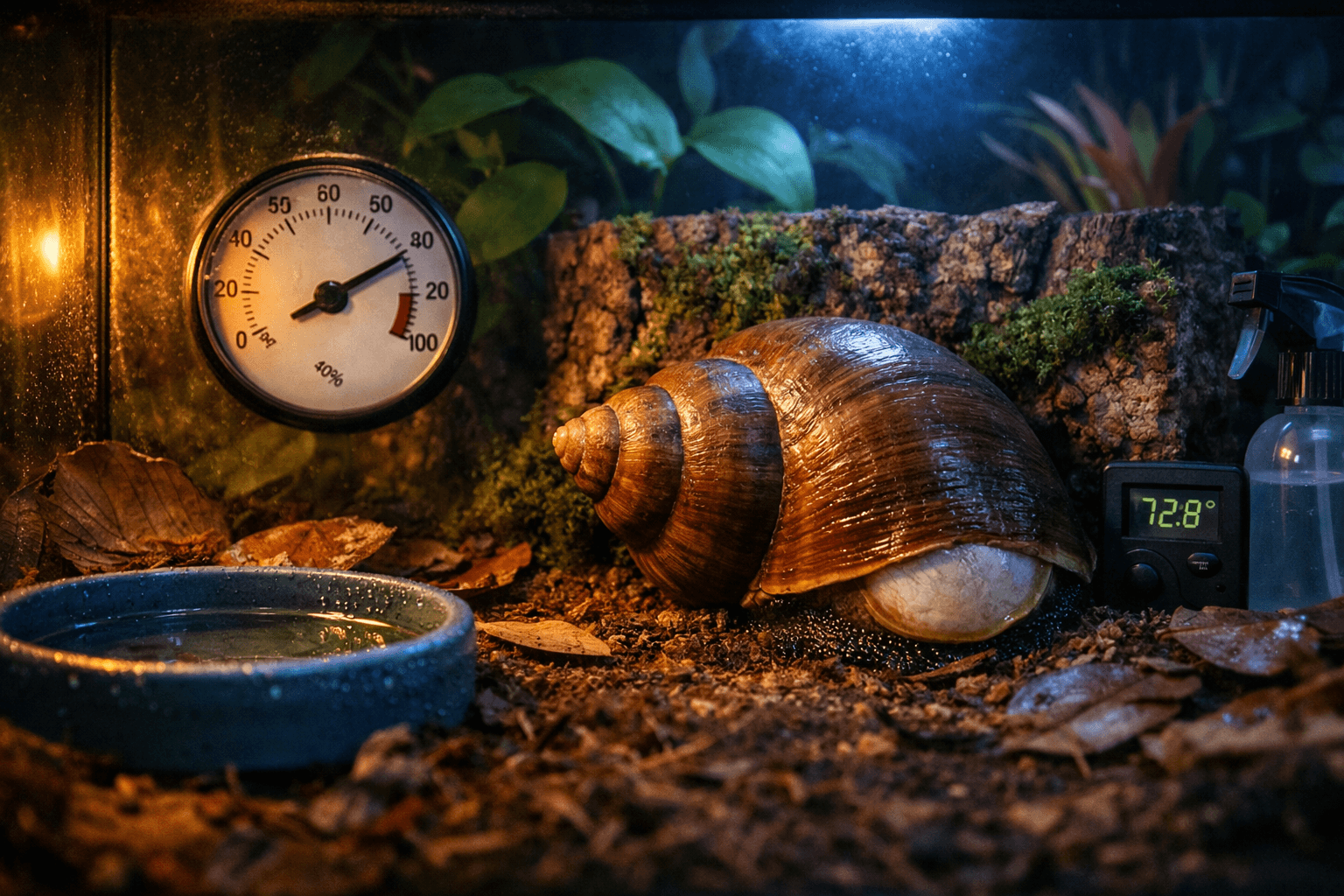
A 12-hour on, 12-hour off light schedule is the standard. A simple plug-in timer on a regular LED bulb handles this automatically. The BN-LINK brand timers cost around $10 and are reliable for years. Keep the light dim; bright overhead lighting stresses nocturnal animals and pushes them to hide instead of feed.
A 5-watt LED bulb placed a foot or more away from the enclosure is plenty. You’re not trying to heat the tank with it. You’re just giving the snail a reliable sunrise and sunset signal.
The snail will naturally become more active in the evening hours once the light goes off. If yours is barely moving during the day, that’s normal behavior, not a health problem.
Sticking to the same schedule every day matters more than the exact wattage. Irregular light cycles (like leaving a lamp on all night because you forgot) can confuse the snail’s rhythm over time and make it less active overall. Set the timer once and leave it alone.
Estivation: Not Dead, Just Dormant
Estivation is the snail’s built-in survival response to cold, drought, or stress. The snail seals its shell opening with a dried mucus layer called an epiphragm and goes dormant, sometimes for weeks. New keepers often panic and assume the snail is dead.
The epiphragm looks like a thin, papery film or a chalky plug across the shell opening. It can be surprisingly solid, which is why a quick glance can genuinely look alarming to someone who hasn’t seen it before.
Before assuming the worst, check for the epiphragm and gently place the snail in a shallow dish of lukewarm dechlorinated water for 10-15 minutes. A healthy snail in estivation will usually emerge within that time. If yours estivates frequently, the enclosure conditions (humidity, temperature, or food availability) need a closer look.
One common trigger is a humidity drop below 70%. If you notice the snail retreating into its shell and sealing up right after you’ve had the lid off for a while, that’s the most likely cause. Check your hygrometer reading before anything else.
Repeated estivation events, say two or three times in a single month, are a sign something is consistently off, not just a one-time stress response. Track when it happens and what changed in the enclosure that day.
Handling, Hygiene, and Cleaning the Enclosure
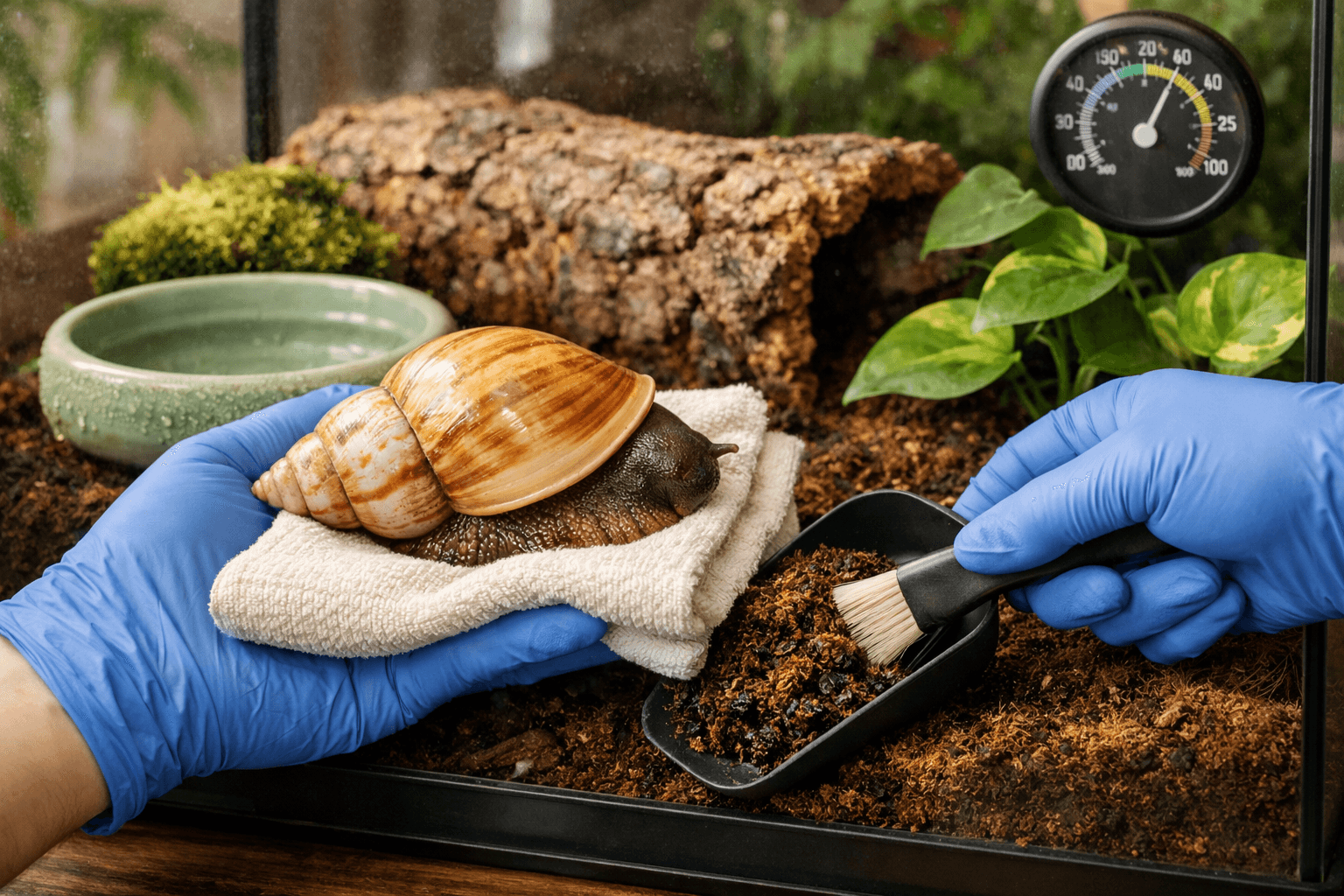
Handle your snail on a flat surface close to the ground. African giant land snails have soft bodies and no ability to brace a fall — even a drop of 12 inches can crack a shell. Let the snail move onto your hand at its own pace rather than pulling it off a surface, which risks tearing the foot muscle it uses to grip.
If a snail retracts into its shell during handling, just set it down and wait. Forcing it out stresses the animal and can cause it to seal itself inside with a dried mucus layer called an epiphragm, which it normally saves for dry conditions.
Always wash your hands before and after handling. Snails carry Angiostrongylus cantonensis (rat lungworm) in regions where the parasite is present, so basic hygiene is a genuine health precaution, not just good practice.
Plain soap and water for at least 20 seconds does the job. Antibacterial hand sanitizer alone is not enough — it does not remove the physical residue that matters here.
For enclosure cleaning, do a spot clean every 2-3 days: remove uneaten food, waste, and any visibly soiled substrate. A full substrate replacement every 4-6 weeks keeps bacterial buildup in check. When you do a full clean, move the snail to a temporary container, rinse the tank with hot water (no soap — residue lingers), and let it dry before adding fresh substrate.
A plain plastic storage bin works fine as a temporary holding container during full cleans. Keep a damp paper towel inside so the snail stays comfortable while you work.
Wipe down the walls with a damp cloth during spot cleans. Moisture plus waste equals mold, and a moldy enclosure stresses the snail even if it looks otherwise fine.
Pay extra attention to the corners and lid edges, where condensation collects and mold starts first. A quick wipe with a cloth dampened in plain warm water takes under two minutes and prevents most buildup before it becomes a real problem.
Frequently Asked Questions
Are African giant land snails legal to own in the US?
No. Achatina fulica and other African giant land snail species are federally prohibited in the US without a USDA permit. Possession or import without one can result in fines and confiscation. US hobbyists should look into legally kept native species instead.
How often should I mist the enclosure?
Once daily works for most setups. If your home drops below 40% ambient humidity in winter, mist twice a day. Always use dechlorinated or distilled water — tap water left out for 24 hours is fine if you don’t have a dechlorinator on hand.
My snail hasn’t moved in days and the shell opening looks sealed. Is it dead?
It’s almost certainly estivating. Place it in a shallow dish of lukewarm dechlorinated water for 10-15 minutes. A living snail in estivation will typically emerge within that window. If it doesn’t respond after two or three attempts over a couple of days, then it’s worth a closer look at shell condition and smell.
How many snails can I keep together?
Two snails do well in a 10-gallon tank, provided you scale up space as they grow. Achatina achatina adults can reach 7-8 inches, so a pair of full-grown adults needs closer to 20 gallons. Snails are not aggressive toward each other, but overcrowding raises ammonia levels in the substrate fast.