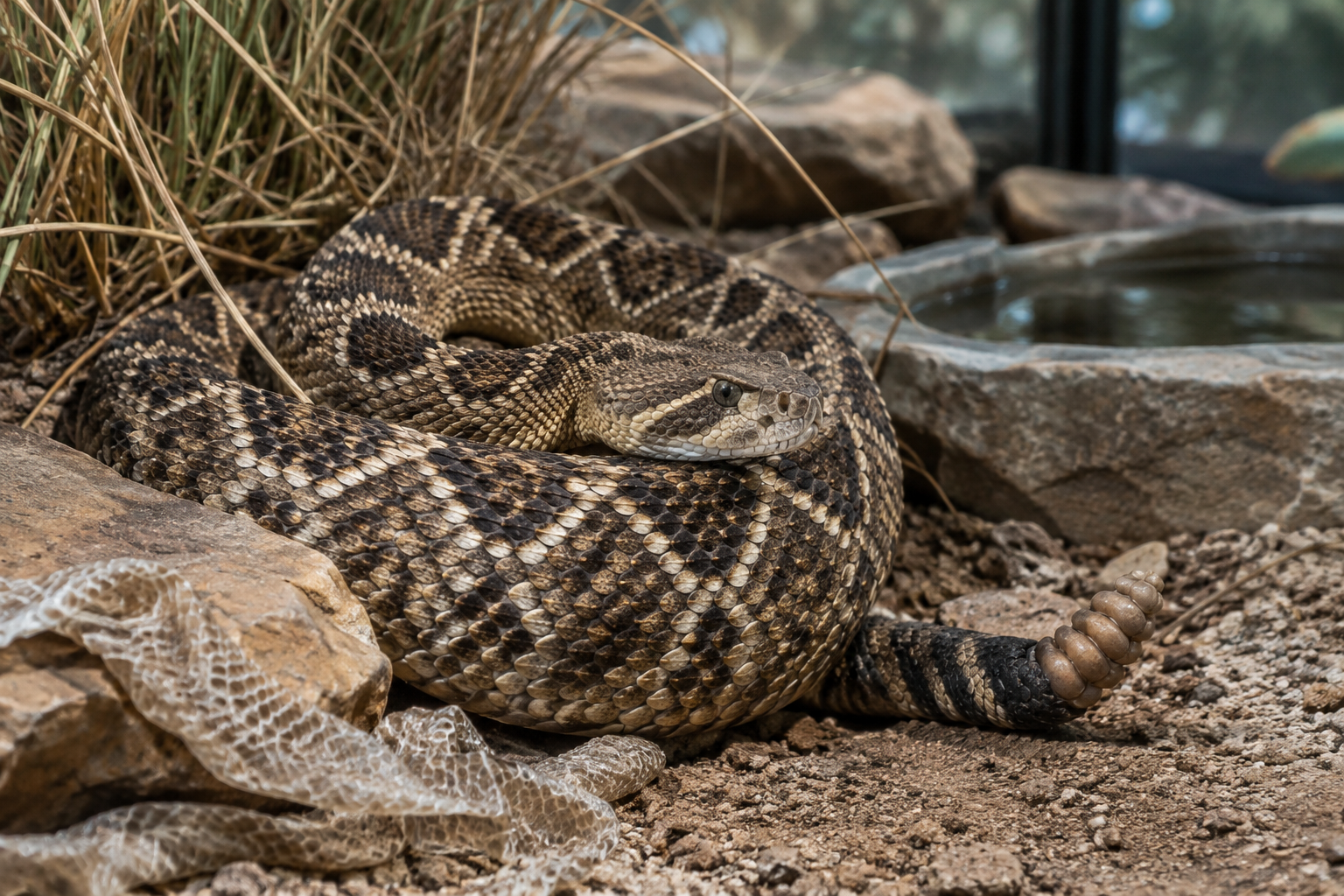
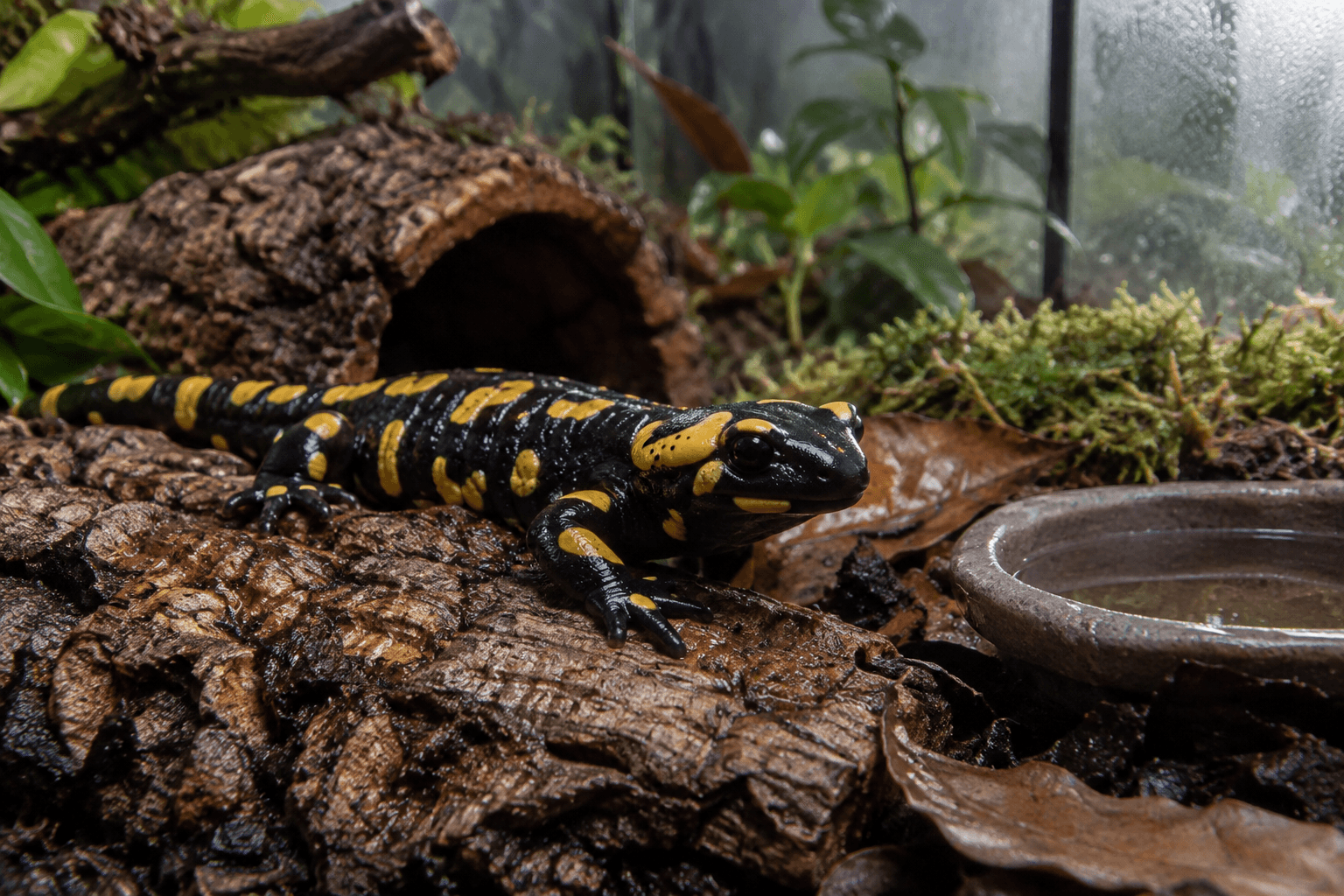
Most day-active and basking reptiles need UVB light. Their skin uses it to make vitamin D3, and D3 lets them absorb calcium. Without it, they can develop metabolic bone disease (MBD), a painful softening of the bones. So match the lamp to your species’ UV Index zone, mount it at the distance the maker lists, keep glass and plastic out of the beam, and replace it on schedule.
Treat UV like a measured dose, not a bulb you buy once. Let’s set yours up by the numbers!
UVA vs. UVB: What Each One Does for Your Reptile
Why do reptile bulbs list two kinds of UV? Because they do different jobs. Here’s the quick split.
UVB: The Vitamin D3 Maker
UVB is the part of sunlight that lets skin make vitamin D3. Your reptile then uses D3 to pull calcium out of its food. Skip UVB, and even a perfect calcium supplement can’t fix the problem.
Early MBD signs are easy to miss. Look for weakness, tremors, a soft or bent jaw, and slow growth in juveniles. Catching it early gives you a real chance to turn things around, but a vet visit comes first.
UVA: The “Seeing” Light
Reptiles see UVA. It shapes how they spot food, mates and rivals, and it affects normal behavior like feeding and basking. Most UVB tubes put out some UVA too.
A bulb that only gives UVA is not a UVB source. Neither is a plain basking lamp. Heat lamps warm the animal, but they make no vitamin D3.
Do All Reptiles Need UVB? Species and Ferguson Zones
Not every reptile needs the same dose. Researcher Gary Ferguson and colleagues watched wild reptiles and recorded the UV Index (UVI, a number that measures UV strength) where each species spends its day. Those readings became the Ferguson Zones, four ranges from shade lovers to full-sun baskers.
Full-spectrum lighting with a safe amount of UVB is now widely recommended for all species, for health and welfare. Still, a night-active gecko needs far less than a bearded dragon.
Here is a simple guide. Treat the numbers as starting points and check your lamp maker’s chart for your exact setup.
Every enclosure also needs a spot with zero UV. That shaded retreat lets your animal control its own dose.
Snakes and Frogs
Do snakes and frogs need UVB? Often a low level helps, but it varies. Many snakes live fine in low-UV setups, and some, like ball pythons, are usually kept without strong lighting. Diurnal snakes that bask in the open may benefit from Zone 1 or 2 levels.
Frogs are the same story. Many do well with a weak, shaded UVB source. Some keepers also use very low-output lamps on small species. Check a species-specific care sheet, and always give hiding spots.
The Meter Beats the Calendar
Guessing from the box isn’t enough. A UV Index meter shows what actually reaches your animal. The Solarmeter 6.5 is the one reptile researchers use, and Zoo Med sells a digital UV Index radiometer for keepers too.
Meters cost real money up front. They can also save you money, because good bulbs often last longer than a year and you stop replacing them early.
How to Use One
Hold the sensor at the spot where your reptile’s back sits when it basks. Point it at the lamp. Read the number, then compare it to your species’ zone.
Check again at the cool end and in the shade. You want a smooth drop from the top reading down to zero. Measure at least monthly, and again after you move a lamp, add a branch or swap a bulb.
No Meter? Use the Maker’s Chart
Arcadia publishes UVI data for its ProT5 lamps, measured with a Solarmeter 6.5. It lists a minimum lamp-to-reptile distance of about 10 inches (250 mm) for that product. That figure belongs to Arcadia only. Don’t copy it onto another brand.
Without a meter, follow the chart for your exact lamp and fixture, and replace the bulb on schedule.
T5 HO, T8 or Compact: Which Bulb Fits?
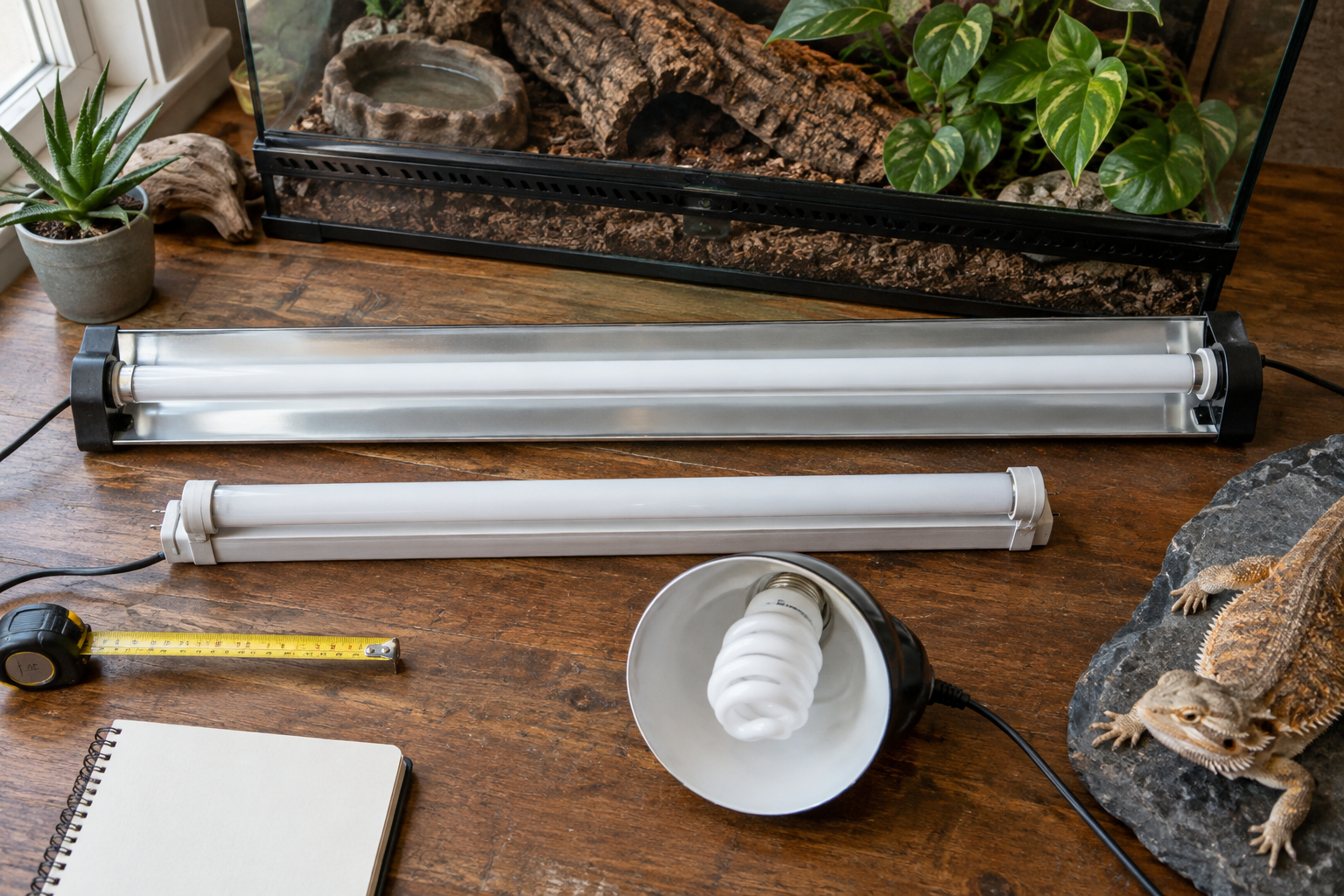
Which UVB tube is better, T5 or T8? For most setups, a T5 HO (high output) tube. It covers more area, reaches farther down, and fades more slowly. T8 tubes are thinner on output and usually need replacing sooner.
Compact bulbs are the ones to be careful with. They make UVB only in a small zone near the lamp, with a steep drop-off. Starter kits often include them. In a very small enclosure, they can work if you block direct contact with the mesh below.
Bulb type
Best for
Coverage
Typical replacement
T5 HO tube
Most lizards, chameleons, larger enclosures
Wide, long reach
About every 12 months
T8 tube
Smaller enclosures, low-UV species
Shorter reach
About every 6 months
Compact (coil)
Very small tanks only
Small, intense zone
Follow the maker; often 6 months
Mercury vapor
Large enclosures needing UVB and heat in one
Big, strong beam
Follow the maker
Brands you’ll see most are Arcadia, Zoo Med and Exo Terra. Skip the cheap, unknown-brand lamps. Their UVB output varies a lot, and they may fade in just 3 to 6 months.
A rare but real risk: some high-output compact lamps and tubes have caused eye injury (photokeratoconjunctivitis). If your reptile suddenly won’t open its eyes after you fit a new lamp, turn it off and call your vet.
Mercury Vapor Bulbs
Mercury vapor bulbs give UVB, heat and light from one fixture. They suit big enclosures. Because they are powerful, you need more distance and a good ceramic socket. Use a timer, and measure the result.
Basking Heat Is Not UV: Build a “Patch of Sunlight”
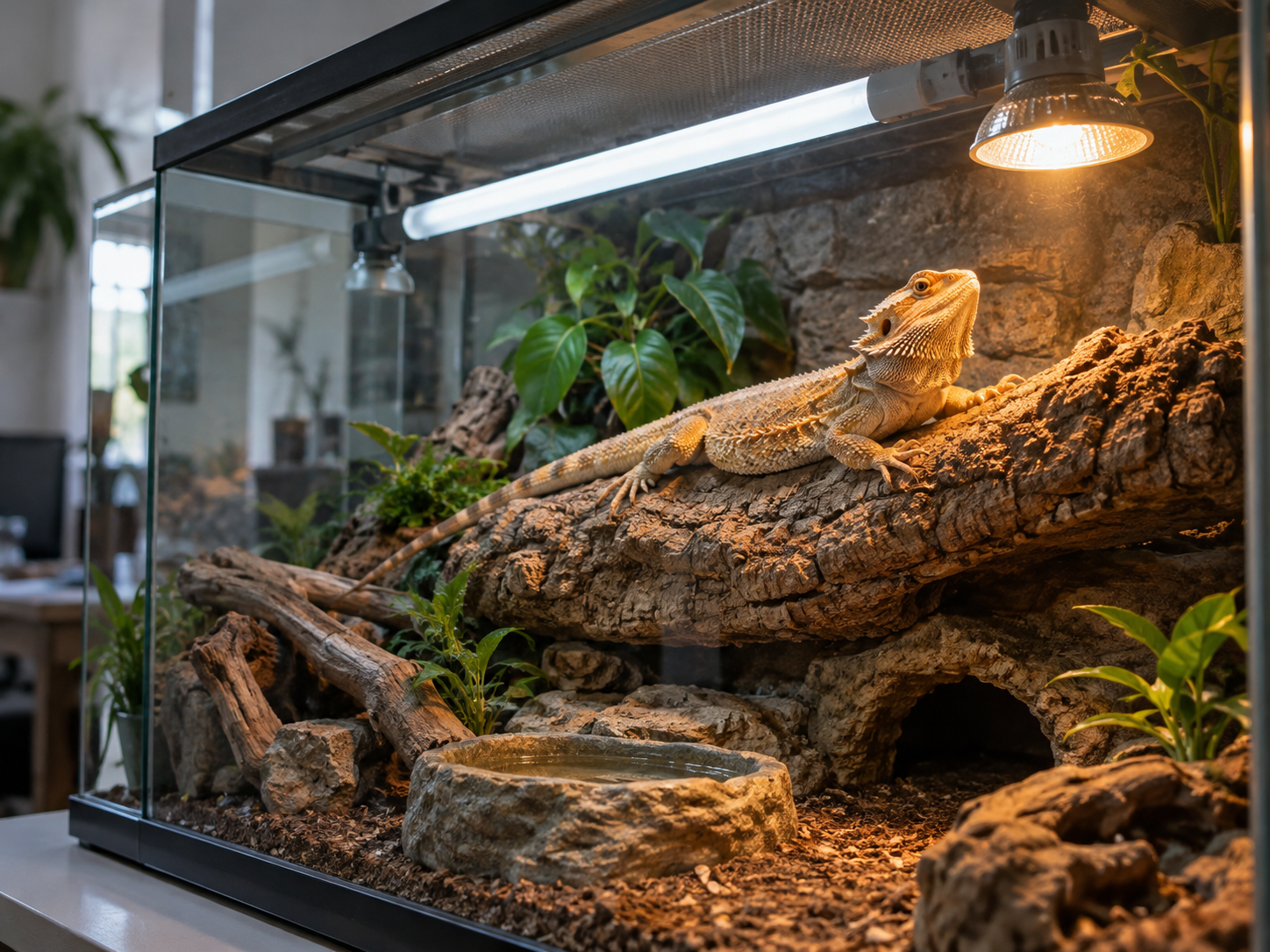
Can one bulb do everything? Usually not. No single lamp copies the whole sun, so keepers combine lamps. A UVB tube gives UVB, UVA and some light. A basking bulb, like a halogen or a tungsten reflector, adds heat. A bright white LED adds strong visible light.
Aim them at one basking spot. Your reptile reads that bright, warm, UV-rich patch as sunshine and responds to it.
Heat and UV are separate numbers. Warm basking temperatures don’t mean enough UVB, and strong UVB doesn’t mean the right temperature. Measure both.
Setting Up Your UV Lamp Step by Step
Ready to build yours? Follow these steps in order.
Find your species’ zone. Use the table above, then confirm with a species care sheet.
Pick a lamp that fits. Choose a T5 HO or the type your maker lists for that zone, and make sure the fixture is the right length. Aim for about half to two-thirds of the enclosure’s length.
Mount it inside the enclosure, or over open mesh. Place it where your animal’s basking spot sits, with a reflector to push light down.
Set the distance. Start at the maker’s listed distance for your exact model, then adjust.
Measure. Put a UV meter at the basking height. Raise or lower the lamp, or add a perch, until you hit your zone.
Check the gradient. Make sure a zero-UV hide exists at the far end.
Add a timer. Many keepers run about 10 to 12 hours a day, though seasonal changes and species needs vary.
Glass, Plastic and Mesh Block UV
Can UVB pass through glass or mesh? Glass and plastic block most of it, so never place a lamp above a glass lid. Screen mesh also cuts output, and fine mesh cuts more. A study by Burger, Gehrmann and Ferguson tested the common materials used in reptile housing, and it’s why you measure under the mesh, not at the bulb.
If your lamp sits above mesh, check the UVI at animal height. You may need to lower the lamp or choose a stronger one.
Too Close and Too Far
Too far, and UVI drops below your target, so the reptile gets too little. Too close, and UVI spikes, and it can burn eyes and skin. Most problems are distance problems.
Leave your reptile real choices. Add branches at different heights and a dark hide, and the animal will pick its own dose!
When to Replace a Reptile UVB Bulb
How often should you replace one? Plan on every 6 to 12 months. A good T5 HO usually gets 12 months, while a T8 often needs swapping at about 6. Follow your lamp maker’s own advice, because brands differ.
A bulb that still glows isn’t necessarily still working. UVB fades long before the light burns out, and you can’t see UVB anyway.
Warning Signs to Check
Look at your reptile and the date. Review the setup if you see any of these:
The bulb is past its replacement date
Your reptile basks less or hides more
Appetite drops
Juveniles grow slowly
Weakness or tremors, which can point to MBD (see a vet)
Make It a Habit
Write the install date on the fixture with a marker, or set a phone reminder. A new tube costs far less than treating bone disease. If you own a meter, replace the bulb when readings fall below your target zone instead of by date. Many good T5s hold up longer than a year!
If you want help with the rest of the build, Pet Terrarium also has enclosure setup guides for lizards, geckos and snakes.
Frequently Asked Questions
Do all reptiles need UVB light?
Not at the same level. Day-active and basking species, like bearded dragons, need it. Night-active species and many snakes need much less, and some do fine with very low levels. Match your animal to its Ferguson Zone and always offer shade.
What is the difference between UVA and UVB for reptiles?
UVB lets skin make vitamin D3, which your reptile needs to absorb calcium. UVA affects vision and behavior. A bulb that gives only UVA, or only heat, won’t protect against metabolic bone disease.
How far should a UVB bulb be from my reptile?
It depends on the exact lamp, reflector and mesh. For example, Arcadia lists about 10 inches (250 mm) as the minimum for its ProT5 lamps. Use your maker’s chart, then confirm the UVI with a meter at basking height.
How often should I replace a reptile UVB bulb?
Typically every 6 to 12 months. T5 HO tubes often last about 12 months and T8 tubes about 6. A UV Index meter is the best way to tell when output has really dropped.