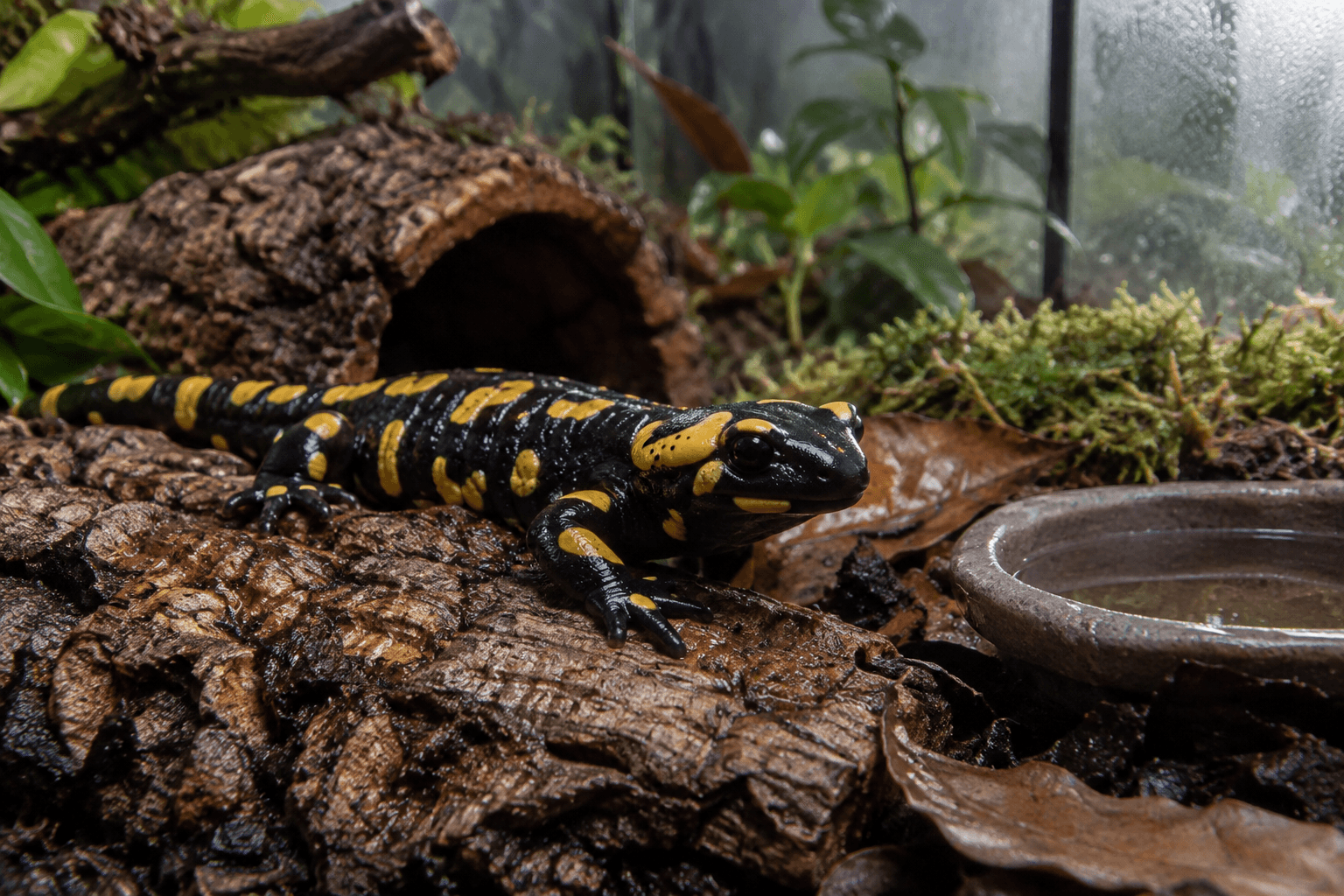
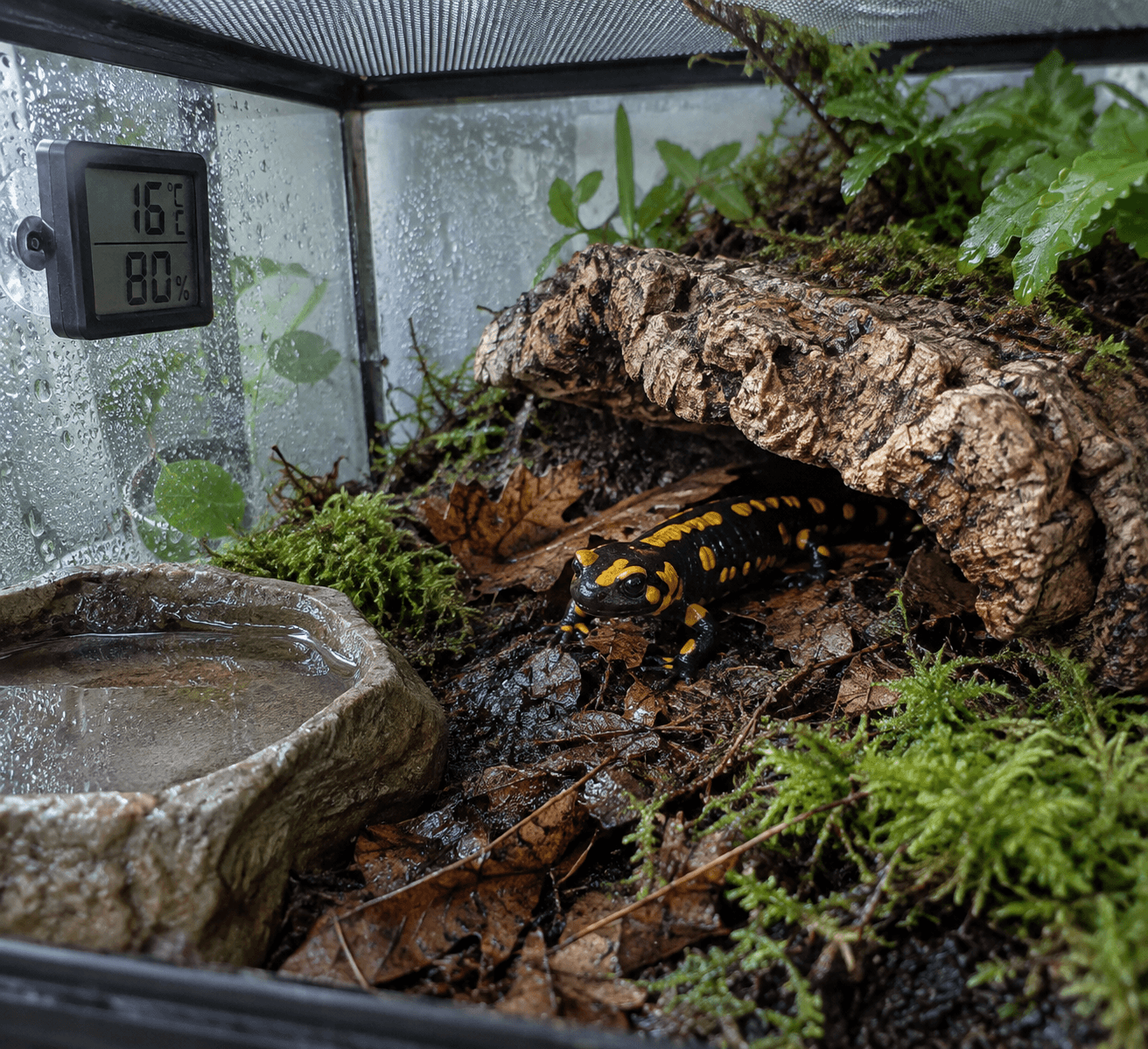
Can you legally keep a fire salamander where you live, and can you keep a room cold enough for one? Answer both before you buy a single cork hide. Fire salamanders (Salamandra salamandra) live in cool, damp forests near clean, shallow water. In captivity they need a cold, dim, humid terrestrial terrarium at about 60-65°F, with no heat lamp, plenty of leaf litter and hides, a shallow water dish, and live insects and worms.
Quick Suitability Check: When You Should NOT Keep One
Fire salamanders are not small reptiles with a different skin. They break the rules most reptile and frog keepers know. Let’s run the check first, because it saves money and heartache.
The Four Dealbreakers
Skip this animal, or wait, if any of these fit you:
Your home runs warm. Temperatures above about 75°F stress them, and summer in most of the U.S. pushes past that without air conditioning.
You want a pet to handle. Their skin is toxic and absorbs things from your hands.
You love bright, planted display tanks. They hide all day under strong light.
You can’t find a legal, captive-bred source. More on that below.
If you got through that list and still want one, keep reading. The rest of this guide is for you!
The Legal Picture in the U.S.
The U.S. Fish and Wildlife Service published rules listing 36 salamander genera as injurious wildlife under the Lacey Act (specifically 18 USC 42). The goal is to keep a deadly fungus out of native salamander populations. That fungus is Batrachochytrium salamandrivorans, called Bsal or salamander chytrid. It has caused major die-offs in Europe and is not yet known to be in the United States.
Fire salamanders are a European species, so they fall squarely into this worry. Importing and moving salamanders across state lines can be restricted. Rules for animals already in private hands differ from rules for new imports, and states add their own laws.
Before you build anything, check the current Fish and Wildlife Service rules page and your state wildlife agency. Ask what applies to ownership, transport and sale where you live. If a seller offers you “legal” animals, ask where they came from and get that in writing.
Where Fire Salamanders Live in the Wild
Why does the wild habitat matter for your build? Because every part of a good enclosure copies it. The more you understand the forest, the easier the setup gets.
Range and Forest Type
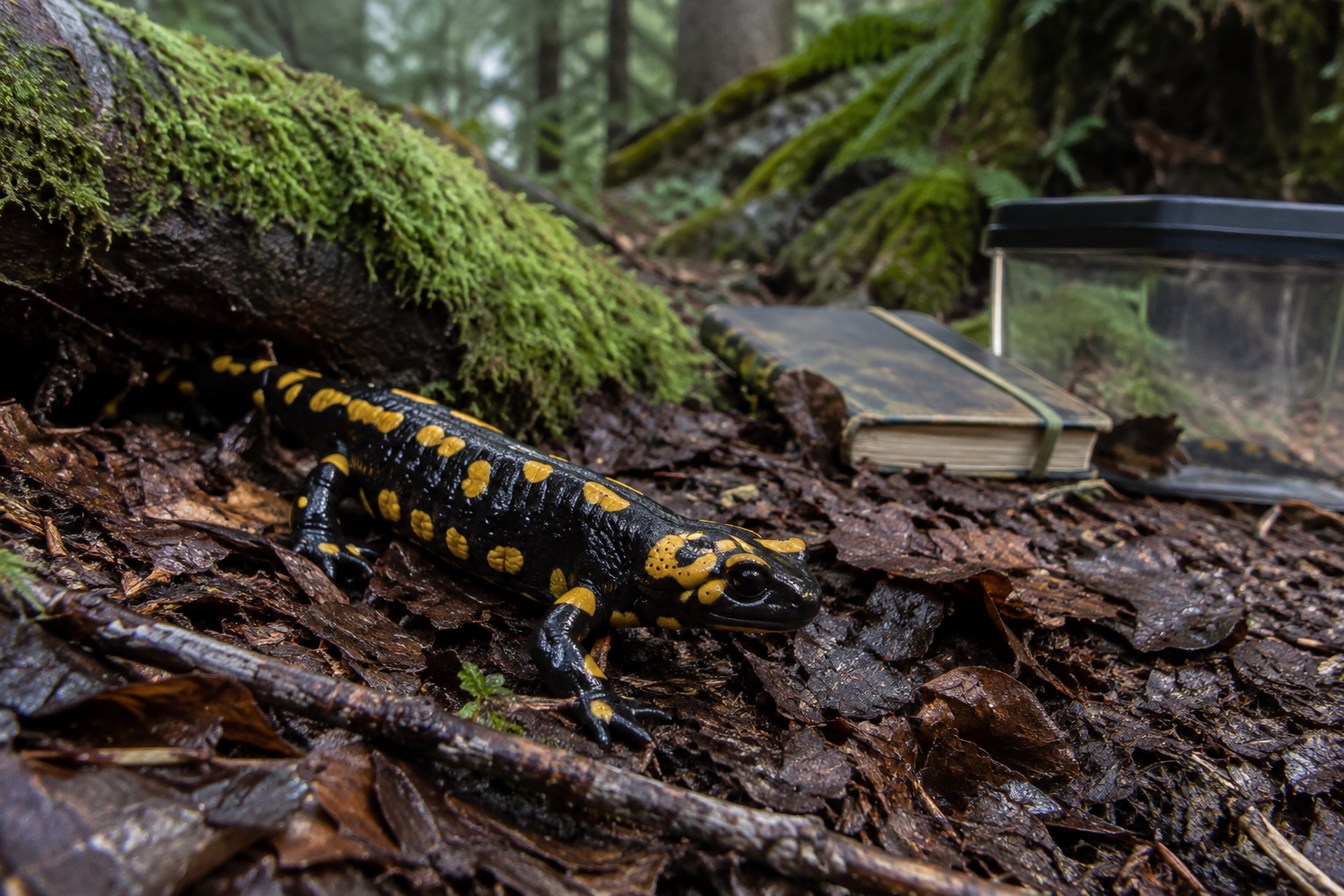
The common fire salamander lives across much of central and southern Europe. Related subspecies reach from Morocco and Algeria to Turkey and Lebanon. They favor mature deciduous or mixed woodland, usually in hilly country. Activewild notes they are rarely found below about 820 feet (250 m).
Think of a beech or oak forest on a damp slope. The ground is thick with leaves, logs and stones. A small, clean stream runs nearby.
Daily and Seasonal Rhythm
Fire salamanders are mostly nocturnal. By day they hide under leaf litter, logs or stones. They come out at night, and they get much more active after rain.
In the cold months, roughly late fall to early spring, they retreat deep underground. Their metabolism slows and they stop eating. Spring warmth and rain bring them back out, and breeding starts.
Why Water Quality Matters
Females return to small, clean, well-oxygenated streams to deposit larvae. These animals breathe partly through their skin, so they react badly to pollution. That is why scientists treat them as a warning sign for forest health. It is also why your tap water and cleaning products matter later.
Enclosure Size and Layout for Adults
How big should the tank be? Bigger floor space beats height. A single adult does well in an enclosure at least 36 inches long, 18 inches wide and 18 inches high. That is roughly a 50-60 gallon-style footprint, such as a front-opening terrarium.
Some keepers go smaller. A 15-gallon aquarium is often cited for a pair, and a 16 x 16 inch footprint has been called enough for two. I’d treat those as bare minimums for a short stay, not a happy home. A larger floor gives you room for a temperature gradient, more hides and fewer fights.
Use glass, acrylic or plastic. Put on a secure lid with good airflow. Fire salamanders climb corners more than you’d expect.
Layout Zones
Divide the floor into simple zones:
Hide zone: cork bark flats, half-logs, and coconut shells along the back and sides.
Dig zone: the deepest substrate in one corner, where they can bury themselves.
Water zone: one shallow dish at the cool end.
Open zone: a patch of leaf litter for night foraging.
How Many Salamanders?
You can house two or three together, and many keepers do. But give each animal at least one hide of its own, and two is better. Too few hides or too little space can lead to fighting, hiding all day, refusing food or frequent shedding.
For a first try, a single animal is simplest.
Temperature and Humidity: Cold, Damp, and Well Ventilated
This is where reptile keepers trip. Skip the heat lamp, the basking spot and the heat mat. Your target is 60-65°F, and you should avoid anything much over 75°F.
Keeping It Cool
Heat tolerance varies a bit by where the animal’s ancestors lived, but none of them like warmth. Watch for signs of heat stress:
Frantic pacing around the enclosure
Repeated climbing of the glass
Sitting in the water bowl and never leaving
If you see these, cool the animal right away. In summer, air conditioning is usually necessary. Choose a basement, a cool room with a window unit, or a dedicated wine-cooler-style setup. Check the temperature with a digital probe at floor level, not the air above.
Humidity Without Soggy Ground
Fire salamanders are mostly land animals, but their skin must stay moist. Mist the enclosure daily. Missing a day or two is rarely a disaster, as long as the substrate stays damp.
Damp is not soaked. Squeeze a handful of substrate: it should feel like a wrung-out sponge, with no water dripping. A soggy enclosure that can’t dry out breeds mold and bacteria. Good ventilation lets the surface dry slightly while the lower layers stay wet.
Winter Cooling (Optional)
In the wild they go dormant in winter. Some keepers copy this to prepare animals for breeding. Only healthy animals in good weight should do it. Withhold food for 10-14 days first, then lower the temperature slowly over several days to about 40-45°F, often in a small fridge. The rest can last up to four months, with several inches of damp sphagnum moss. Warm them up slowly afterward.
If that sounds like too much work, you can skip it for a pet-only animal.
Substrate, Hides, Plants and Lighting
What goes on the floor? Think forest floor, several inches deep. A fire salamander digs, so the substrate needs to be deep enough to cover its whole body, typically 3-4 inches or more.
Substrate Mix
Good choices hold moisture without packing down:
Material
Role
Notes
Coconut fiber (coir)
Base layer
Holds water well
Orchid bark
Mixed in
Keeps the mix airy
Sphagnum moss
Damp patches, winter rest
Soft for burrowing
Leaf litter (oak, beech, magnolia)
Top layer
Hiding cover and foraging
Damp paper towels
Quarantine only
Easy to clean
Avoid cedar and pine shavings, and skip anything with pesticide or fertilizer. Spot clean daily. Replace the top layer if you see mold, and add springtails if you want a cleanup crew.
Hides
Cork bark rounds and flats are the classic pick. Coconut shells and clean clay plant-pot pieces also work. Make sure the animal can fit snugly under each one, since they like a tight, dark space.
Dim Light, Tough Plants
Bright light makes them hide constantly. Use low-intensity LED lighting on a natural day-night cycle. Many keepers use no special lamp at all, just room light.
Live plants are possible in dim, cool conditions. Try pothos, ferns, and moss, which tolerate low light. Plastic plants are a fine backup and are easier to keep clean. Skip anything that needs strong light, and don’t expect a lush jungle!
Water Dish and Water Treatment
Do fire salamanders need water? Yes, but only a little. Offer one shallow dish that they can climb in and out of easily. They soak often, but they are poor swimmers, so a deep bowl is a drowning risk.
Use dechlorinated water. Tap water contains chlorine or chloramine, and both harm amphibian skin. A bottle of water conditioner from any aquarium store handles this. Change the water often, usually daily or every other day, and rinse the bowl with plain hot water instead of soap.
Place the dish at the cool end. Add a flat rock or a ramp of stones if the sides are steep.
Breeding is a different story. Females give birth to larvae, and the larvae need clean, shallow, still-to-gently-moving, dechlorinated water. Plan a separate aquatic setup, with plenty of live food, if you ever expect a litter.
Feeding: What Fire Salamanders Eat
What to feed? Live prey, offered mostly at night or dusk. Fire salamanders are hearty eaters, which is part of their appeal for first-time amphibian keepers.
Staple and Rotation Foods
Earthworms make a great staple. Cut larger ones into pieces so the salamander can manage them. Crickets are another common staple. Rotate in:
Silkworms
Butterworms
Mealworms and superworms
Phoenix worms and hornworms
Waxworms are high in fat. Feed them rarely, no more than a couple of times a month.
Schedule and Supplements
Adults typically eat every two to three days, while juveniles eat more often. Offer what they finish in about 15-20 minutes, then remove leftovers. Dust insects lightly with a calcium supplement, and use a multivitamin now and then. Variety matters more than any single food.
If your animal stops eating, check the temperature first. Too warm is a common cause. Appetite also drops during winter cooling.
Lifespan, Size, Toxic Skin and Sourcing
How long does it live, and is it safe? Fire salamanders can live 20 years or more in good care, with some documented cases past 30. Adults typically reach roughly 6-10 inches. That is a long commitment for an animal that stays mostly hidden.
Toxic Skin and Handling
Fire salamanders produce toxic skin secretions. The bright yellow and black coloring is a warning. The toxin can irritate your eyes and mouth, and it can hurt other pets that mouth or lick the animal. Keep dogs and cats away.
Handle them as little as possible. Their skin also absorbs lotions, soap and oils from your hands. When you must move one, wet your hands with dechlorinated water and wear powder-free nitrile gloves. Wash up well afterward.
Captive-Bred or Wild-Caught?
Captive-bred is the answer. Wild collecting hurts forest populations, and wild animals can carry parasites and disease. With Bsal worries and the U.S. injurious wildlife rules, the source of any animal matters more than ever. A seller should be able to tell you the animal’s origin and the legal basis for the sale. If they can’t, walk away.
Ready to build yours, or walk away? If your home stays cool and your state allows it, a fire salamander is a quiet, long-lived forest animal. For more step-by-step habitat builds, Pet Terrarium has guides for other cool, humid setups too.
Frequently Asked Questions
What habitat do fire salamanders live in?
They live in cool, damp deciduous or mixed forests, usually in hilly areas, with leaf litter, logs and stones for cover. A clean, shallow stream nearby is needed for breeding.
What temperature do fire salamanders need?
Keep them at about 60-65°F with no supplemental heat. Anything much above 75°F causes stress. In summer you will usually need air conditioning or a naturally cool room.
Are fire salamanders poisonous to touch or keep with other pets?
Their skin secretions are toxic and can irritate eyes and mouths. Their skin also absorbs substances from your hands. Avoid handling, and keep dogs and cats away from the enclosure.
Is it legal to own a fire salamander in the U.S.?
It depends. Federal injurious wildlife rules, tied to Bsal, restrict importing and moving many salamanders, and states add their own laws. Check the Fish and Wildlife Service and your state wildlife agency before you buy.