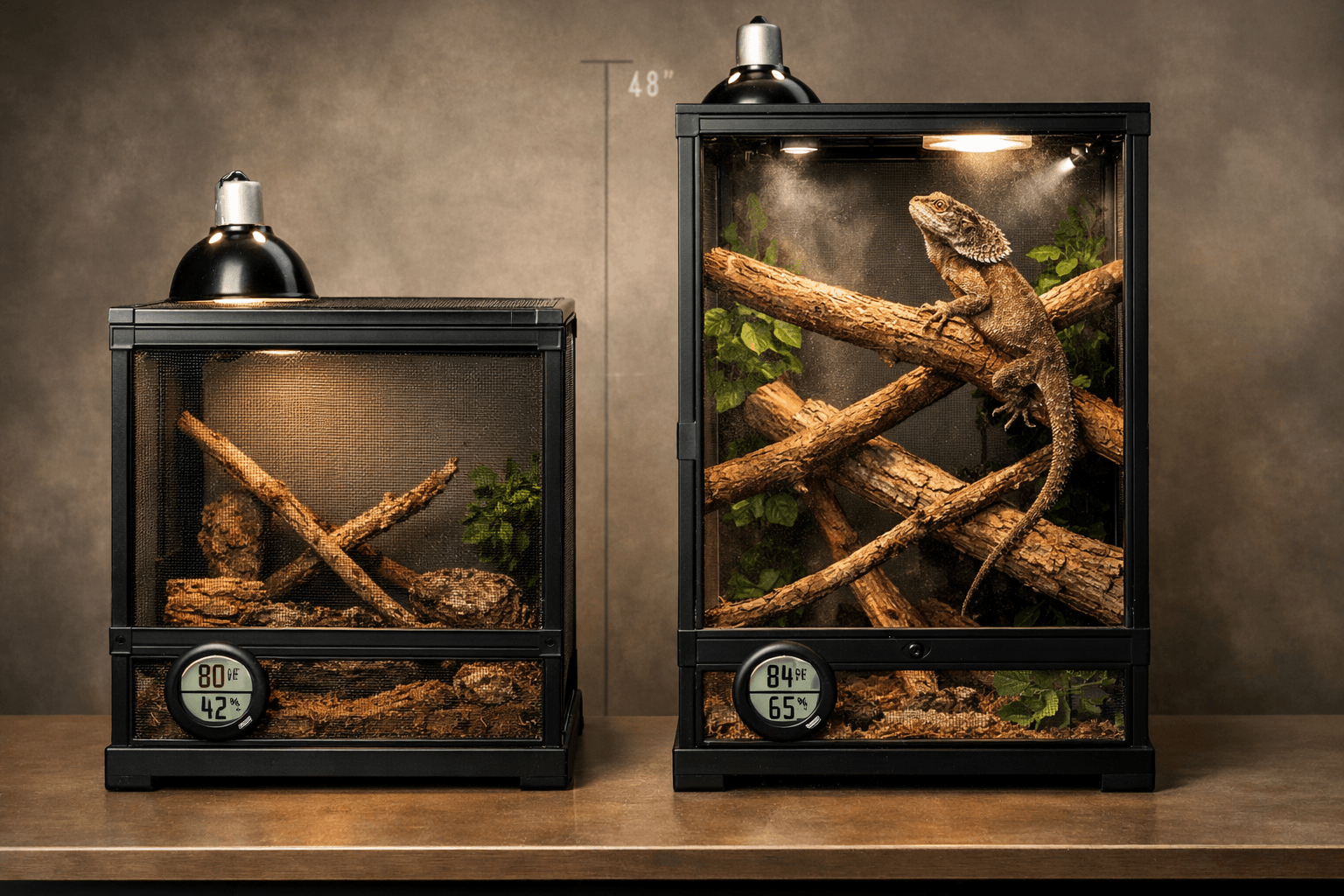
A guy at my local reptile expo once showed me his brand-new 40-gallon breeder tank, all set up for a juvenile frilled dragon he’d just bought. It looked great on paper: wide floor, nice branches, warm basking spot. The problem? That tank was 18 inches wide but only 16 inches tall, and his dragon spent the next three weeks pacing the glass instead of climbing, because there was nowhere up to go.
That’s the mistake almost everyone makes with a lizard frilled dragon setup. People buy width when they should be buying height, and they seal up airflow to chase humidity numbers that don’t actually matter as much as they think. Frilled dragons are tree lizards first, and their whole housing plan needs to reflect that from day one.
Enclosure Size and Shape: Height Beats Floor Space
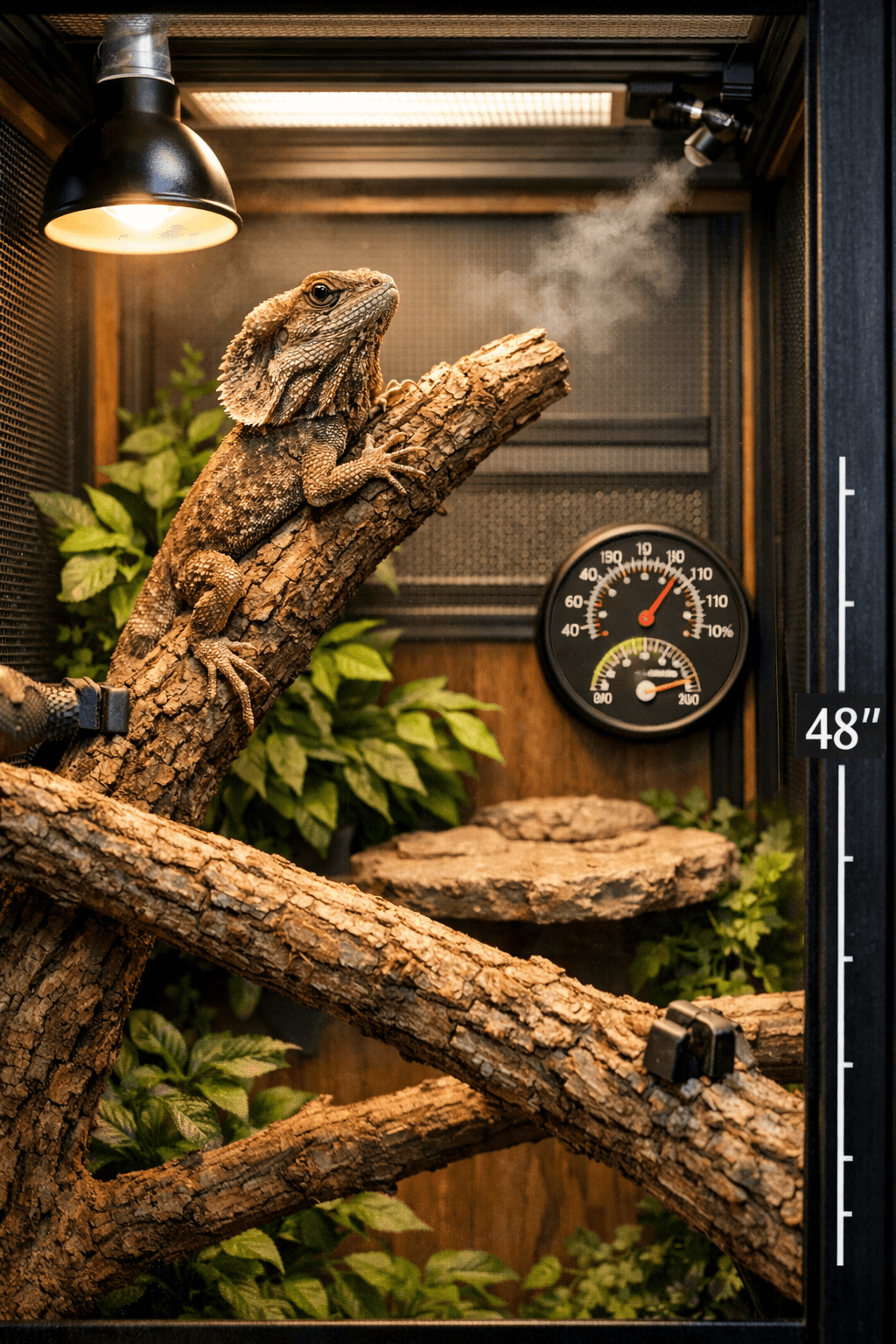
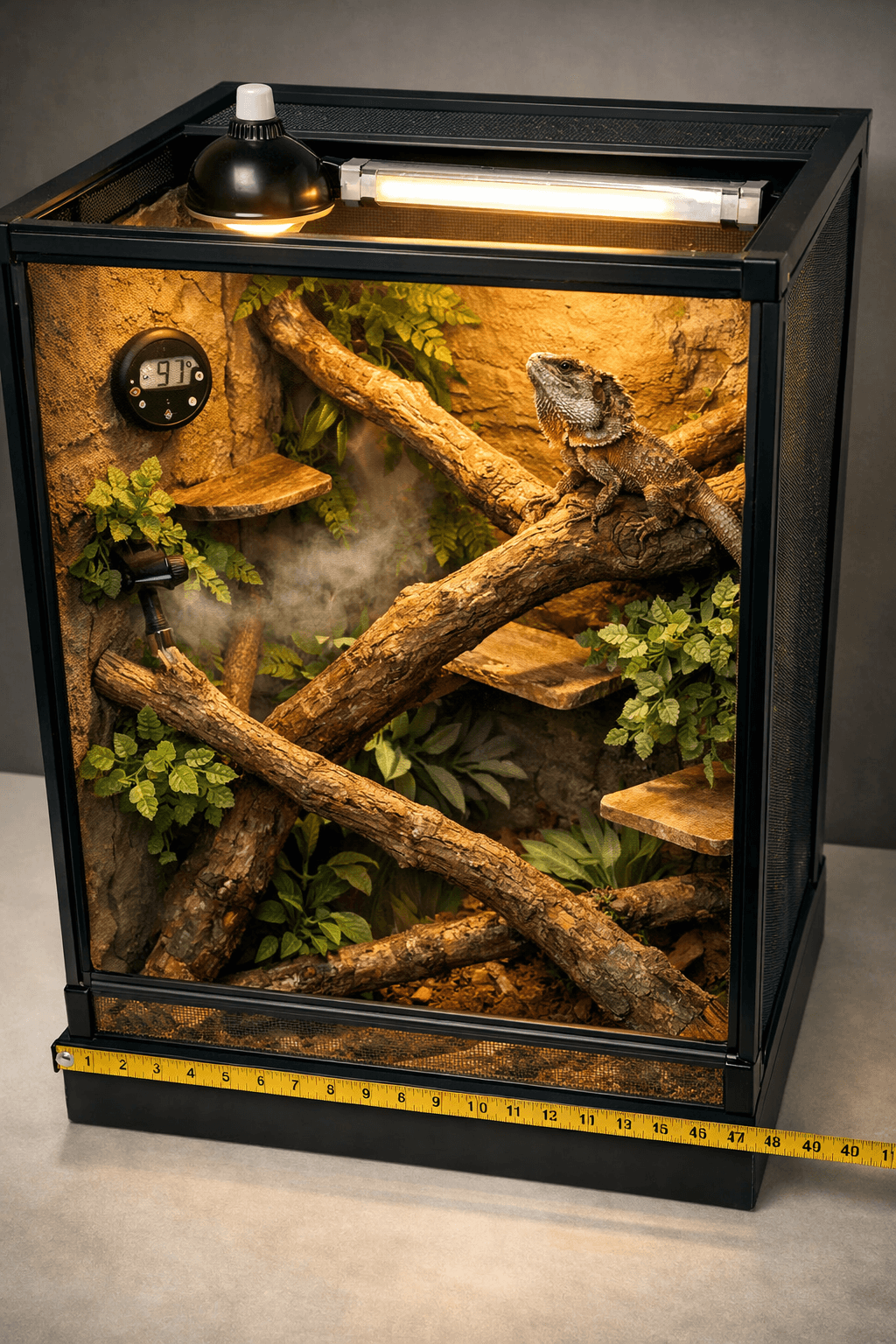
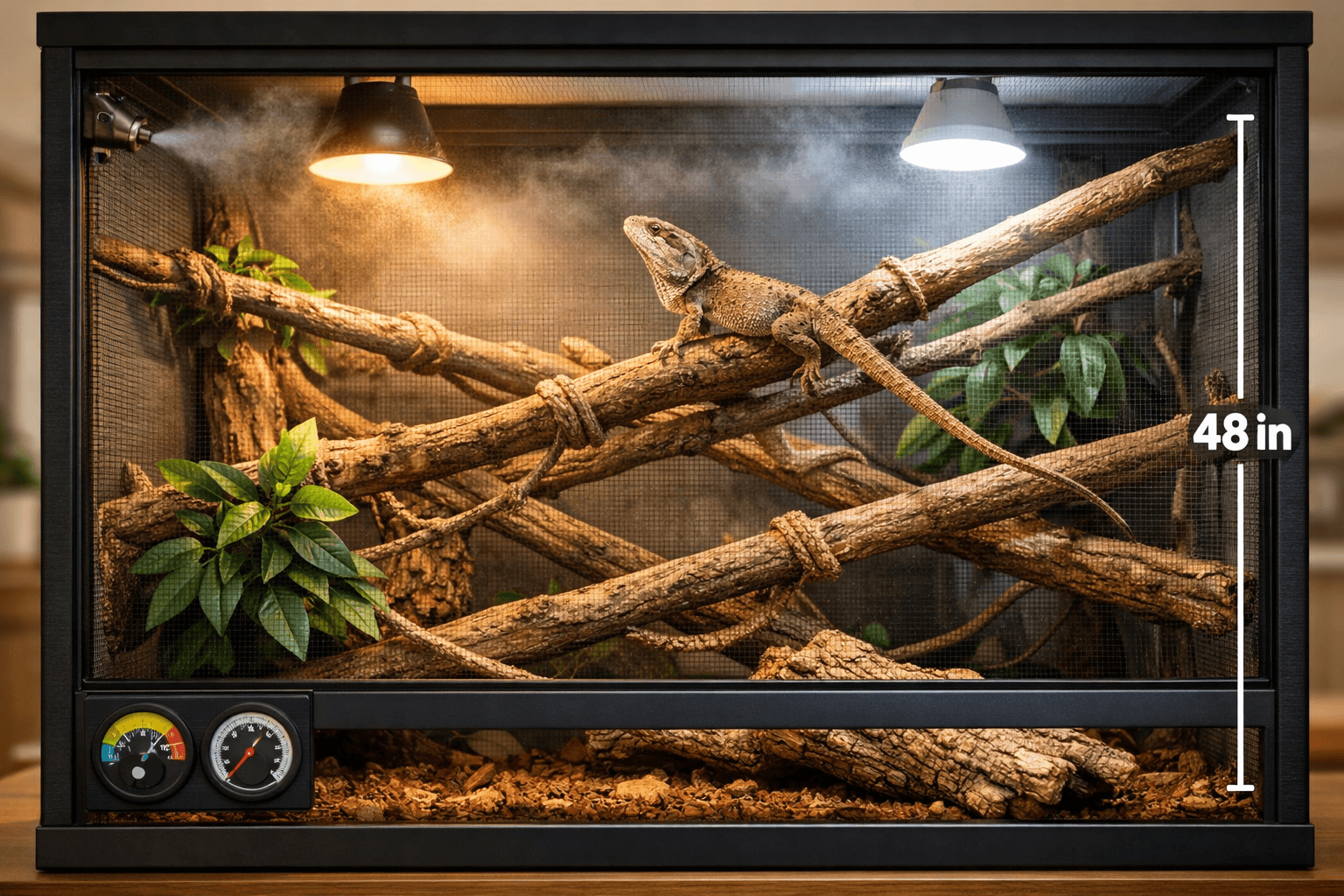
For an adult Chlamydosaurus kingii, the minimum realistic enclosure is 36 inches wide by 24 inches deep by 48 inches tall, and taller is always better than wider. This is the single biggest correction most beginners need, because frilled dragons spend the vast majority of their lives off the ground, perching, climbing, and surveying their territory from up high.
Why Vertical Space Changes Everything
A frilled dragon that only has floor space to work with will act stressed, refuse food, and sometimes develop odd pacing behavior along the glass. Give that same animal 4 feet of height with branches at different levels, and you’ll usually see calmer behavior within a week or two. This isn’t a minor preference. It’s close to the core of what makes this species different from a bearded dragon or a leopard gecko.
Juvenile vs. Adult Housing: When to Upgrade
Juveniles can start in something smaller, like a 20-gallon tall aquarium or a 24x18x36 inch enclosure, but they grow fast. A frilled dragon can reach 24 to 30 inches in total length (including that long tail) by around 18 months old, and I’d plan the upgrade to full adult housing well before that point, not after you notice they’ve outgrown the tank. Waiting too long is one of the most common and most avoidable mistakes in this hobby — a cramped adult enclosure leads to stress, poor appetite, and stunted growth that’s hard to reverse later.
Screen-front enclosures or PVC enclosures with mesh panels tend to work better than glass aquariums for adults, mainly because of the ventilation angle, which I’ll get into shortly. Wood and PVC “arboreal” style cages built for chameleons or monitors are often a better structural match than tanks marketed for bearded dragons.
Ventilation Is the Real Priority, Not Sealed-In Humidity
Airflow matters more than humidity percentage for a lizard frilled dragon setup, because this species is highly prone to respiratory infections in stagnant, damp air. A screen top, mesh side panels, or cross-ventilation on at least two sides isn’t optional here, it’s the thing that keeps your dragon breathing easy.
This runs against what a lot of beginners expect. Bearded dragon care sheets and even some general reptile guides push the idea of sealing up a tank to hold onto heat and moisture. Frilled dragons come from open woodland and monsoonal habitats in northern Australia and New Guinea, places with real air movement, not still, swampy pockets.
Signs Your Airflow Is Wrong
Watch for open-mouth breathing, clicking or wheezing sounds, and thick mucus around the nostrils or mouth. These are the classic signs of a respiratory infection, and in my experience, poor ventilation combined with soggy substrate is behind most of these cases in captive frilled dragons. A vet visit and antibiotics can treat it, but fixing the airflow problem before it starts is a lot cheaper and a lot kinder to the animal.
Balancing Airflow With Humidity Needs
You still need humidity, just not the sealed-tank kind. A well-ventilated enclosure with daily misting will let humidity spike briefly after each misting and then drop back down, which mimics how humidity actually behaves in the wild. That rise-and-fall pattern is healthier than a constant, flat 70% humidity reading that never moves.
If you’re building or shopping for an enclosure, look for one with a full screen top and at least one full mesh wall panel, not just a few small vents drilled into glass. Sites like petterrarium.com list specific enclosure builds that hit this balance for arboreal species, which can save you a few rounds of trial and error compared to retrofitting a bearded dragon tank.
Temperature Gradient: What the Basking Spot and Cool End Should Read
A frilled dragon needs a basking spot between 100 and 110°F, an ambient warm side around 85°F, and a cool end that drops to 75-78°F, with nighttime temps allowed to fall to around 70°F. That range gives the animal room to thermoregulate by moving through the vertical space you built for it.
Because the enclosure is tall, temperature naturally stratifies, warmer air near the top, cooler near the substrate. This works in your favor. Mount the basking branch high, near the heat source, and let the lower branches and floor serve as the cool retreat zone.
Choosing the Right Heat Source
A halogen basking bulb or a ceramic heat emitter mounted above a screen top usually does the job, paired with a digital probe thermometer at both the basking branch and the cool end. Stick-on dial thermometers are cheap but notoriously inaccurate, sometimes off by 10 degrees or more, so I’d skip those entirely for a species this sensitive to overheating and respiratory stress.
Nighttime Drops and Seasonal Adjustment
Don’t panic if your house dips to 68°F overnight, that’s within a safe range for most adult frilled dragons, and a slight nighttime drop is actually normal in their native range. If your home regularly drops below 65°F in winter, a low-wattage ceramic heat emitter on a thermostat overnight is worth adding, rather than leaving a bright basking bulb on 24/7, which disrupts their day-night cycle.
UVB Lighting: Distance and Replacement Matter More Than Brand
Frilled dragons need a UVB bulb running the full length of the enclosure, positioned so the basking branch sits within the manufacturer’s recommended distance, typically 8 to 12 inches for a standard T5 High Output tube. Skipping UVB, or running an old bulb well past its replacement date, is one of the fastest routes to metabolic bone disease in this species.
Metabolic bone disease, often shortened to MBD, happens when a reptile can’t process calcium properly because it isn’t getting enough UVB exposure to synthesize vitamin D3. Early signs include a soft or slightly bent jaw, wobbly movement, and reluctance to climb, things that are easy to miss if you’re not looking for them weekly. Left untreated, MBD leads to fractures and permanent deformity, and it’s genuinely heartbreaking because it’s so preventable.
Bulb Types and How Often to Replace Them
T5 HO linear UVB tubes, something like a ReptiSun 10.0 or similar high-output T5 fixture, are the standard recommendation for taller enclosures because they throw usable UVB further than compact coil bulbs. Even the best bulb loses effective output over time, so plan to replace it every 6 to 12 months regardless of whether the light still turns on, since visible light output doesn’t tell you anything about UVB strength.
Placement Inside a Tall Enclosure
Because your enclosure is tall, mount the UVB fixture across the top on the warm side, and set the highest basking branch at the correct working distance from that light rather than jamming it right up against the mesh. Middle and lower branches will get progressively less UVB, which is fine, since the dragon will move between zones on its own throughout the day.
Humidity, Misting Schedule, and Substrate Choices
Aim for humidity in the 50-70% range, achieved through daily misting rather than a constantly damp substrate. Mist once or twice a day, enough to wet the leaves and branches so your dragon can drink droplets, then let the enclosure dry out somewhat between mistings.
This is where a lot of well-meaning owners go wrong. They see “humidity 60-70%” on a care sheet and assume that means the substrate should always feel moist. For a lizard frilled dragon setup, damp, compacted substrate sitting in a poorly ventilated tank is close to a worst-case scenario, since it breeds mold and bacteria right at ground level, even though the dragon spends most of its time up in the branches.
Choose a substrate that drains and dries well, like a mix of coconut fiber and orchid bark, or a bioactive blend with leaf litter on top.
Layer it 2-3 inches deep if you’re going bioactive with live plants and cleanup crew insects.
Spot-clean waste daily and check for any lingering damp patches after misting.
Fully replace loose substrate every 2-3 months, sooner if it starts smelling musty.
Avoid pure sand, gravel, or reptile carpet, none of which manage moisture or support live plants well.
A bioactive setup, meaning live plants, springtails, and isopods working together to break down waste, tends to handle the humidity swings better than a bare-bottom or paper-lined tank, because the living components actually process moisture instead of letting it sit. It takes more setup work upfront, usually a solid weekend to get drainage layers and plants established, but it cuts down on manual cleaning a lot once it matures.
Climbing Structure: Branches, Vines, and Vertical Decor
Fill at least 60-70% of the vertical space with branches, vines, and cork bark at varying angles and thicknesses. This isn’t decoration, it’s the core functional layout of the whole enclosure, since frilled dragons rest, bask, hunt, and sleep almost entirely off the ground.
Grapevine, manzanita branches, and cork bark rounds are all solid choices, and they’re widely available through reptile supply shops for reasonable prices, often $15-40 depending on size. Mix diameters so your dragon can grip comfortably at different life stages, thinner flexible branches near the top for baskers, and thicker sturdy limbs lower down.
Building a Layout That Actually Gets Used
Angle branches diagonally rather than straight up and down, since frilled dragons like to move at an angle and often prefer resting at 45-degree tilts rather than clinging vertically. Leave at least one branch running horizontally near the basking light and another lower down in a cooler, more shaded spot, so your dragon has genuine choices, not just one usable perch.
Live Plants vs. Artificial Foliage
Live plants like pothos, ficus, or hardy dracaena varieties add humidity buffering and cover, and they generally survive the lighting and misting schedule a frilled dragon setup already needs. Artificial vines and foliage are a fine budget substitute if you’re not ready for live plants yet, just make sure they’re reptile-safe and don’t have small parts that could be swallowed.
Feeding, Water, and Handling: Daily Care That Builds Trust
Feed juveniles daily and adults every 1-2 days, offering appropriately sized crickets, dubia roaches, and the occasional treat like superworms, along with regular greens for adults. A shallow water dish plus daily misting covers hydration, since frilled dragons often drink moving droplets off leaves more readily than standing water.
Getting feeding and handling right day-to-day is where you build the kind of relationship that makes this hobby genuinely rewarding, not just manageable.
Building a Feeding Routine
Gut-load insects with a nutritious feed for 24 hours before offering them, and dust with a calcium supplement at most feedings, adding a vitamin D3 and multivitamin powder once or twice a week. Juveniles under 6 months typically eat daily, while adults settle into an every-other-day rhythm once they’re past a year old. Offer collard greens, mustard greens, or squash a couple times a week for adults, since frilled dragons become more omnivorous as they mature, even though juveniles are almost entirely insectivorous.
Water Dish Setup and Drinking Behavior
Keep a shallow, sturdy water dish somewhere in the mid-level branches, not just on the floor, since some frilled dragons rarely bother with ground-level water sources. Refresh it daily, and don’t be surprised if you rarely see your dragon actually drink from it, since misted leaves and branches are usually their preferred water source.
Handling and Taming Without Stressing the Animal
Frilled dragons are more skittish than bearded dragons, and rushing the taming process usually backfires. Start with short, calm sessions near the enclosure, let the dragon approach your hand rather than grabbing it, and expect real progress over 4 to 6 weeks rather than days. A dragon that’s properly settled will often perch calmly on a shoulder or arm, but getting there takes patience, especially with wild-caught or import-line animals that arrive more defensive than captive-bred ones.
Comparing Enclosure Options at a Glance
Different enclosure types suit different budgets and life stages, and picking the wrong one early is an easy way to end up rebuilding your setup within a year.
Enclosure Type
Approx. Size
Best For
Approx. Cost
20-gallon tall glass tank
24x18x36 in
Juveniles (0-8 months)
$80-150
Screen-front reptile cage
36x24x48 in
Adults, humid climates
$200-350
PVC arboreal enclosure
36x24x48 in
Adults, better heat retention
$300-500
Custom-built wood/mesh cage
48x24x60 in
Adults, breeding pairs
$400-700
For most first-time owners, I’d point toward the screen-front reptile cage in that 36x24x48 inch range once your dragon is past juvenile size. It balances airflow and heat retention better than a fully glass tank, and it costs less than a full custom build while still giving that essential vertical space.
Frequently Asked Questions
How big does a frilled dragon actually get?
Adult frilled dragons typically reach 24 to 30 inches in total length, including their long tail, usually by 18 to 24 months old. Males tend to grow larger than females, so plan your adult enclosure size around a male-sized animal even if you’re unsure of sex yet.
Can I keep a frilled dragon in a bearded dragon tank?
Not successfully long-term. A standard bearded dragon tank is wide and short, while frilled dragons need height over floor space, and reusing that setup usually leads to a stressed, under-climbing dragon within weeks.
Why does my frilled dragon keep opening its mouth and hissing?
Mouth-gaping and hissing are usually stress or threat displays, especially in new or recently handled dragons, and often calm down within a few weeks of consistent gentle exposure. If it’s paired with wheezing, clicking, or visible mucus, that’s a respiratory infection sign, not just attitude, and needs a reptile vet visit.
How often should I replace my UVB bulb?
Replace T5 High Output UVB tubes every 6 to 12 months, even if the bulb still lights up normally. Visible light doesn’t indicate UVB output, so tracking replacement dates on a calendar is more reliable than judging by eye.