A guy at my local reptile shop once bought a juvenile crested gecko, a 20 gallon long tank on clearance, and a heat lamp he swore he “definitely needed.” Six months later he was back, asking why his gecko never climbed and looked stressed all the time. The long tank he’d grabbed was the wrong shape entirely, and that heat lamp was drying the place out like a hair dryer left running.
That story sums up most of the mistakes people make with a crested gecko 20 gallon tank setup. The size can work, but only if you get the orientation, the humidity, and the lighting right from day one. Let’s get into what actually matters.
Tank Dimensions: Why “20 Gallon” Isn’t One Size
A 20 gallon tank comes in two shapes, and only one works for crested geckos. You want the 20 gallon tall, which measures around 24 inches wide by 12 inches deep by 16 inches high, not the 20 gallon long at 30 by 12 by 12 inches.
Crested geckos are arboreal. They spend most of their life climbing, jumping, and hanging out near the top of their space rather than wandering the floor. A long tank gives you floor space you don’t need and robs you of the vertical space that actually matters.
Tall vs. Long: The Real Difference
The tall tank gives a gecko about 16 inches to climb, which is roughly what you need for one adult to move naturally between basking spots, hide spots, and feeding ledges. The long tank caps you at 12 inches of height, and that’s just not enough room for a gecko that likes to leap between branches.
If you already own a 20 gallon long tank, it’s not a total loss. You can use it for a bioactive isopod colony, a quarantine tank, or even a different species like a leopard gecko that actually prefers floor space. Just don’t force a crestie into it.
Why Some Keepers Skip the 20 Gallon Entirely
Here’s the thing a lot of setup guides don’t say clearly enough: a 20 gallon tall is really a one-gecko, medium-term enclosure. Adult cresties do fine in it, but many experienced keepers jump straight to an 18x18x24 inch enclosure (about 40-45 gallons equivalent) from the start.
Why? Because a hatchling grows into an adult within about 12 to 18 months, and once that happens, the 20 gallon starts to feel tight fast, especially if you want live plants and real branching. If your budget allows it, starting bigger saves you from buying two enclosures instead of one.
Setting Up the Enclosure Step by Step
Getting the physical setup right the first time saves you from tearing everything down later. Here’s a practical order of operations that works whether you’re a first-timer or restocking after an upgrade.
Choose the 20 gallon tall enclosure and check the lid or front doors seal well enough to hold humidity without trapping stale air.
Add substrate at a depth of 2 to 4 inches, depending on whether you’re going bioactive or using a simpler liner.
Install background panels or cork bark on the back and sides to give climbing surfaces and hide the glass.
Add branches, vines, and at least one broad leaf plant (real or fake) angled diagonally, not just straight up and down.
Mount your UVB light and any thermometer/hygrometer probes at gecko-eye height, not just near the top glass.
Place a shallow feeding ledge and water dish at a mid-level height, somewhere your gecko will actually find it.
Mist heavily once to settle dust and check that humidity climbs into the correct range before adding your gecko.
Skipping the misting step before move-in day is a common one. You want the tank already holding humidity and looking lived-in before your gecko goes in, not scrambling to adjust everything with a stressed animal watching you.
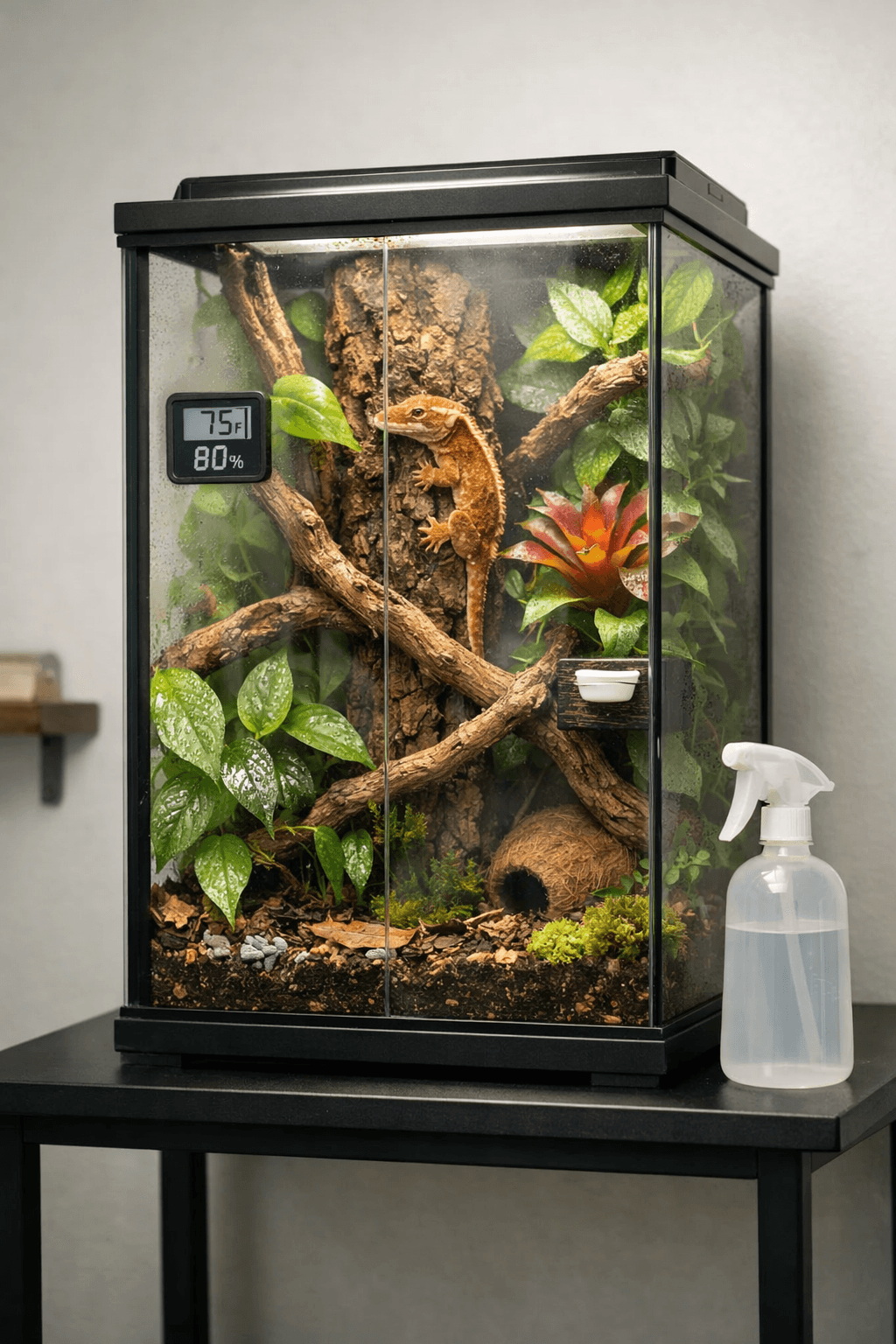
Take your time on the decor placement. Cresties use diagonal branches way more than vertical ones, since it mimics how branches actually grow in the wild, and it gives them easier launch points for jumping.
Substrate Choices: Bioactive, Coco Fiber, or Paper Towel
For a crested gecko 20 gallon tank, coco fiber-based substrate is the easiest long-term choice for most beginners, while bioactive setups reward you with less cleaning once established. Paper towel works, but only as a short-term or quarantine option.
Coco Fiber and Simple Substrate Blends
Coco fiber, sometimes mixed with sphagnum moss, holds humidity well without staying soggy. It’s affordable, usually $8 to $15 for a brick that expands into several gallons of substrate, and it’s forgiving if you get your misting schedule slightly wrong in the first few weeks.
The downside is you’re doing full or partial substrate swaps every 4 to 6 weeks to keep it from developing odor or mold. That’s not hard, just something to plan into your maintenance routine.
Bioactive Substrate with Isopods and Springtails
A bioactive setup layers substrate, leaf litter, and a cleanup crew of isopods and springtails that eat waste and stray food. Once it’s running, usually after 4 to 6 weeks of “seeding” the crew before adding your gecko, you’re doing far less scooping and swapping.
It costs more upfront, often $40 to $60 for substrate, leaf litter, and a starter cleanup crew culture, and it takes more patience to set up correctly. But for a 20 gallon that’s going to house a gecko for a year or two, I’d say it’s worth the investment.
Paper Towel: Fine for Now, Not Forever
Paper towel is cheap and lets you monitor droppings easily, which matters for young or sick geckos. It’s a smart choice for hatchlings or quarantine setups, but it holds zero humidity on its own and needs replacing every couple of days.
Don’t use it as your permanent substrate in a display tank. It looks sterile, and long-term it just adds extra work compared to coco fiber or bioactive blends.
Humidity and Misting: The Number One Cause of Problems
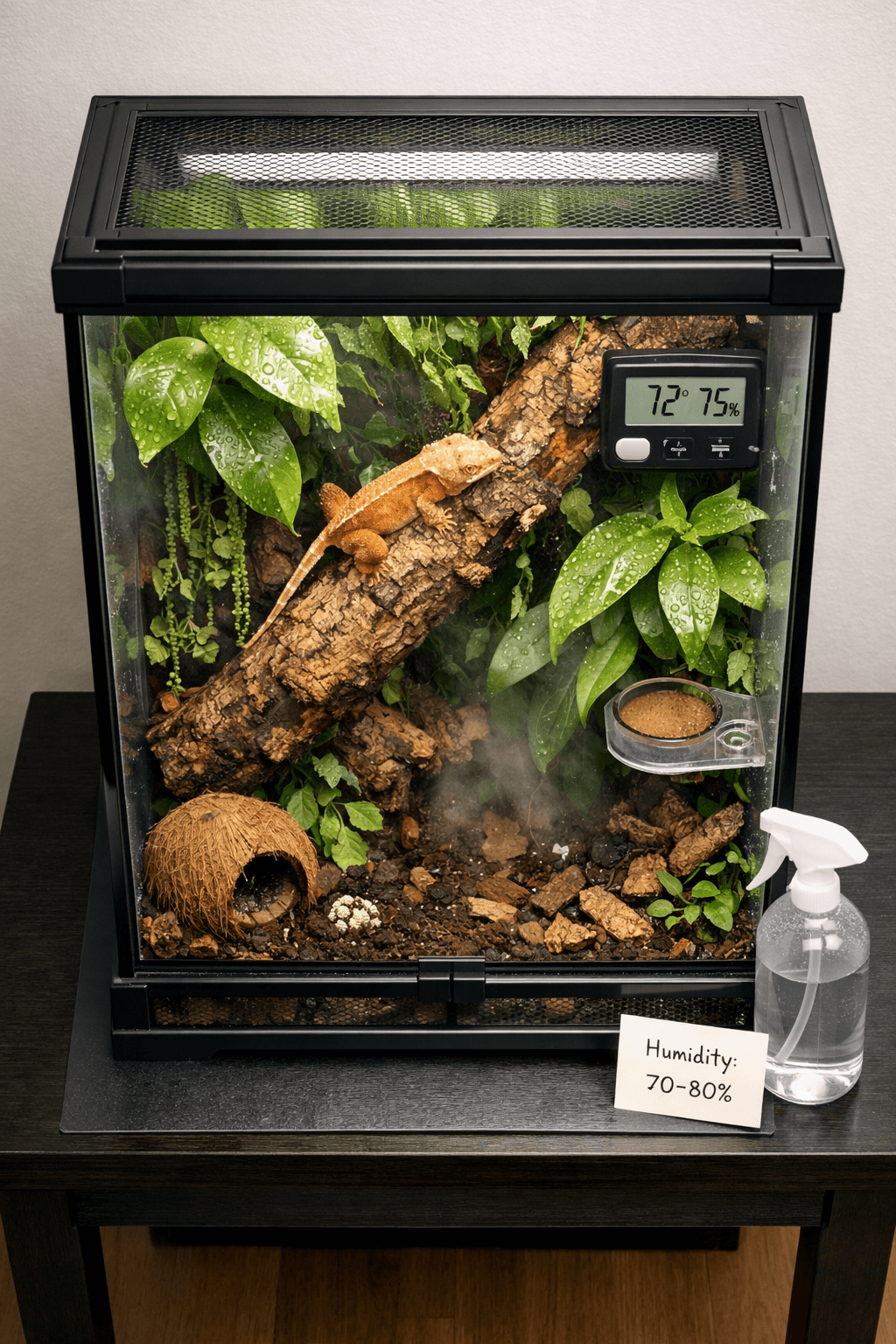
Crested geckos need humidity between 50% and 80%, cycling higher at night and lower during the day, and getting this wrong is the single biggest cause of stuck sheds and dehydration. Aim for two misting sessions a day, one in the morning and one before lights-out.
A lot of new owners either mist too little, worried about mold, or too much, turning the tank into a swamp. Both extremes cause problems. Too dry and your gecko struggles to shed cleanly, especially around the toes and tail tip. Too wet and you’re inviting mold and bacterial growth in the substrate.
Reading Your Hygrometer Correctly
Place your hygrometer at the mid-level of the tank, not right against the glass or right under the light, since those spots give false readings. A digital probe hygrometer, usually $10 to $20, is far more reliable than the stick-on dial kind.
Check it right before your morning misting and again a few hours after your evening misting. If you’re consistently seeing 40% or lower during the day, that’s your cue to add more live plants or adjust your substrate moisture, not just mist more randomly.
Automatic Misting Systems Versus Hand Misting
Hand misting with a simple spray bottle works fine and costs almost nothing, but it does require you to actually be home twice a day. Automatic misting systems, running $50 to $120 depending on the brand and reservoir size, take that pressure off if your schedule is unpredictable.
I’d recommend starting with hand misting for the first month so you actually learn how your specific tank holds and loses humidity. Once you know the pattern, decide if an automatic system is worth the money for your household.
Temperature and Lighting: What Crested Geckos Actually Need
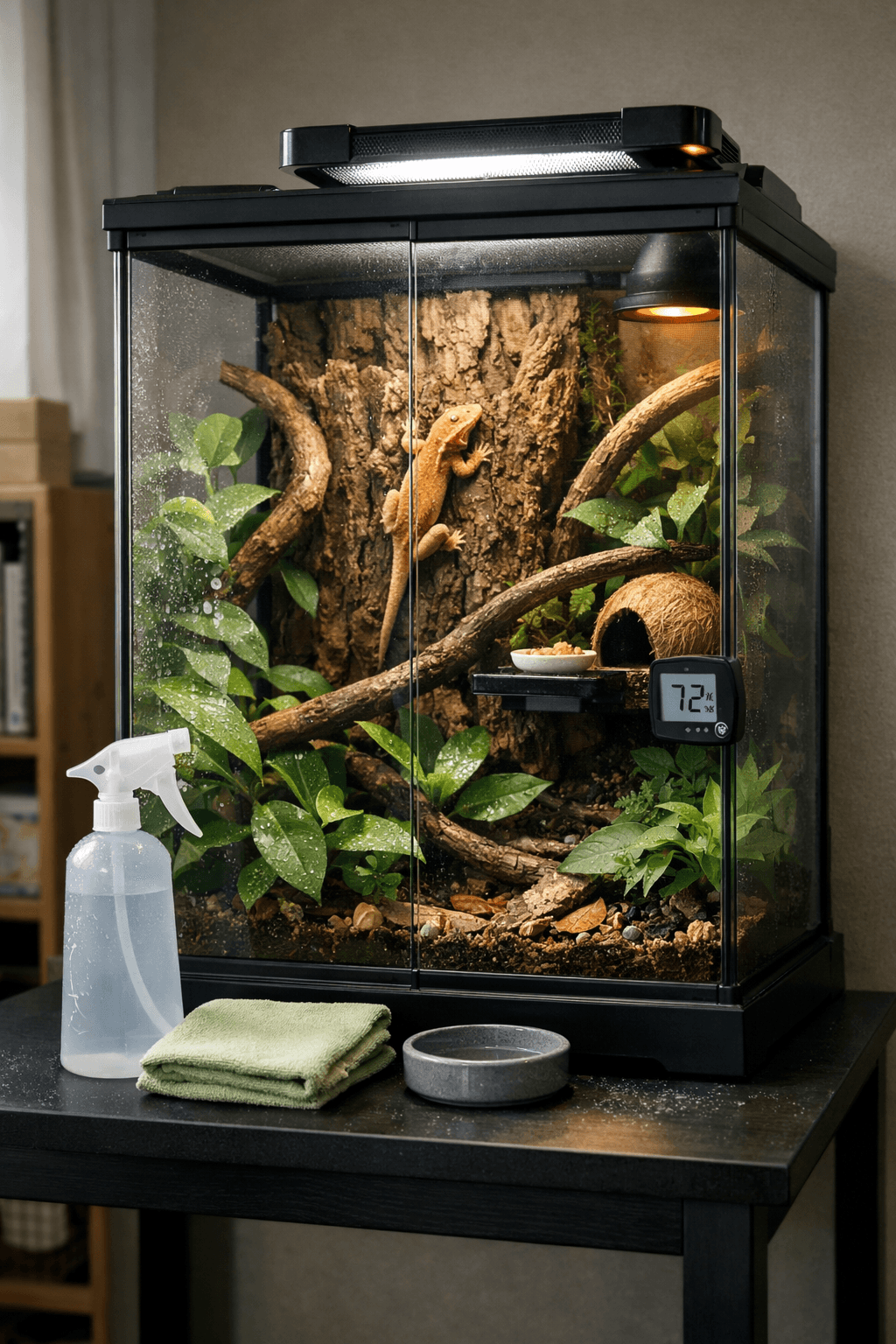
Crested geckos do not need a heat lamp, and running one can push temperatures dangerously high for a species that evolved in cooler, shaded rainforest canopy in New Caledonia. Room temperature in the 72-78°F range is usually enough, with no supplemental heat required in most homes.
That said, low-level UVB lighting is now recommended, even though cresties are nocturnal. A low output bulb, roughly 5-6% UVB strength, mounted over part of the tank, supports natural vitamin D3 processing and calcium metabolism, similar to the benefit reptile keepers have documented across other nocturnal species.
Why the “No Lighting at All” Advice Is Outdated
For years, the standard advice was that cresties needed zero lighting since they’re nocturnal. That’s shifted. Current thinking, echoed by keepers and vets working with arboreal geckos, is that even brief, low-intensity UVB exposure during dusk and dawn hours mimics what geckos would get in the wild, filtered through rainforest canopy.
Run the UVB bulb on a timer for about 10 to 12 hours a day, same as a normal day-night cycle, and make sure at least part of the tank stays in complete shade so your gecko can opt out of exposure whenever it wants.
Avoiding Overheating Mistakes
If your house runs warm in summer, over 80°F, that’s more of a concern than a lack of heat source. Cresties can get heat-stressed quickly, showing signs like darkened color, lethargy, or refusing food. A small fan in the room or moving the tank away from a sunny window solves this in most cases without any extra equipment.
Never place the tank directly under a household lamp or near a heating vent just because it seems logical. The goal is stable, moderate temperature, not warmth for warmth’s sake.
Climbing Decor, Feeding Setup, and Plants
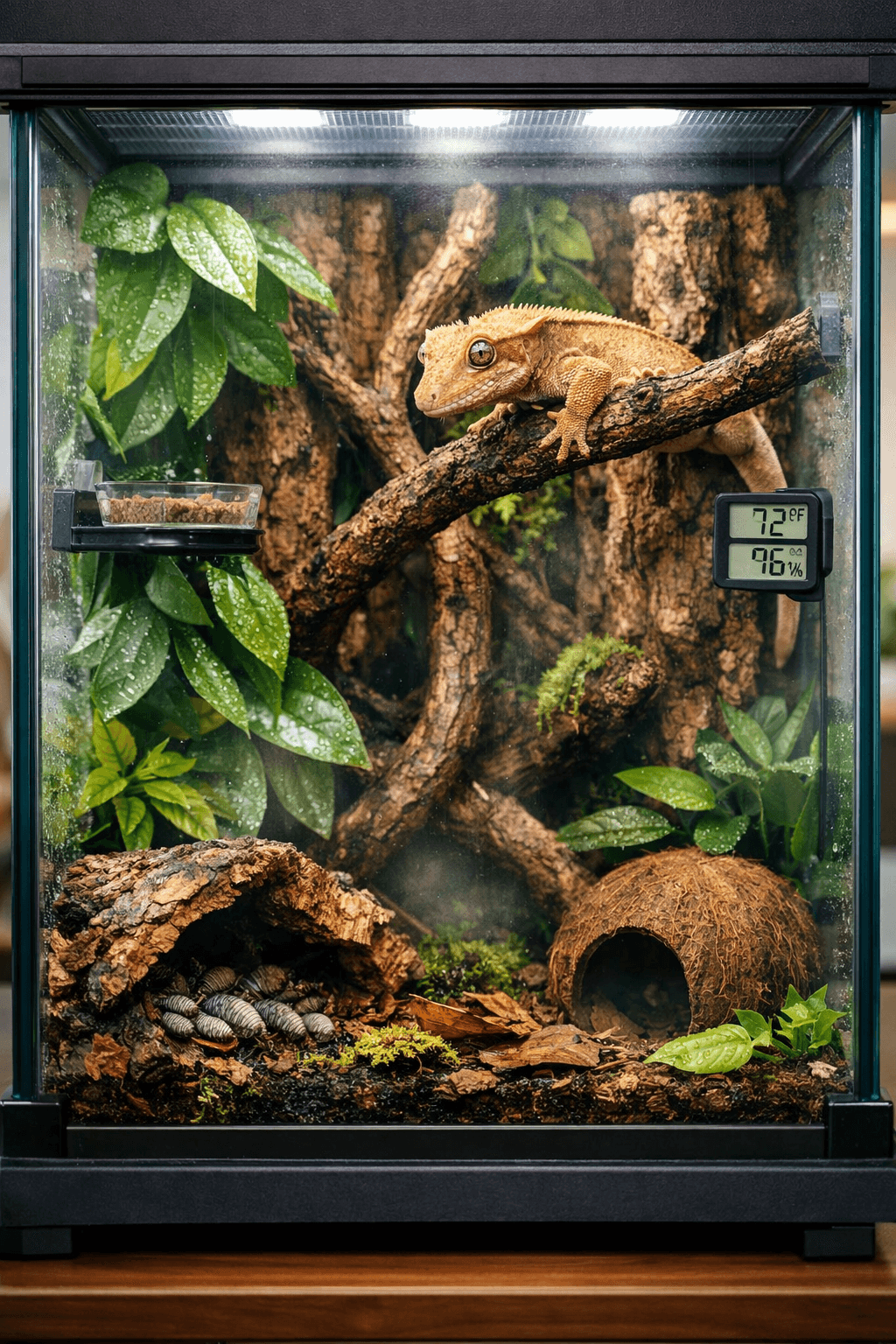
Since cresties live in the air more than on the ground, your decor plan should prioritize height and pathways over floor coverage. A tank with three or four crossing branches at different heights gives your gecko real choices about where to rest, hide, and hunt.
Building Climbing Structure That Works
Cork bark rounds, flexible vines, and real or artificial pothos plants are the core of a good setup. Angle branches so they cross each other at different heights, creating a sort of climbing lattice rather than a single ladder straight up.
Leave gaps and dense pockets both. Cresties like tight hiding spots during the day and open perches at night, so a setup with only one type of space limits natural behavior.
Feeding Ledges and Dishes
Crested geckos eat a mix of commercial crested gecko diet (CGD) powder mixed with water, plus occasional live insects like small crickets or dubia roaches. Put the food dish on a raised ledge, roughly a third of the way up the tank, since these geckos rarely come down to floor level to eat in a well-decorated setup.
A shallow water dish works too, though most hydration actually comes from misting droplets on leaves rather than drinking from standing water. Change the CGD dish every 24 to 48 hours since it spoils fast, and don’t leave uneaten live insects wandering the tank overnight.
Multiple Geckos and Long-Term Cost: What a 20 Gallon Really Supports
A 20 gallon tall tank comfortably holds one adult crested gecko, and that’s it for long-term housing. Trying to keep two adults, especially two males, in this size risks stress, fighting, and in males specifically, real injury from territorial aggression.
Female pairs sometimes coexist in larger enclosures, but even then, most experienced keepers recommend at least 29 to 40 gallons of space, not 20, before considering cohabitation. If you’re set on multiple geckos, plan for separate 20 gallon talls or one significantly larger enclosure from the start, rather than cramming two animals into a single tank meant for one.
Full Cost Breakdown for a 20 Gallon Setup
Budgeting for a crested gecko 20 gallon tank goes beyond just the glass box. Here’s roughly what you’re looking at for a full, responsible setup:
Item
Estimated Cost
20 gallon tall tank
$50 – $80
Screen/hybrid lid with ventilation
$20 – $40
Substrate (coco fiber or bioactive starter)
$15 – $60
Low-level UVB light and fixture
$25 – $45
Branches, vines, cork bark, plants
$30 – $60
Thermometer/hygrometer (digital)
$10 – $20
Feeding ledge, dishes, misting bottle
$10 – $20
Total
$160 – $325
That range covers a basic-but-solid setup on the low end and a nicer bioactive display on the high end. It doesn’t include the gecko itself, which typically runs $40 to $150 depending on morph and where you buy it, or ongoing costs like CGD powder and live insects, which usually run $10 to $20 a month.
When Two Tanks Beats One Bigger Purchase
If cost is the main concern, it’s sometimes smarter to buy two separate 20 gallon talls for two geckos rather than one oversized enclosure meant for cohabitation. Separate tanks avoid fighting risks entirely and let you tailor humidity or plant density to each individual gecko’s needs.
For anyone comparing this against other arboreal species care, checking a resource like petterrarium.com for species-specific comparisons (say, how a crested gecko setup differs from a Chinese water dragon’s needs) can help you avoid buying gear that’s overkill or undersized for what you’re actually keeping.
Cleaning and Maintenance Schedule
Regular upkeep on a crested gecko 20 gallon tank isn’t complicated, but skipping it lets waste and mold build up fast in a warm, humid space. Spot-clean daily, do a deeper clean weekly, and rotate substrate on a longer cycle depending on what type you’re using.
Daily and Weekly Tasks
Every day, remove old CGD, check the water dish, and spot-check for droppings on leaves or branches. This takes maybe 5 minutes and prevents most odor problems before they start.
Once a week, wipe down glass or acrylic surfaces with a reptile-safe cleaner, check that misting is keeping humidity in range, and give branches a quick inspection for mold, especially in the corners where airflow is weakest.
Monthly Deep Cleans
Once a month, do a fuller clean: rinse dishes, check substrate depth and moisture, and if you’re on coco fiber rather than bioactive, plan for a partial or full substrate swap around this point. Bioactive setups need far less monthly intervention since the cleanup crew is doing a lot of that work continuously.
Keep a simple log, even just a note on your phone, of misting times and cleaning dates for the first couple of months. It sounds like overkill, but it’s the fastest way to spot patterns, like humidity dropping every time you run your home’s heater.
Frequently Asked Questions
Is a 20 gallon tank big enough for a crested gecko?
Yes, for one adult crested gecko, a 20 gallon tall tank (24x12x16 inches) is adequate long-term housing. It’s tight for two adults and wrong entirely in the “long” orientation, which sacrifices the vertical climbing space cresties need most.
Do crested geckos need a heat lamp in a 20 gallon tank?
No, most homes stay within the 72-78°F range cresties need without any added heat source. A heat lamp often overheats a 20 gallon tank fast, so a room thermometer check is usually enough instead of extra equipment.
How often should I mist a crested gecko’s 20 gallon tank?
Mist twice daily, once in the morning and once before lights-out, to keep humidity cycling between 50% and 80%. Adjust based on your hygrometer reading rather than a fixed schedule, since home humidity varies by season.
Can two crested geckos live together in a 20 gallon tank?
Not recommended, especially for two males, since a 20 gallon tank is sized for one adult gecko. Female pairs sometimes work but usually need 29 to 40 gallons of space to reduce stress and territorial conflict.