A guy in my local reptile group posted a photo last winter of his bearded dragon basking spot reading 145°F on a cheap stick-on thermometer, right before the poor lizard got third-degree burns from a 150-watt bulb sitting too close with no thermostat. He’d bought the bulb because the pet store box said “recommended for 40-gallon tanks” and figured that was that. That single word, “recommended,” is exactly why so many people pick the wrong reptile heat light bulb and end up guessing instead of measuring.
The truth is a heat bulb’s wattage tells you almost nothing on its own. Screen tops, tank size, room temperature, and bulb distance change the real basking surface temp more than the number on the box ever will.
Why Bulb Wattage Numbers on the Box Are Only a Starting Guess
Wattage charts on packaging assume a solid-top enclosure, a specific distance, and a room sitting around 70°F. Your setup almost never matches all three, so the printed wattage is a rough starting point, not a guarantee.
A mesh screen top is the biggest wildcard. Screen can block 30 to 40 percent of usable heat from reaching the basking spot, because both convective heat and a chunk of infrared just scatter through the gaps instead of landing on the surface below. That’s why a 100-watt bulb that hits 110°F on an open-top tank might only reach 85°F under the same size screen lid.
Tank size matters just as much. A 75-gallon enclosure has far more air volume to heat than a 20-gallon, so the same bulb that overheats a small tank might barely warm a big one. Ambient room temperature stacks on top of that. A basement terrarium room running 65°F in January needs more wattage than the same setup in a warm living room at 78°F.
The Only Way to Know for Sure
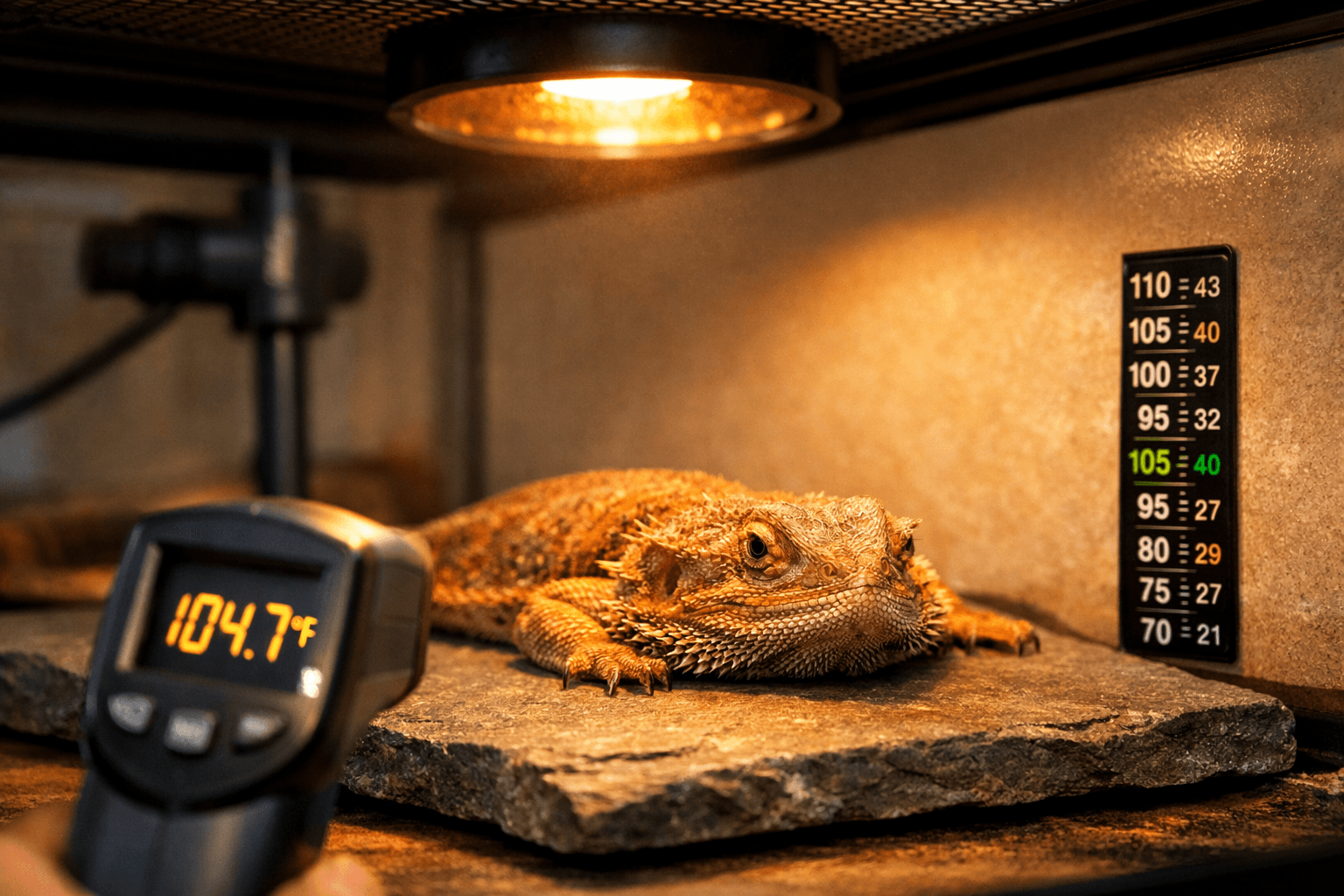
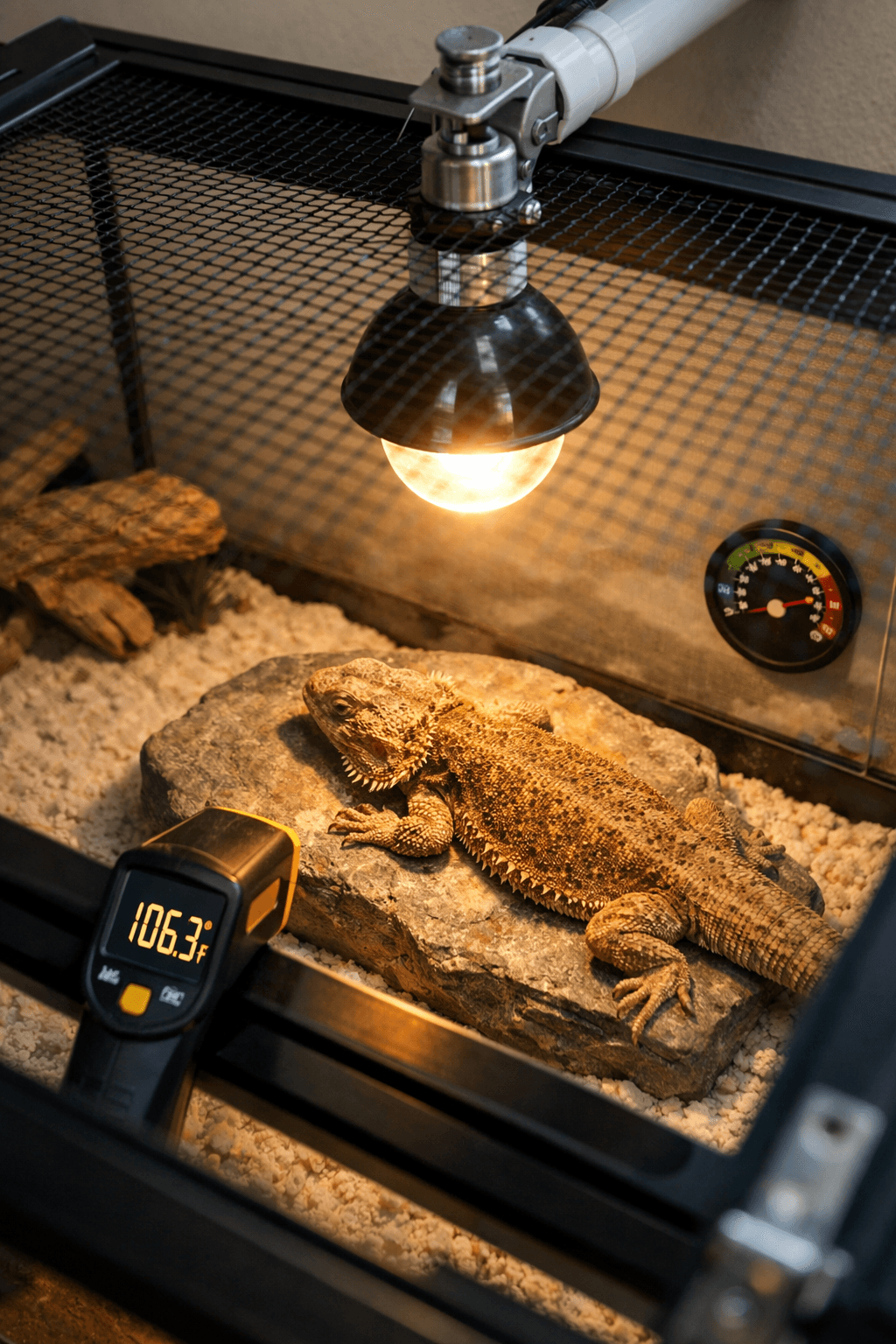
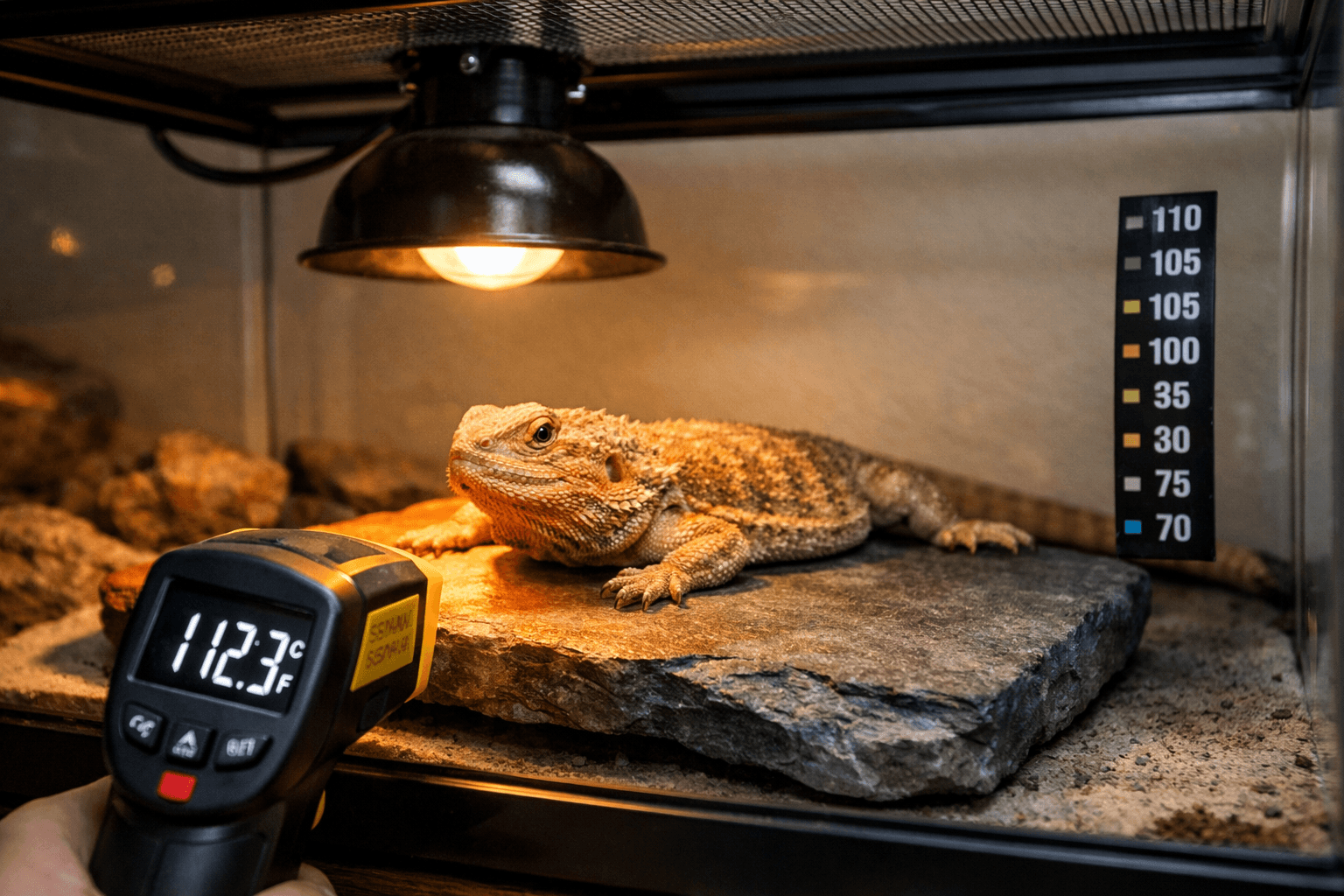
Buy a temperature gun (an infrared thermometer, sometimes called a laser thermometer) for around $15 to $25, and point it directly at the basking surface, not the air near it. This is the single habit that separates people who guess right from people who cook their pets or leave them cold.
Check the reading at the actual spot your animal sits, not the bulb, not the glass, and not six inches to the left. Do this at the same time daily for the first week after any new bulb or fixture change, since temps drift as bulbs age and rooms warm or cool with the seasons.
A basic dial or digital probe thermometer works fine for ongoing daily checks, but it can’t beat a temp gun for pinpointing hot spots during setup. I’d keep both in the toolkit: temp gun for setup and troubleshooting, probe thermometer for a quick daily glance.
Incandescent vs. Halogen: Which Basking Bulb Actually Holds Up
Halogen basking bulbs beat standard incandescent bulbs for most reptile setups because they run hotter per watt, last longer, and hold a steadier output as they age. Incandescent bulbs are cheaper up front but drift and dim faster.
How They Actually Compare
A standard incandescent basking bulb, the kind that looks like a regular household bulb, usually lasts somewhere around 1,000 to 2,000 hours before it burns out or dims noticeably. Halogen bulbs, by contrast, often push past 2,000 to 3,000 hours and keep a more consistent color temperature the whole time. That difference matters because a dimming bulb means a slowly dropping basking temp that’s easy to miss until your dragon or gecko stops climbing up to bask at all.
Halogens also tend to focus heat more directly, which can create a tighter, hotter basking spot instead of a broad, weaker glow. For species that want a clearly defined hot zone, like a bearded dragon (Pogona vitticeps) or a Chinese water dragon, that focused heat is a real advantage.
When Incandescent Still Makes Sense
Incandescent bulbs aren’t useless. They’re a fine budget pick for smaller tanks, low-power species, or as a backup bulb you keep on hand for emergencies. A 60-watt incandescent running $3 to $5 a bulb is an easy spare to stash in a drawer.
Just don’t expect the same lifespan or heat consistency you’d get from halogen. If you’re running a heavy-use setup, like a shop with a dozen enclosures, the extra couple dollars per halogen bulb pays for itself in fewer replacements and fewer temperature crashes nobody notices in time.
Ceramic Heat Emitters: Heat Without Light, and When You Need It
A ceramic heat emitter (CHE) puts out infrared heat with no visible light at all, which makes it the right choice for nighttime heating or for species that get stressed by constant glow. It screws into a standard fixture just like a bulb but looks like a dark ceramic dome.
Nocturnal species, including many leopard geckos and crested geckos, don’t need light overnight, and running a bright bulb 24/7 disrupts their natural rhythm. A ceramic heat emitter solves that by keeping ambient temps up after dark without lighting the tank like a stage.
CHEs also run longer than most basking bulbs, often rated for 15,000-plus hours, since there’s no filament burning out the way it does in a light-producing bulb. That’s a real cost advantage over a year of nightly use.
The catch: ceramic emitters run hot and stay hot, so they need a ceramic socket fixture rated for high heat, not a standard plastic dome meant for lower-wattage bulbs. Using the wrong fixture is a fire risk, full stop. Always check the fixture’s wattage rating before installing a CHE above 100 watts.
They also always need a thermostat. Because a CHE doesn’t dim visually the way a bulb does when it’s overheating, you have no visual cue that something’s wrong until the tank is dangerously hot. Pairing one with a proportional or on/off thermostat rated for the wattage you’re running is not optional in my book.
Mercury Vapor Bulbs: The Only Bulb That Combines Heat and UVB
Mercury vapor bulbs are the one common bulb type that genuinely produces both heat and UVB in a single fixture, which makes them popular for larger enclosures housing UVB-dependent species like bearded dragons and monitors. Most other “heat bulbs” produce zero UVB, no matter what the packaging implies.
This is where a lot of new owners get tripped up. A basic basking bulb, halogen or incandescent, screwed into a dome fixture gives you heat and nothing else. If your species needs UVB for calcium metabolism and bone health, and most diurnal reptiles do, you need a separate UVB tube or a mercury vapor bulb doing double duty.
Sizing and Placement
Mercury vapor bulbs run hot and typically need distances of 12 to 24 inches from the basking spot, depending on wattage, versus 6 to 12 inches for a standard halogen basking bulb. Check the manufacturer’s distance chart, then confirm the real surface temp with your temp gun anyway, because enclosure shape and screen coverage still shift the actual number.
They also can’t run on a standard dimming thermostat the way a basking bulb can, since dimming the bulb reduces UVB output unpredictably along with heat. Most mercury vapor setups run without a thermostat and instead rely on correct wattage selection and distance for temperature control, which means placement precision matters more than with other bulb types.
Lifespan and Replacement Timing
Mercury vapor bulbs typically hold usable UVB output for about 12 months of regular use, even though the bulb might still light up and produce heat well past that point. This is the sneaky part: the bulb looks fine, the basking spot still feels warm, but the UVB has quietly dropped off a cliff. Mark a replacement date on your calendar the day you install one, and don’t wait for it to visibly fail.
Day Bulbs vs. Night Bulbs: Don’t Run Heat Lamps Around the Clock
Running a bright basking bulb 24 hours a day is one of the most common setup mistakes, and it disrupts the natural light cycle that most reptiles and amphibians depend on for feeding, digestion, and breeding behavior. Daytime bulbs should go off at night, full stop.
For most temperate-climate species, ambient nighttime temperatures naturally drop a bit, and that’s fine. Species like ball pythons and many geckos handle a modest nighttime dip just fine without any supplemental heat at all, as long as the room doesn’t get uncomfortably cold. If your house drops below 65°F overnight, that’s when a nighttime heat source becomes worth adding.
For nighttime heat without disrupting the day-night cycle, a ceramic heat emitter or a specific “night light” bulb in deep red or blue is the way to go. These produce heat, or in the red/blue bulb’s case a very dim glow reptiles can’t see well, without mimicking daylight.
A cheap mechanical timer, the kind you’d use for holiday lights, running $8 to $12, is enough to automate the day/night switch for a basking bulb. Set it for a 12-hour on/12-hour off cycle as a starting point, then adjust seasonally if your species benefits from shifting daylight length, which some breeders do intentionally to mimic seasonal changes.
Here’s the sequence I’d follow when setting up day/night heat for a new enclosure:
Confirm your species’ natural day-length and nighttime temperature tolerance before buying anything.
Install a daytime basking bulb (halogen or incandescent) on a timer set to 10-12 hours.
Add a ceramic heat emitter or deep-red night bulb if the room drops below your species’ safe nighttime minimum.
Test basking surface temp with a temp gun at both the hottest daytime point and coolest nighttime point.
Adjust wattage or distance based on actual readings, not the box recommendation.
Recheck temps weekly for the first month, then monthly after that.
Thermostats and Rheostats: The Piece Most New Owners Skip
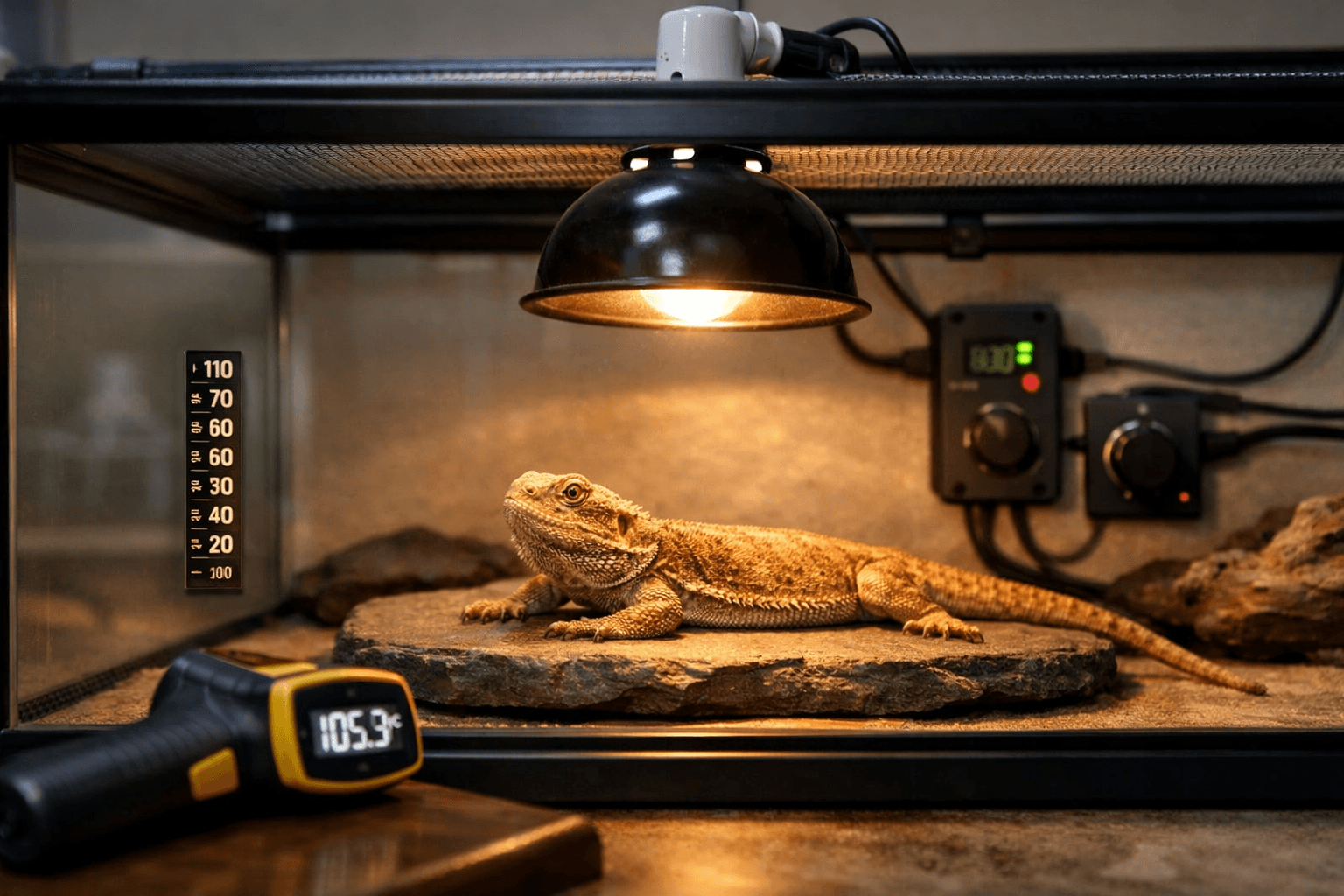
A thermostat is the single most important safety add-on for any heat bulb setup, because it cuts power to the bulb automatically if the basking spot gets too hot, preventing burns and heat stroke. Skipping one is the most common way heat bulb setups go wrong.
Thermostat vs. Rheostat: They’re Not the Same Thing
A rheostat just dims the bulb manually, like a household dimmer switch, which lowers wattage output but does nothing automatically if temps spike from a sunny window or a warm afternoon. A thermostat, by contrast, uses a probe placed at the basking spot to monitor real temperature and cuts or reduces power the instant it crosses your set point.
For safety, a thermostat wins every time. A rheostat can help fine-tune a bulb that’s slightly too strong for the tank, but it should never be the only safeguard on a heat setup, especially for skittish or slow-moving species that can’t easily escape a bulb sitting too close.
What a Basic Thermostat Setup Costs
Budget on/off thermostats run around $25 to $40, while pulse-proportional models that hold temps more precisely run $50 to $80. For a single-bulb setup housing one bearded dragon or water dragon, the budget on/off model is genuinely fine. It won’t hold temps as tight as a proportional unit, but it will absolutely stop a bulb from cooking your animal if the fixture slips closer to the glass or a screen panel goes missing.
Placement of the probe matters as much as the thermostat itself. Put it at the actual basking surface, not taped to the glass or dangling in open air, or you’ll get readings that don’t reflect what your reptile is actually sitting in.
Matching Bulb Wattage to Tank Size and Species Needs
There’s no single wattage number that works across tank sizes, so treat any wattage chart as a rough starting point you’ll adjust with real thermometer readings. The table below gives reasonable starting wattages for common setups, assuming a screen top and average room temp around 72°F.
Tank Size
Species Example
Starting Bulb Wattage
Typical Basking Distance
20 gallon
Leopard gecko (heat only, no basking bulb needed)
40-60W (under-tank preferred)
N/A
40 gallon
Juvenile bearded dragon
75-100W
8-10 inches
75 gallon
Adult bearded dragon
100-150W
10-14 inches
90+ gallon
Chinese water dragon
100-150W (plus humidity control)
10-14 inches
120+ gallon
Adult monitor species
150-250W or mercury vapor
14-24 inches
Notice the leopard gecko row has no basking bulb wattage at all. That’s intentional. Leopard geckos and several other ground-dwelling species do better with belly heat from an under-tank heater than an overhead bulb, since they’re not big baskers the way a bearded dragon is. Using an overhead heat bulb for a species that wants belly heat is a common mismatch that leaves the animal cold where it actually needs warmth.
Species-specific setups vary enough that a general wattage chart can only take you so far; if you’re setting up for a species with unusual needs, like a frilled dragon or a chameleon that wants a steep temperature gradient, looking up a dedicated care guide (petterrarium.com has species-specific heating breakdowns for several of these) will save you a lot of trial and error compared to adapting a generic chart.
Bigger tanks almost always need more wattage than the chart above at first glance, but don’t just crank up the number and walk away. Increase wattage in one step, wait 24 hours, then measure the basking spot again with your temp gun before deciding you need to go even higher.
Common Mistakes That Overheat or Underheat the Tank
Most heat bulb problems trace back to a handful of repeat mistakes, and every one of them is fixable once you know what to look for. None of these require expensive new gear, just better habits.
Assuming Any Heat Bulb Provides UVB
This is the big one. Standard incandescent and halogen basking bulbs produce zero UVB, no matter how bright or warm they run. If your species needs UVB, which includes most diurnal lizards and many tortoises, you need a dedicated UVB tube (usually a T5 HO fluorescent) or a mercury vapor bulb, not just a stronger basking bulb.
Trusting Wattage Without Accounting for Screen Loss
A wattage chart built for a solid-top enclosure will underheat a screen-topped tank of the same size. Always verify with a temp gun after setup, and expect to bump wattage up 20 to 30 percent if you’ve got a full mesh lid versus a partial or solid one.
Running Heat Lamps 24/7
Constant light disrupts natural cycles for feeding, breeding, and general behavior in most reptiles and amphibians. Put daytime bulbs on a timer and use a ceramic heat emitter or red/blue night bulb if nighttime heat is genuinely needed.
Placing Bulbs Too Close Without a Thermostat
A bulb sitting a few inches closer than intended, whether from fixture slippage or a redesigned enclosure layout, can turn a safe 95°F basking spot into a 140°F hazard fast. A thermostat with a probe at the basking surface catches this before it becomes an emergency, while a setup with no thermostat relies entirely on you noticing in time, and that’s a bad bet for an animal that can’t move away fast enough.
Frequently Asked Questions
How often should I replace a reptile heat bulb?
Replace standard incandescent bulbs every 1,000 to 2,000 hours of use, and halogen bulbs closer to 2,000 to 3,000 hours. Mercury vapor bulbs need replacement around 12 months regardless of whether they still light up, since UVB output drops long before the bulb visibly fails.
Can I use a regular household light bulb as a reptile heat lamp?
You can in a pinch for very light heating needs, but dedicated reptile basking bulbs are built to run hotter and more reliably at close range. Standard household LED bulbs in particular produce very little usable heat and won’t create a real basking spot.
Do heat bulbs need to be on at night?
Usually not for daytime bulbs, since running them 24/7 disrupts natural day-night cycles most species need. If nighttime supplemental heat is required because your room runs cold, use a ceramic heat emitter or a deep red/blue night bulb instead of the daytime basking bulb.
What’s the safest distance between a heat bulb and my reptile’s basking spot?
It depends on wattage and bulb type, roughly 6 to 12 inches for standard halogen basking bulbs and 12 to 24 inches for mercury vapor bulbs. Always confirm the actual surface temperature with an infrared thermometer rather than relying on distance guidelines alone.