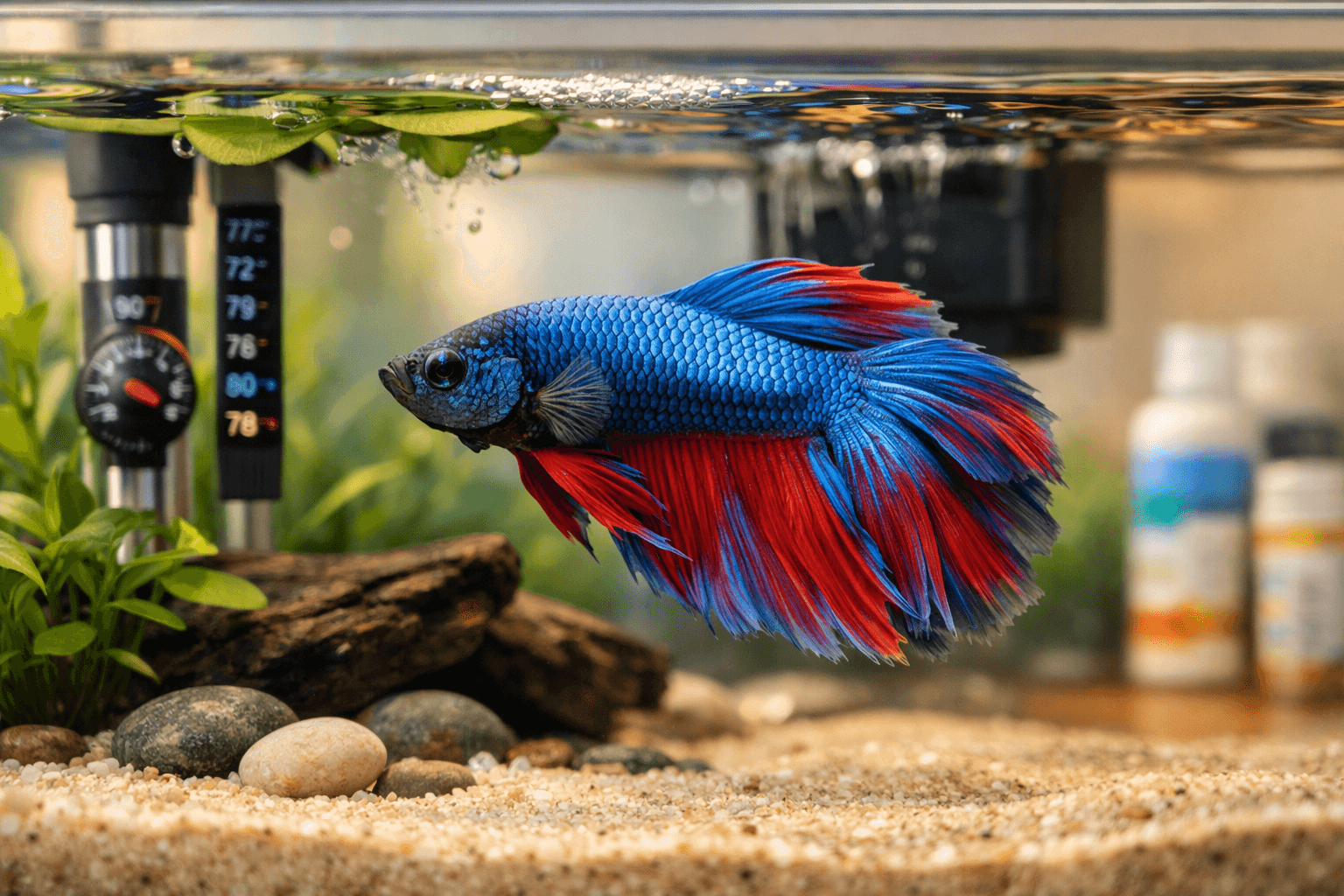
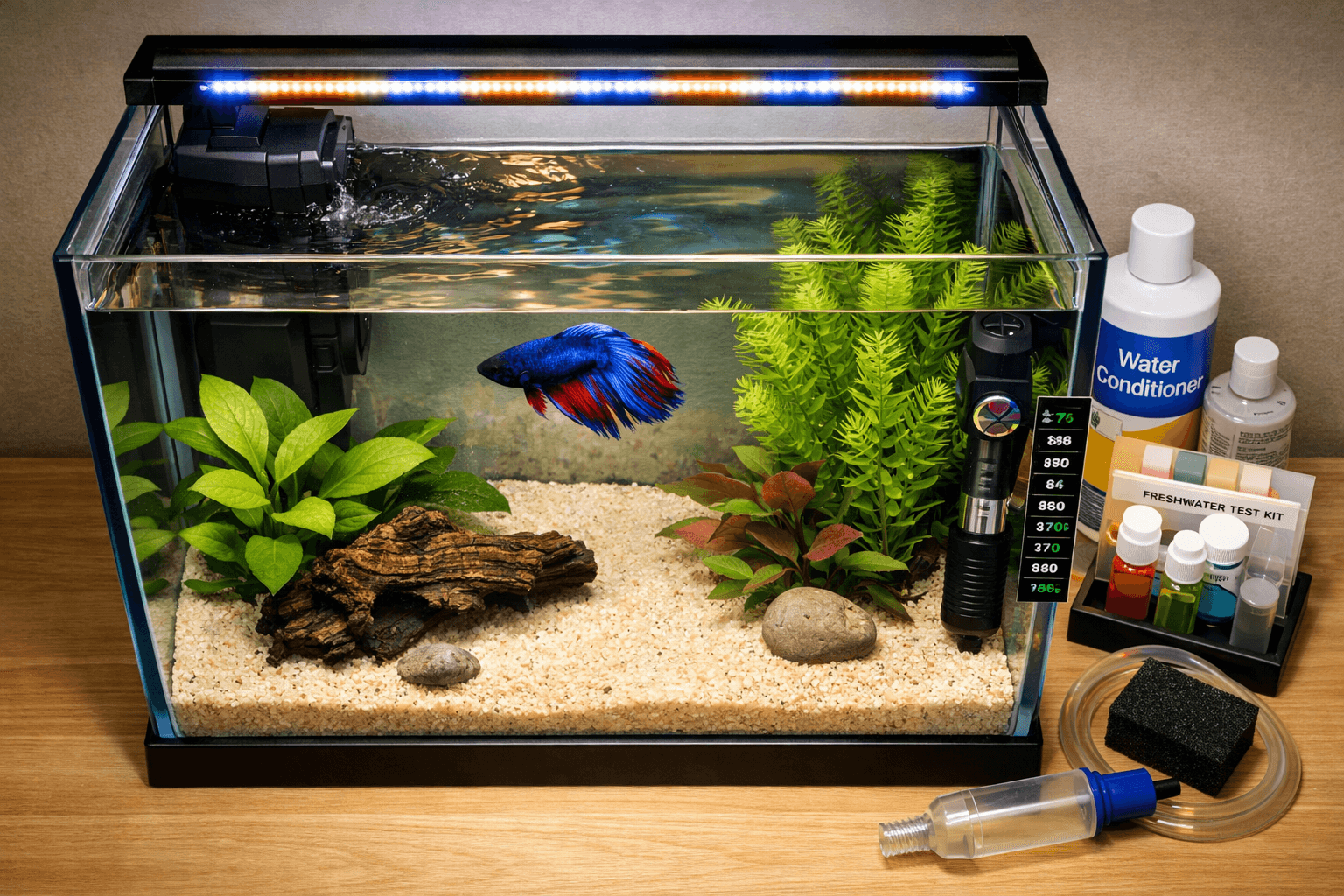
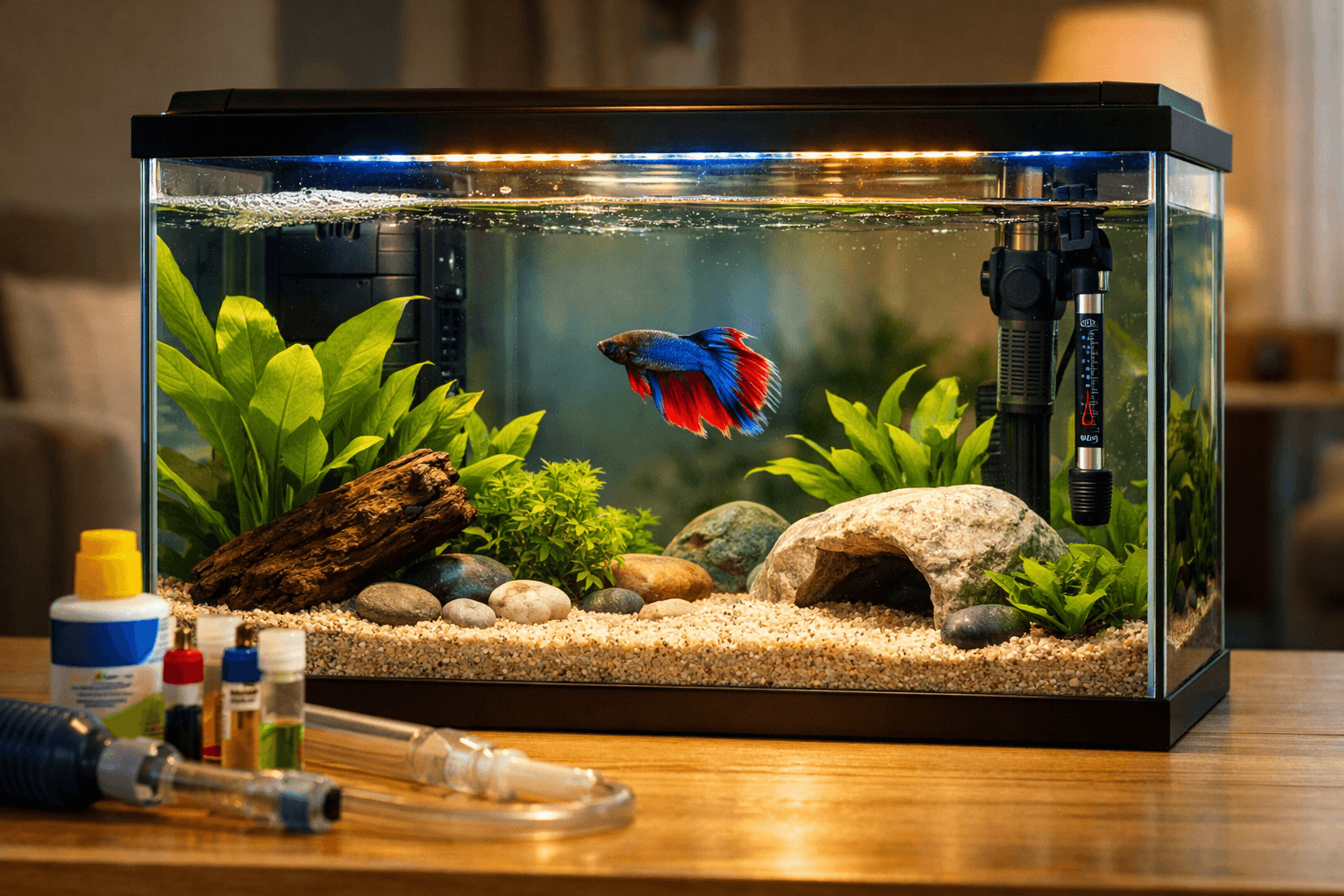
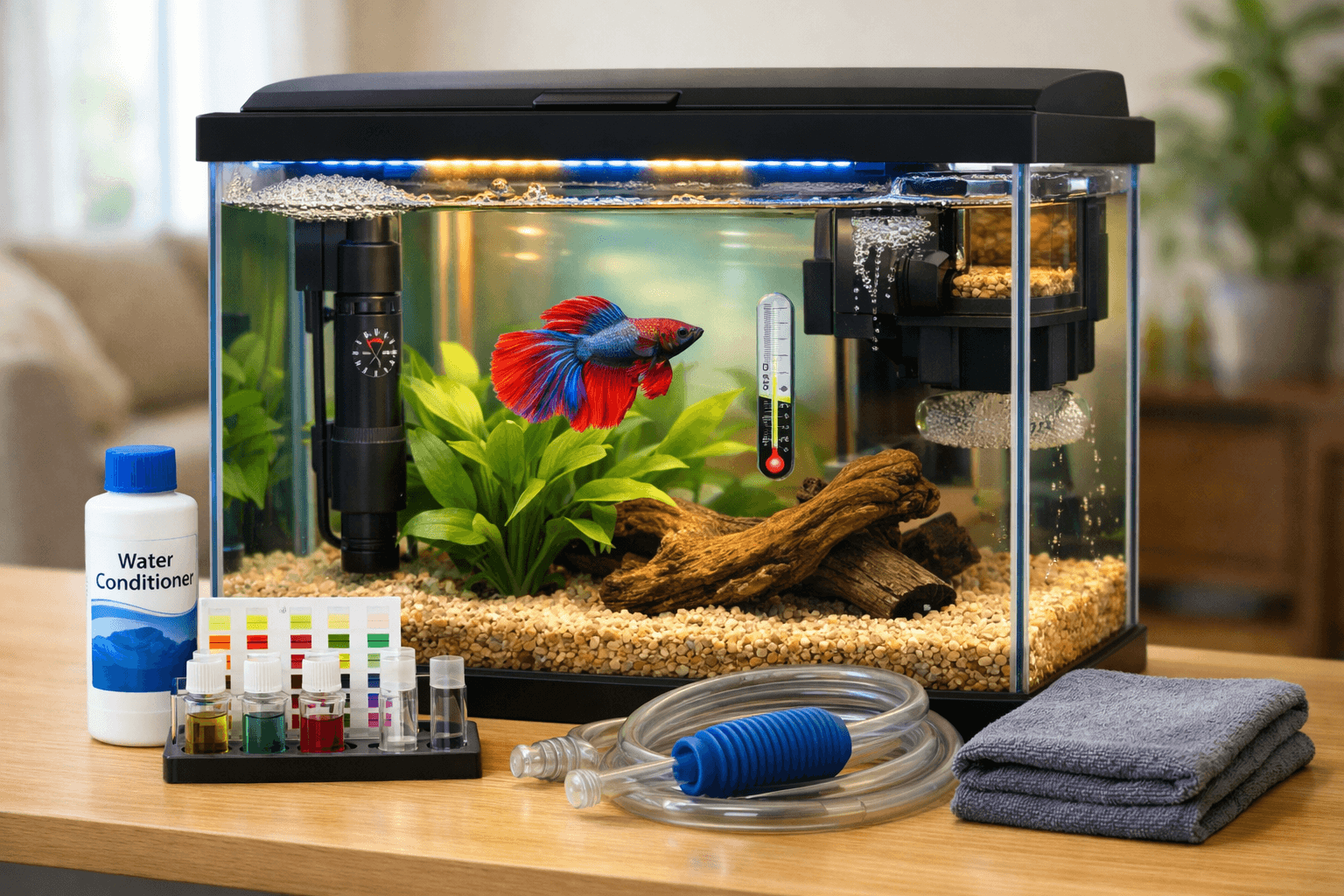
A guy at my local fish store told me a story I can’t shake: he bought a betta for his desk, dropped it in a half-gallon vase with some marbles and a plastic plant, and it died in nine days. He came back convinced bettas were just “fragile fish.” They’re not. He’d built a small, cold, filthy bowl and called it home for a living animal. The real story of an aquarium for betta fish isn’t about pretty decor at all — it’s about water quality, and most of the deaths people blame on bad luck actually trace back to skipping that one step.
If you’re shopping for a betta or you already brought one home in a cup, you’re probably wondering what setup actually keeps them alive and thriving, not just alive for a few weeks. That’s what this guide covers, step by step.
Tank Size: Why 5 Gallons Is the Real Minimum
A betta needs at least a 5-gallon tank, not the 1-gallon bowls sold right next to them in most pet stores. Anything smaller swings in temperature and ammonia too fast for a fish to survive long-term, even if it looks fine for the first few weeks.
I get why the tiny bowls are tempting. They’re cheap, they look tidy on a shelf, and the store display makes it seem normal. But a betta in the wild lives in shallow rice paddies and slow-moving ditches across Thailand, not a sealed glass cup — there’s actual space and turnover of water even in a puddle.
What Size Actually Buys You
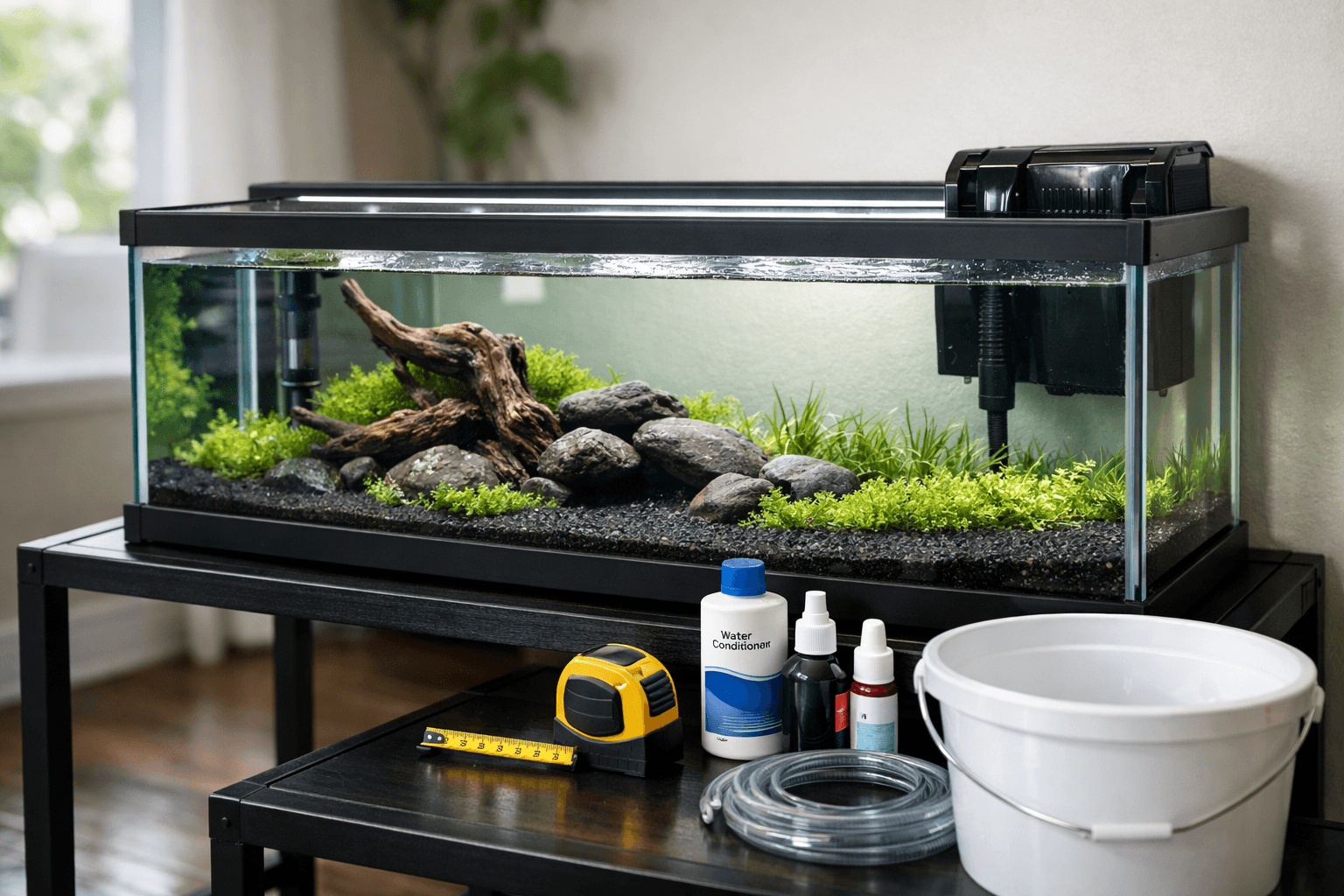
A 5-gallon tank gives you room for a heater, a small filter, plants, and decor without cramming your fish. Bigger is even better: a 10-gallon tank buys you more stable temperature swings and way more forgiveness if you forget a water change for a few days. Ammonia dilutes faster in a larger volume, which is the biggest reason size matters more than people think.
The Bowl Myth, Debunked
The idea that bettas “prefer” tiny spaces because they’re territorial is a myth that got twisted into an excuse for undersized housing. Being territorial toward other bettas has nothing to do with needing less swimming room. In practice, a betta in a proper 5- or 10-gallon setup swims more, builds bubble nests more often, and shows brighter color than one crammed into a bowl.
If you’re deciding between a 5-gallon and a 10-gallon starter kit, go with the 10 if your budget and space allow it. The extra $20 to $40 you’ll spend upfront saves you from an early upgrade six months in.
Heating: Bettas Are Tropical Fish, Not Cold-Tolerant Ones
Bettas need a heater set between 76 and 82°F, and skipping one is one of the most common — and most fatal — mistakes new owners make. The myth that bettas can handle room temperature comes from their labyrinth organ, which lets them breathe surface air, but that has nothing to do with tolerating cold water.
A room that feels comfortable to you, say 68 to 70°F, is genuinely stressful for a betta. Cold water slows their metabolism, weakens their immune system, and makes fin rot and other infections far more likely. This is exactly the “cold-tolerant” myth that quietly kills a lot of desk and dorm-room bettas within the first month.
Picking a Heater That Fits a Small Tank
For a 5-gallon tank, a 25-watt adjustable heater is usually enough. For a 10-gallon, step up to 50 watts. Get one with a built-in thermostat rather than a preset heater — preset units run around 78°F but don’t adjust if your room temperature shifts with the seasons.
Always pair your heater with a separate thermometer, either a stick-on strip or a digital probe. Heaters can fail high or low, and you won’t know until the thermometer tells you.
A Realistic Heating Timeline
Expect to check the temperature daily for the first week after setup, then a couple times a week once you know your heater holds steady. If your house runs cold in winter, don’t be surprised if you need to bump the heater setting up a couple degrees once fall hits.
Filtration and Flow: Gentle Movement, Not a Fin-Shredding Current
Bettas need a filter, but it has to be a low-flow one — strong currents exhaust their long fins and can leave them pinned in a corner, unable to swim against the water. A small sponge filter or an adjustable hang-on-back filter with the flow turned down works best.
This is where a lot of well-meaning owners overcorrect. They read that filtration matters, buy whatever filter came with a starter kit, and end up with a betta that looks permanently tired, hiding behind a plant just to avoid the current.
Filter Types That Actually Work
A sponge filter run off an air pump is close to ideal for a betta tank. It’s gentle, it doesn’t create a strong pull, and it doubles as a home for the beneficial bacteria that keep your water safe. Hang-on-back filters work too, as long as you can adjust the flow rate down or baffle it with a piece of sponge or a plastic bottle redirect.
Choose a sponge filter or an adjustable hang-on-back filter rated for a tank size close to yours.
Turn the flow to its lowest setting on day one.
Watch your betta swim for five minutes — if it’s fighting the current or clinging to decor, turn it down further.
Add a baffle (a piece of foam or a repurposed bottle) if the filter has no adjustable dial.
Recheck flow after any filter cleaning, since some units reset to a higher default.
Why “No Filter at All” Isn’t the Answer Either
Going filterless might seem like the safer choice after hearing about fin damage, but that just trades one problem for a worse one. Without any filtration, waste and ammonia build up fast in a tank this size, and you’re stuck doing near-daily manual cleaning to keep up. A gentle filter plus a normal water change schedule is far less work long-term than a filterless tank ever will be.
The Step Most Guides Skip: Cycling the Tank Before the Fish Goes In
Cycling means growing a colony of beneficial bacteria that convert toxic ammonia into nitrite and then into much less harmful nitrate, and it’s the single biggest factor in whether a new betta survives its first month. Skipping this step kills more bettas than wrong decor, wrong plants, or wrong tank mates combined.
Here’s the problem: most first-time owners set up a tank, let it “settle” overnight, and add the fish the next day. But an empty tank has zero bacteria built up to handle waste. The betta’s own waste becomes the first thing poisoning the water it’s swimming in — a process called new tank syndrome.
Fishless Cycling in Practice
The safest approach is a fishless cycle that runs your tank through the ammonia-to-nitrite-to-nitrate process before your fish ever goes in. You add a small ammonia source, test daily with a liquid test kit, and wait until ammonia and nitrite both read zero and nitrate is present. This usually takes somewhere between 3 and 6 weeks depending on your water and temperature.
If You Already Have the Fish in a Cup
If you’re reading this with a betta already sitting in a store cup, don’t panic and don’t wait 6 weeks to act. Set up your tank, add a bacterial starter product (a bottled live-bacteria supplement), and do a fish-in cycle with small daily water changes and daily ammonia testing. It’s more hands-on for the first two to three weeks, but it keeps the fish safe while the bacteria colony catches up.
Reading Your Test Results
Reading
What It Means
What To Do
Ammonia above 0.25 ppm
Bacteria colony not established yet
Do a 25-50% water change, retest next day
Nitrite above 0 ppm
Cycle in progress, still toxic stage
Water change, keep testing daily
Nitrate present, ammonia and nitrite at 0
Cycle complete
Safe to add fish or resume normal schedule
All three at 0 consistently for a week
Possible test kit issue or tank not cycling
Recheck test kit expiration, consider bacterial starter
A liquid test kit (not the dip strips, which are far less accurate) is worth the $20 to $25 it costs. You’ll use it constantly in the first month and occasionally after that.
Substrate, Plants, and Decor That Protect Betta Fins
Substrate and decor aren’t just about looks — the wrong choices scrape and tear the same delicate fins you’re trying to protect. Smooth gravel or sand works well; anything sharp, like unrinsed crushed coral or rough lava rock, is a real risk for fin damage.
Live plants are worth the small extra effort over fake ones. Java fern, Anubias, and marimo moss balls are hardy, low-light options that also help absorb some of the nitrate your cycle produces. If live plants feel like too much right now, silk plants are a fine substitute — just avoid plastic ones with hard, sharp edges near the leaf tips.
Building In Hiding Spots
Bettas are more confident, and honestly happier-looking, when they have places to retreat. A half of a coconut shell hide, a smooth ceramic cave, or a dense plant cluster all work. Without any cover, a betta tends to sit in one corner looking stressed rather than exploring the tank.
Decor to Avoid
Skip anything with rough seams, sharp plastic edges, or tight tunnels a betta’s fins could snag on when turning around. Fake plants marketed generically as “aquarium plants” without a soft-fabric description are the most common fin-shredders I’d steer people away from. If you can drag a decoration across a piece of nylon stocking and it catches or tears the fabric, it’s too rough for a betta tank.
Lighting, Water Changes, and the Weekly Maintenance Routine
Bettas do fine with 8 to 10 hours of light a day, on a timer if possible, followed by a real dark period at night. Constant light stresses fish out and encourages algae growth you’ll be scrubbing off the glass every week.
Weekly maintenance is where most tanks either thrive or slowly decline. It’s not complicated, but it does need to happen on a schedule rather than “whenever I remember.”
A Realistic Weekly Routine
Test water weekly once your tank is fully cycled (ammonia, nitrite, nitrate, pH).
Change 20-25% of the water weekly, using a dechlorinating water conditioner every time.
Vacuum the substrate lightly during the water change to pull out waste before it breaks down.
Wipe algae off the glass with a scraper or algae pad as needed.
Rinse (never bleach) filter media in old tank water if it looks clogged.
Check the heater and thermometer reading to confirm they still match.
Top off evaporated water between changes with conditioned water at matching temperature.
Why Water Conditioner Isn’t Optional
Tap water almost always contains chlorine or chloramine, both of which are lethal to the bacteria colony you just spent weeks growing and irritating to your betta’s gills directly. A bottle of dechlorinator like the widely sold Seachem Prime or a similar conditioner costs around $10 to $12 and lasts months at the dose a 5- or 10-gallon tank needs. Skipping it, even “just this once,” can wipe out your cycle overnight.
If you want a deeper dive into full aquarium build-outs alongside terrarium setups for other pets, petterrarium.com has additional habitat guides worth browsing once your betta tank is running smoothly.
Tank Mates: Why Most Combinations Fail
The honest answer is that most tank mates fail because people research the tank mate’s needs but not the betta’s aggression triggers. Bettas are territorial, and males in particular will attack anything with bright colors, long fins, or slow movement — which rules out a lot of the “beginner” community fish people assume are safe.
Neon tetras, guppies, and other bright, flowing-finned fish are frequently sold as betta tank mates and frequently end up shredded or dead within days. It’s not guaranteed to go wrong every time, but the risk is real enough that I wouldn’t recommend it to a beginner.
Tank Mates That Actually Have a Shot
Bottom-dwelling, drab-colored, fast fish tend to do better, and even then only in tanks larger than the 5-gallon minimum. Corydoras catfish need a group and a bigger footprint, so they really belong in a 10-gallon or larger setup, not a 5-gallon betta tank. Snails, like nerite or mystery snails, are probably the safest and lowest-risk option for a smaller tank since they don’t trigger the same aggression response.
When to Just Keep It Solo
A solo betta in a well-planted 5-gallon tank isn’t a compromise — it’s often the better outcome. You get to skip the guesswork of aggression, skip the extra bioload that speeds up ammonia buildup, and give your betta the whole space to patrol. If you’re set on a community tank, plan for at least 10 gallons and research each species individually rather than trusting a “betta-safe” label on a bag at the store.
Frequently Asked Questions
Can a betta fish live in a bowl with no filter?
No. A betta needs at least 5 gallons with a heater and gentle filtration. Bowls swing in temperature fast and build up ammonia within days, which is a leading cause of early betta deaths.
How long does it take to cycle a betta tank?
A fishless cycle typically takes 3 to 6 weeks, depending on temperature and your ammonia source. A fish-in cycle with a bacterial starter and daily water changes can protect your betta while the colony establishes faster.
Do bettas need a heater if they’re kept indoors?
Yes, even indoors. Room temperature usually sits below the 76-82°F range bettas need, and consistently cold water weakens their immune system and makes fin rot far more likely.
What fish can live with a betta in a 5-gallon tank?
Realistically, none — 5 gallons is too small for a safe community setup. Snails like nerites work in a pinch, but true tank mates like Corydoras need at least 10 gallons and their own research into aggression risk.