A guy in my local reptile club bought a 20 gallon long tank for what he swore would be a simple community fish tank. Three weeks later, he’d swapped in cypress mulch, a heat lamp, and a pair of fire-bellied toads, because he realized the footprint was perfect for a paludarium and the fish idea just fizzled out. That switch is more common than you’d think, and it’s exactly why picking the right aquarium tank 20 gallon setup from day one matters so much. Whether you end up with fish, frogs, or a mix of land and water, the decisions you make in week one decide how much work you’re doing in month six.
20 Gallon Long vs 20 Gallon High: Why the Shape Changes Everything
A 20 gallon long tank runs about 30 inches by 12 inches by 12 inches tall, while a 20 gallon high is closer to 24 by 12 by 16 inches. Same water volume, completely different usable space, and that difference decides what animals actually thrive in it.
The long tank gives you floor space. That’s gold for bottom-dwelling fish, for turtles that need to walk around, and for anyone building a paludarium where land area matters more than water depth. The high tank gives you vertical room instead, which climbing geckos, tree frogs, and taller planted aquascapes actually need.
Why This Trips People Up
Most online tank charts just say “20 gallon” and move on, treating both shapes as interchangeable. They’re not. A bearded dragon enclosure built on a 20 gallon high frame will feel cramped and tall with no basking runway, while the same footprint in a 20 gallon long gives that lizard room to actually move.
Fish keepers hit the same issue in reverse. A tall, narrow 20 high looks nice on a dresser, but bottom-feeders and schooling fish that want to swim laterally end up boxed in.
Matching Shape to Purpose
Before you buy anything else, decide what’s going in the tank. If it’s fish that swim across open water, go long. If it’s climbing amphibians or arboreal reptiles, go high. Trying to force the wrong animal into the wrong shape is the single most common regret I hear about from first-time 20 gallon owners, right after skipping the nitrogen cycle.
If you’re not sure yet, the long tank is the safer default. It converts more easily into a paludarium later, and it’s easier to find canopy lighting and background decor sized for it.
Filtration: Matching Flow Rate to Real Water Volume
Filtration for a 20 gallon tank needs a filter rated for at least 40 to 60 gallons per hour of turnover if you’re keeping fish, not just something labeled “for 20 gallon tanks” on the box. Manufacturers often size filters to the smallest fish load possible, and that undersells what a fully stocked tank actually needs.
A basic hang-on-back filter, like a mid-range Aqueon or Fluval model rated for 20-40 gallons, works fine for a lightly stocked community tank. But if you’re running a paludarium with a water feature and land area, you’re dealing with less total water volume than a full aquarium, so flow rate calculations change again.
Sizing It Right for Fish-Only Setups
Aim for your filter moving the entire tank volume through it about 4 times per hour. For a true 20-gallon water volume, that’s 80 gallons per hour of rated flow, though many hobbyists get away with less if the tank isn’t heavily stocked. Buying a filter rated for double your tank size is cheap insurance against cloudy water and ammonia spikes.
Canister filters cost more upfront, usually $60 to $120, but they handle bioload better for tanks with messier fish like goldfish or bigger cichlids. Hang-on-back filters run $20 to $40 and are plenty for tetras, guppies, and other light-waste species.
Filtration in Paludarium Conversions
If you’re converting to a paludarium, the water section might only hold 5 to 8 gallons even in a 20 gallon long shell. A small submersible filter rated for 20-30 gallons is often overkill in flow but still worth using for mechanical filtration and to keep the water moving so it doesn’t stagnate near the land area. Don’t skip it just because the water volume looks small on paper — stagnant water in a paludarium grows algae and smells fast.
Cycling Your Tank Before Anything Moves In
The nitrogen cycle takes 4 to 6 weeks to fully establish, and skipping it is the number one reason new fish die within the first two weeks of setup. This isn’t optional, even though it’s the least exciting part of the whole process.
Here’s what’s actually happening: beneficial bacteria need time to colonize your filter media and substrate. Those bacteria convert ammonia (from fish waste and uneaten food) into nitrite, then into far less toxic nitrate. Without that bacteria colony established, ammonia builds up and burns your fish’s gills, which is often fatal within days.
The Fishless Cycling Method
I’d recommend fishless cycling over the old “cycle with a couple of hardy fish” method, since it doesn’t put any animal at risk. Here’s the general process:
Add a source of ammonia — either pure ammonia drops or a small amount of fish food left to decay.
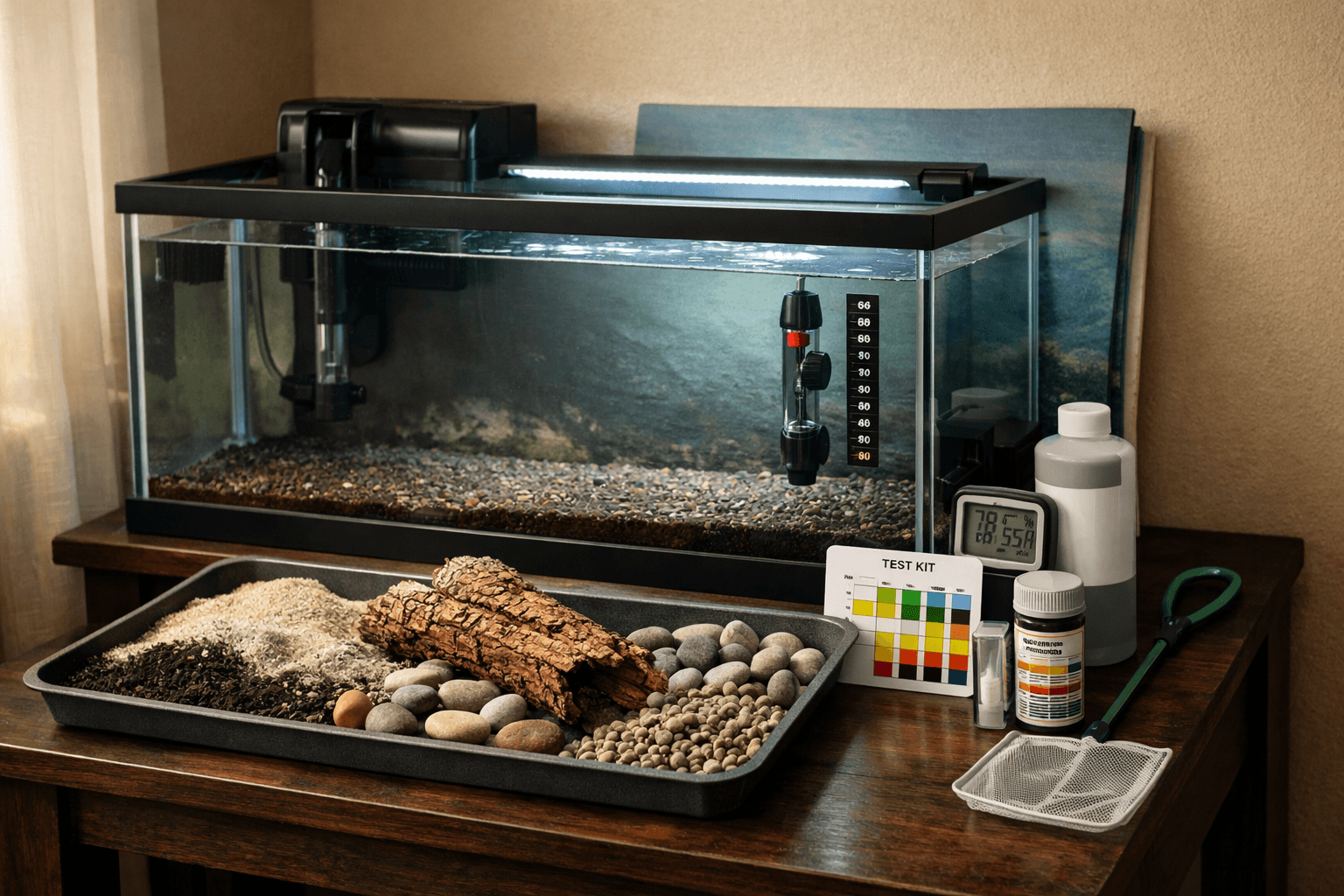
Test water daily using a liquid test kit (the API Freshwater Master Test Kit is a solid, widely-used choice around $25-30).
Watch ammonia rise, then watch nitrite appear as bacteria start converting it.
Keep feeding ammonia until you see nitrite convert to nitrate and ammonia readings drop to zero within 24 hours of dosing.
Once ammonia and nitrite both read zero and nitrate is present, your tank is cycled and ready for fish.
Speeding Things Up Without Cutting Corners
You can cut cycling time down to roughly 2 weeks by seeding your new filter with media, gravel, or a filter sponge from an already-established tank. This transfers existing bacteria colonies directly instead of waiting for them to grow from scratch. Bottled bacteria starters exist too, but results vary — treat them as a boost, not a replacement for testing.
If you’re setting up a terrarium or paludarium instead of a fish tank, you still want a mini version of this process for the water feature, just with lower stakes since there’s no fish waiting to get poisoned by ammonia spikes.
Substrate Choices That Match Your Tank’s Purpose
Substrate isn’t just decoration — it affects water chemistry, plant growth, and (in a paludarium) humidity levels for your animals. The right choice depends entirely on what’s living in the tank.
For a standard fish-only setup, plain gravel or sand both work, and neither is objectively better. Gravel is easier for beginners to vacuum during water changes; sand looks more natural and suits bottom-dwelling species like corydoras catfish that like to sift through it.
Planted Tank Substrates
If you want live plants doing real work in your nitrogen cycle, a nutrient-rich substrate like Fluval Stratum or a basic aquasoil layered under gravel gives roots something to feed on. Expect to pay $15-25 for enough substrate to cover a 20 gallon long tank at a 2-inch depth. Skipping this and using bare gravel with root-feeding plants usually means stunted growth and a lot of frustration by month two.
Substrate for Terrarium and Paludarium Conversions
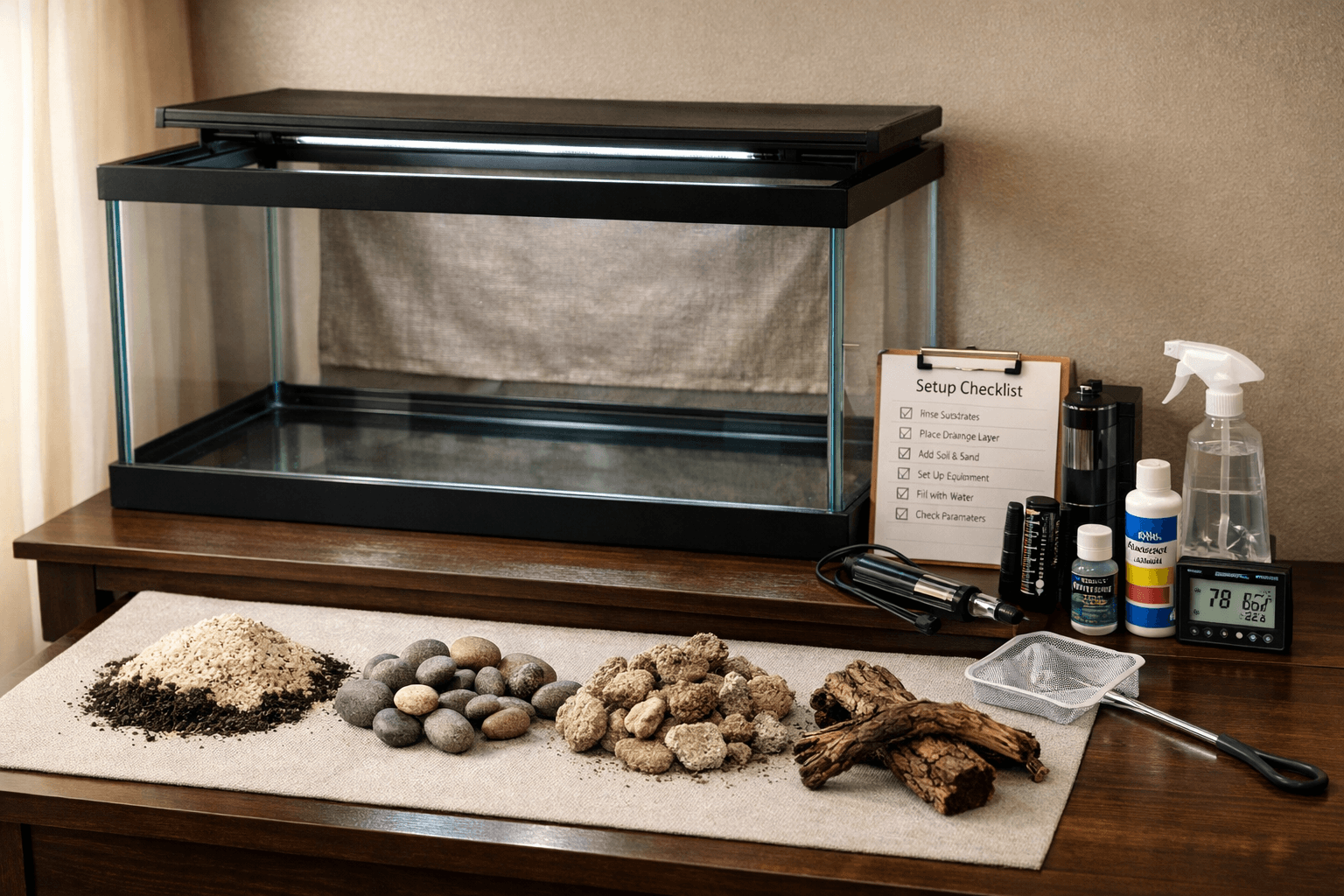
This is where things get more interesting, and it’s the part most standard aquarium guides skip entirely. Converting your 20 gallon into a paludarium means building substrate in layers: a drainage layer of hydroballs or lava rock at the bottom, a mesh barrier, then a soil and sphagnum moss mix on top for the land area. Cypress mulch or coconut fiber (coco coir) works well for the terrestrial zone and holds humidity without turning swampy.
Reptile and amphibian keepers converting tanks this way should budget for substrate differently than fish keepers do — you’re building a two-zone system, not filling a box with gravel. Expect to spend $25-40 total on substrate layers for a full paludarium conversion in a 20 gallon long shell, plus the moss and any leaf litter you add for cover.
Heating, Lighting, and Thermostats: What Actually Needs Control
A 20 gallon tank almost always needs a heater, and it definitely needs a thermostat if you’re keeping tropical fish or reptiles with specific temperature needs. Guessing at temperature with no controller is how you end up cooking or freezing your animals without realizing it for days.
For tropical fish, a 50-100 watt submersible heater with a built-in thermostat, like common Eheim or Fluval models, keeps water in the 75-80°F range most tropical species need. Cheaper heaters without adjustable thermostats exist, but they’re a gamble — I’d skip them for anything more delicate than goldfish, which prefer cooler, unheated water anyway.
Terrarium and Paludarium Heating Needs
Reptile and amphibian setups need a completely different heating approach. Instead of submersible water heaters, you’re looking at overhead heat lamps or under-tank heating pads paired with an external thermostat, like a Herpstat or Vivosun controller, to prevent overheating. Basking reptiles like anoles or small geckos need a temperature gradient across the tank, not one uniform temperature, so placement of the heat source matters as much as its wattage.
Lighting Requirements by Setup Type
Lighting needs vary a lot depending on what’s living in the tank:
Setup Type
Light Type
Daily Duration
Approx. Cost
Fish-only, no plants
Basic LED hood
8-10 hours
$15-30
Planted aquarium
Full-spectrum aquarium LED
8-10 hours
$40-90
Paludarium (frogs/plants)
Full-spectrum LED + UVB
10-12 hours
$50-100
Reptile terrarium
UVB fluorescent + basking bulb
10-12 hours
$40-80
Plants and reptiles both generally need something in the UVB or full-spectrum range, while a fish-only tank with no live plants can get away with basic LED lighting meant mostly for viewing. Don’t buy a $15 LED strip and expect live plants or a UVB-dependent gecko to do well under it — that mismatch shows up as leggy plants or a reptile with metabolic bone disease months down the line.
Stocking the Tank: Matching Species to Space, Not Just Gallons
Gallon size alone doesn’t tell you what a species needs — behavior, adult size, and territory matter just as much. A 20 gallon tank sounds like plenty of room until you realize some fish need horizontal swimming space no matter how “small” they are.
Overstocking based purely on the “one inch of fish per gallon” rule is one of the most common mistakes I see, and it ignores that a fish’s behavior matters more than its length. A single oscar cichlid outgrows a 20 gallon tank fast even though it “fits” the math on paper, while a school of ten neon tetras barely makes a dent in the same space.
Good Fish Choices for a 20 Gallon Long
The long shape’s extra floor space suits active swimmers and bottom dwellers well. A community of neon tetras, a small school of harlequin rasboras, a pair of dwarf gouramis, and a few corydoras catfish for the bottom make a balanced, non-aggressive setup. Avoid mixing in anything territorial like larger cichlids — the floor space that’s great for peaceful community fish becomes a turf war with aggressive species.
Good Choices for a 20 Gallon High
The vertical space suits fish that use the whole water column, like pearl gouramis or angelfish when young (though angelfish outgrow a 20 high within a year or two and need upgrading). For non-fish setups, a 20 high works well for dart frogs, anoles, or small arboreal geckos that want branches and vertical climbing room more than floor space.
Reptile and Amphibian Stocking Notes
If you’ve converted your tank into a terrarium or paludarium, stocking decisions shift to individual animal needs rather than gallon math entirely. A pair of fire-bellied toads does fine in a well-built 20 gallon paludarium, while something like a full-grown bearded dragon needs closer to 40 gallons minimum and will outgrow a 20 gallon shell within its first year. Always check adult size projections before committing — buying the tank for a juvenile animal’s current size is a setup for a rehoming problem down the road.
Placement, Weight, and the Furniture Mistake Everyone Makes Once
A filled 20 gallon tank weighs roughly 225 pounds once you count water, substrate, glass, and decor — water alone is about 8.3 pounds per gallon, so 20 gallons of water is already 166 pounds before anything else. That weight is exactly why placing a tank on a random dresser or bookshelf is risky, even if the furniture looks sturdy.
Regular furniture isn’t built to hold that much weight in one concentrated footprint for months or years at a time. Wood can warp, particleboard can sag, and in the worst cases, furniture legs buckle and the whole tank goes down. This isn’t a rare fluke story — it’s a predictable outcome of physics that a lot of new hobbyists don’t think through until it’s too late.
What to Actually Put It On
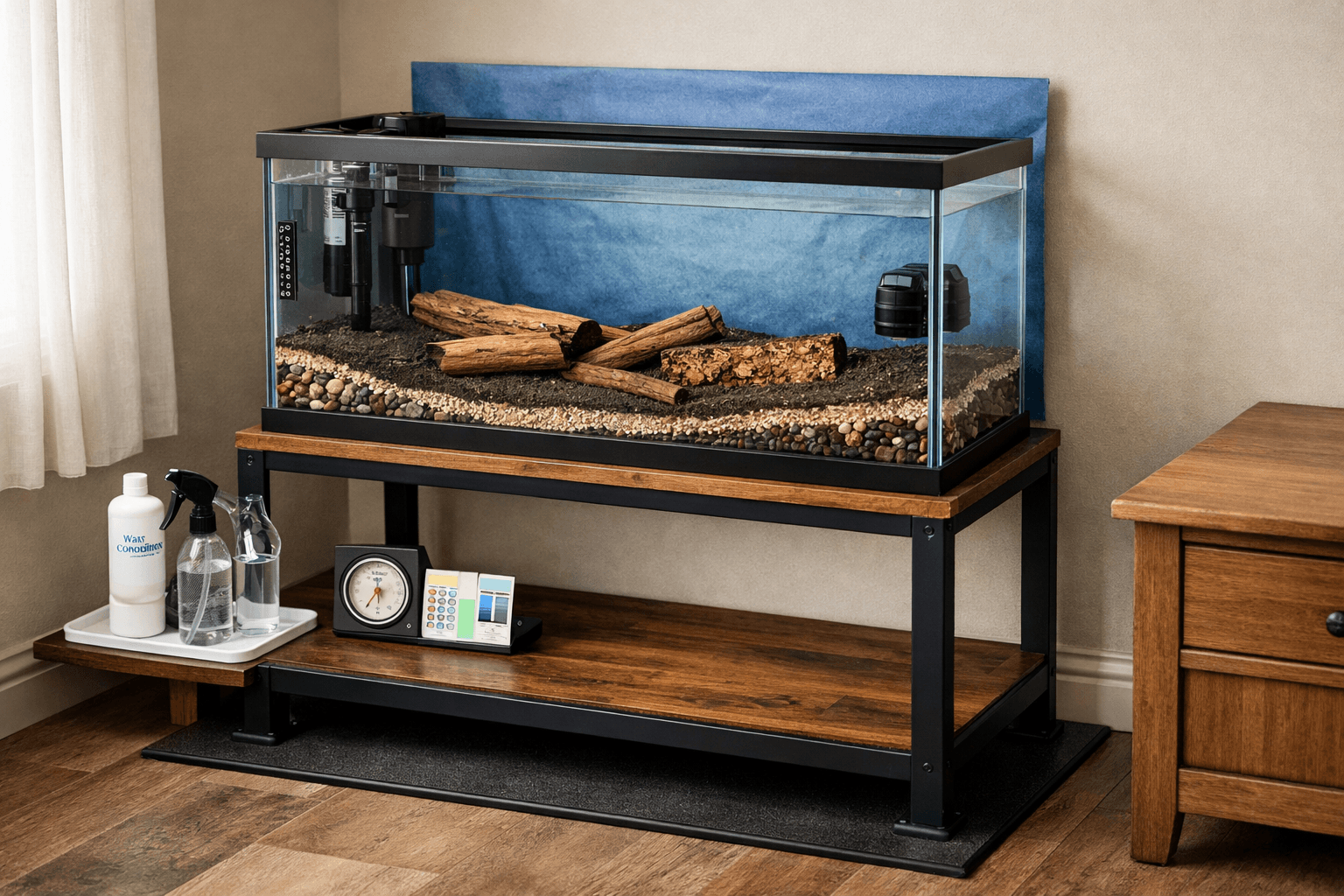
A dedicated aquarium stand rated for at least 250 pounds is the safe move, and most manufacturers rate their stands specifically for the tank sizes they’re sold alongside. Stands built for 20-40 gallon tanks typically run $60-150 depending on material — metal stands tend to be sturdier than particleboard ones for the same price range.
Location Matters Beyond Weight
Skip spots near windows, since direct sunlight fuels algae blooms in aquariums and creates uneven heat swings in terrariums. Also avoid high-traffic areas where the tank gets bumped constantly, and keep it away from heating vents or drafty doors that mess with your thermostat’s accuracy. A quiet corner near an outlet, away from direct sun, is close to ideal for almost any 20 gallon setup.
Water Testing, Maintenance, and Long-Term Upkeep
Weekly maintenance for a 20 gallon tank generally means testing water parameters, doing a partial water change, and checking your equipment — a routine that takes maybe 20-30 minutes once you’ve got a rhythm going. Skipping this for weeks at a time is how small problems turn into dead fish or crashed paludarium ecosystems.
Testing Routine
Test ammonia, nitrite, nitrate, and pH weekly for the first two to three months after cycling, then you can usually stretch to every other week once things stabilize. A liquid test kit beats test strips for accuracy — strips are faster but notoriously imprecise, especially for ammonia and nitrite readings that matter most.
Weekly and Monthly Tasks
Here’s a general breakdown of what upkeep actually looks like over time:
Weekly: test water parameters and do a 10-20% water change using a gravel vacuum or siphon.
Weekly: wipe algae off the glass and check filter flow isn’t clogged or slowed.
Monthly: rinse (don’t fully replace) filter media in old tank water to preserve bacteria colonies.
Monthly: inspect heater and thermostat calibration with a separate thermometer to confirm accuracy.
Quarterly: deep-clean substrate in gravel setups, or check drainage layer function in paludariums.
Paludarium-Specific Maintenance
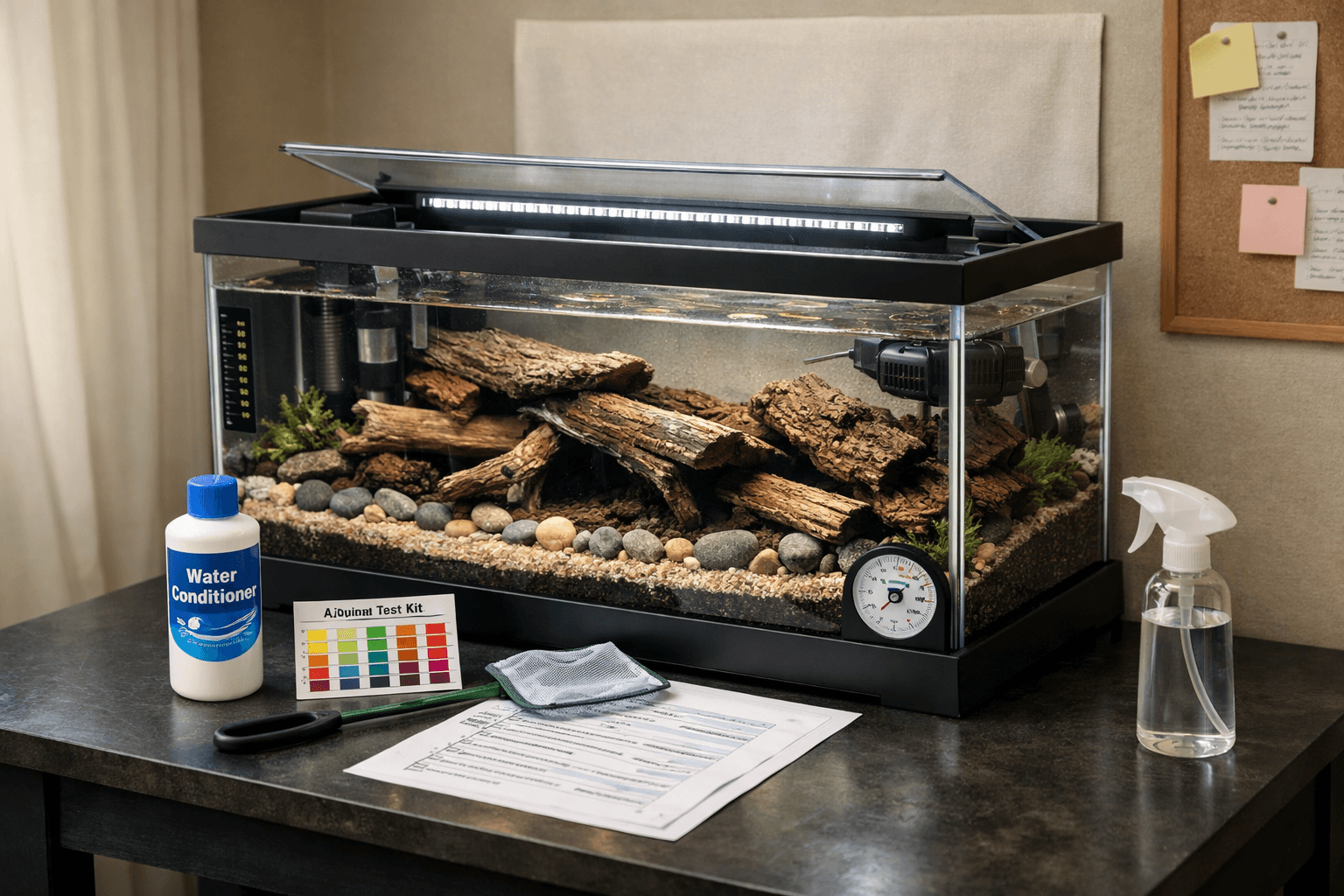
Paludariums need an added layer of attention: check humidity levels with a hygrometer, watch for mold growth on the substrate’s terrestrial side, and make sure the drainage layer isn’t backing up and flooding the land area. Sites like petterrarium.com run detailed build guides for these conversions if you want a walkthrough of the layered substrate and drainage setup before you commit to tearing down a fish tank to build one.
Decor, Hiding Spots, and Turning a Tank Into a Real Habitat
Decor isn’t just about looks — hiding spots reduce stress for both fish and reptiles, and stressed animals get sick more often. A bare tank with nothing to hide in keeps prey-driven species like small fish or frogs in a constant state of alert, which wears them down over time.
For fish tanks, driftwood, rock caves, and dense plant clusters (real or silk) give shy species somewhere to retreat. Corydoras and other bottom fish especially appreciate caves or overhangs they can dart under when startled.
For terrarium and paludarium builds, cork bark rounds, leaf litter, and layered branches create both hiding spots and usable climbing routes. Vertical décor matters more than most beginners expect in a 20 gallon high paludarium — a single well-placed branch can double as a basking spot, a hide, and a visual barrier between two shy animals sharing the same space.
Whatever direction you go, resist the urge to over-decorate on day one. Adding a few solid pieces first and building out gradually lets you see how your animals actually use the space, instead of guessing and rearranging a cluttered tank later.
Frequently Asked Questions
How many gallons of water does a 20 gallon tank actually hold once substrate and decor are added?
Usually closer to 16-18 gallons of actual water once substrate, rocks, and decor take up displacement. This matters for filtration sizing and medication dosing, where exact water volume changes the math.
Can I put a 20 gallon tank on a regular table or dresser?
No — a filled 20 gallon tank weighs around 225 pounds, and most household furniture isn’t rated to hold that safely long-term. Use a stand rated for at least 250 pounds instead.
Is a 20 gallon long or 20 gallon high better for a paludarium conversion?
The 20 gallon long is generally the better choice, since it gives more floor space to split between water and land zones. The high tank works better only if your species needs more vertical climbing room than land area.
How long should I wait before adding fish to a new tank?
Wait until your nitrogen cycle fully completes, which usually takes 4-6 weeks, or about 2 weeks if you seed the filter with established bacteria. Adding fish before ammonia and nitrite both read zero is the most common cause of early fish deaths.