The sea bunny (Jorunna parva) is a real animal, a tiny sea slug in a group called dorid nudibranchs. It lives in coastal Indo-Pacific waters, mainly around Japan, and grazes on sponges. It stores their toxins for defense. It lives about a year at most, so you cannot keep a sea bunny as a pet. Here is what it does in the wild, and what you can do instead.
Sea Bunny Quick Facts
Here is the short version, so you can grab what you need and go.
Fact
Answer
Scientific name
Jorunna parva
Type of animal
Dorid nudibranch (a sea slug)
Size
About 1 inch (2.5 cm)
Range
Coastal Indo-Pacific, mainly the western Pacific near Japan
Diet
Mostly toxic sponges
Lifespan
A few months to about a year
Safe to touch?
No
Pet?
No
What Is a Nudibranch?
Nudibranch means “naked gills.” These are sea slugs that lose their shell as they grow up. There are around 3,000 known kinds, and the sea bunny sits in the family Discodorididae.
Other Names
The animal’s older English name is the peppercorn velvet dorid. Japanese speakers call it the spotted velvet sea slug. The cute “sea bunny” nickname took over after it went viral online in 2015.
Are Sea Bunnies Real or AI?
They are real. Photos of fluffy white sea bunnies with black “ears” are not fakes, and the animal is not a rabbit or any kind of mammal. A Japanese marine biologist, Kikutaro Baba, formally described the species in 1938.
Some AI images do exist, and they often make sea bunnies look bigger or fluffier than they are. A real one is tiny. If a photo shows one sitting in a human palm like a hamster, be suspicious.
Why the Photos Look So Good
Real photos come from macro lenses, which are made to shoot very small things up close. A sea bunny is about an inch long, so a macro shot makes it look like a plush toy. That is a trick of the camera, not a trick of the computer.
Pop Culture
The animal now shows up in games, plush toys and anime. Japanese folklore links rabbits to the moon, and that helped the name stick. One recent example is the character Fushi in Cosmic Princess Kaguya!, a moon-themed design with rabbit touches.
What a Sea Bunny Looks Like (and What the “Ears” Really Are)
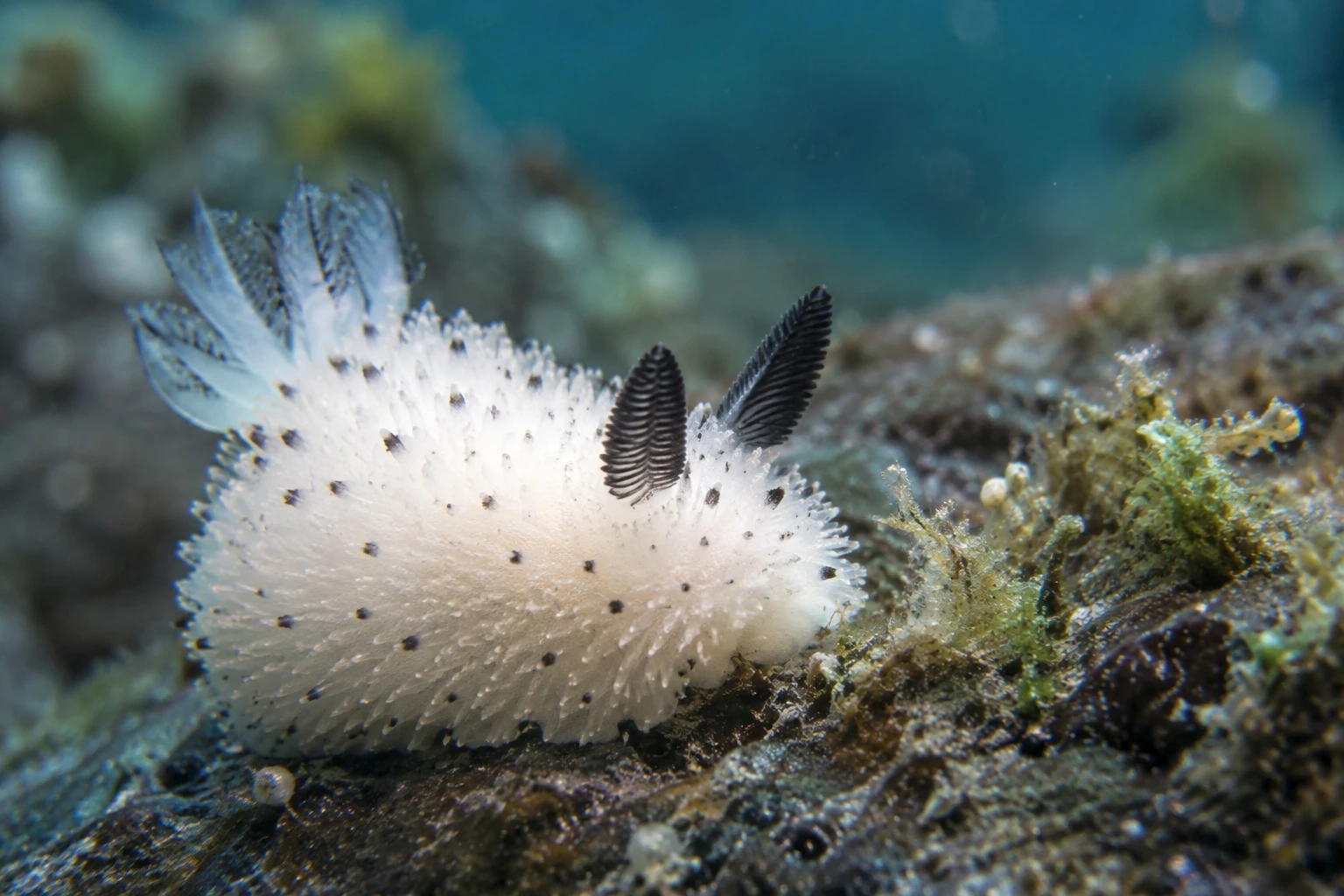
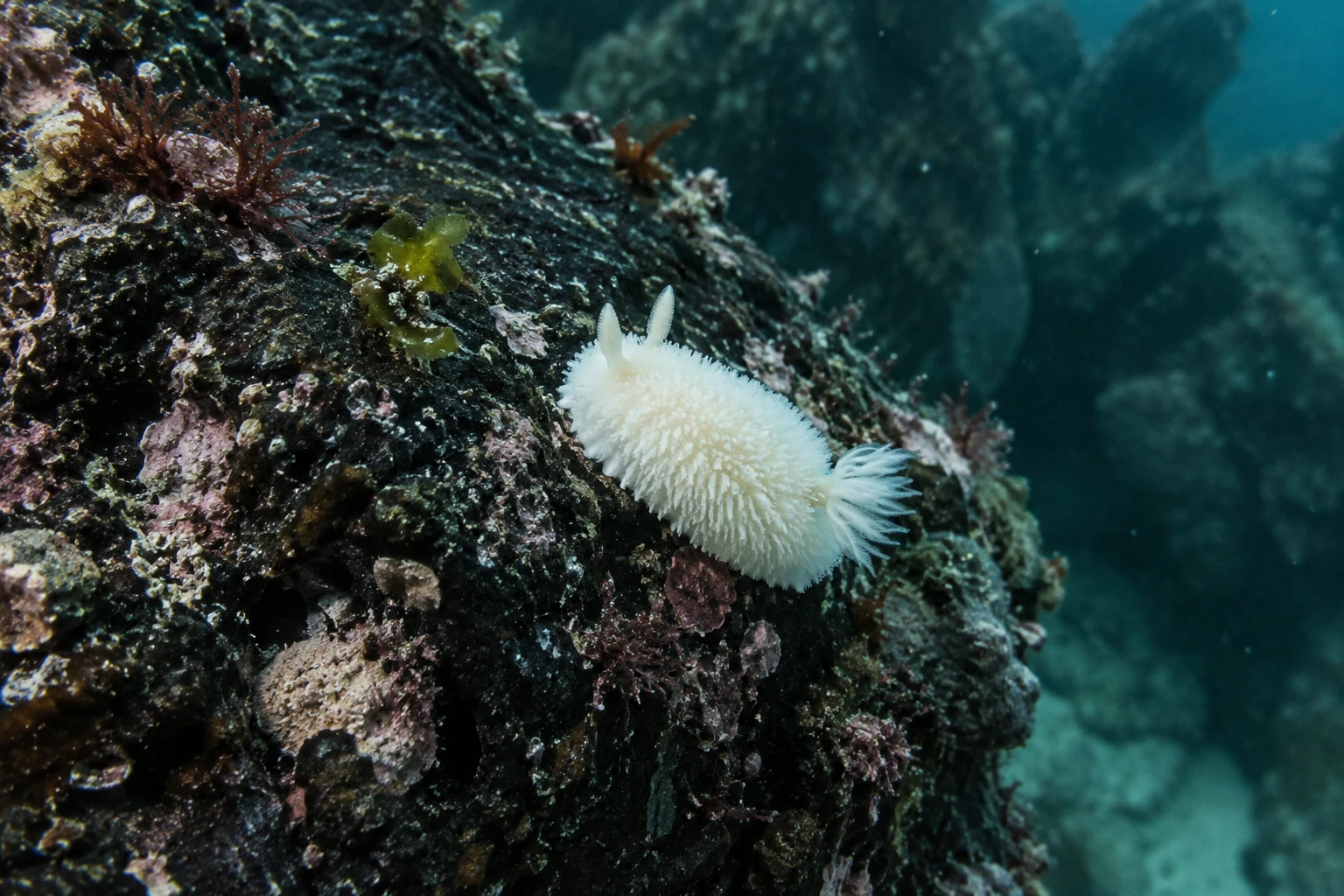
Almost every cute feature on a sea bunny is something else. The body is usually white, but it can be yellow, orange or brown. Adults reach about 1 inch (2.5 cm), so one could sit on your thumbnail.
The “Fur”
It is not fur. The coat is made of small rods called caryophyllidia, and they are thought to help the slug sense its surroundings. Black specks sit between them, which gives the spotted look. Scientists are not fully sure of their job, but a sensory role is the leading idea.
The “Ears”
Those are rhinophores, organs that taste and smell chemicals in the water. They are fuzzy, which gives them more surface to catch scents. That matters because a sea bunny moves slowly and needs to find food and mates from a distance. The tips are often black.
The “Tail”
The fluffy tuft at the back is the gill. In this group of slugs, the gills can pull back into the body. Sea bunny gills can be black and white, or all black.
Pro tip: if you see a picture with long floppy ears or a real tail, you are looking at an edited image or a different animal.
Habitat and Range: Where Sea Bunnies Live
Sea bunnies live in shallow coastal water, close to their food. The species was first described from Kii Province, Japan, and divers still report it most often off the Japanese coast. It has also been recorded in the Philippines, Australia, Papua New Guinea, Tanzania, the Seychelles and Réunion.
They stay near sponges. A sea bunny does not roam an open reef. It spends most of its time on the bottom, often clinging to rock or plants where its food grows. Where there are no sponges, there are no sea bunnies.
Some of those far-flung records may not be the same animal. Scientists suspect Jorunna parva could be a group of look-alike species. That means a “sea bunny” photo from Africa may be a close cousin.
Sea bunnies also blend in. Many nudibranchs take on the color of what they eat, so one living on a pale sponge looks pale, and one on a yellow sponge can look yellow. That is why you see both white and yellow ones online.
Can you see one in the US? Not in local waters. You would need to dive in the western Pacific. Plenty of other nudibranchs live off California and Florida, though, and we cover those below.
What Sea Bunnies Eat and Why It Makes Them Toxic
A sea bunny eats sponges, mostly toxic ones in the family Chalinidae. It scrapes them with a ribbon of tiny teeth called a radula. It does not eat algae pellets, flakes or generic fish food.
It may also nibble algae, seagrass, or small animals like other sea slugs and snails. But sponges make up most of the menu. That narrow diet is the whole reason this animal is so hard to care for.
Stealing the Poison
Sea bunnies do not make their own toxins. They take them from the sponges and store them in their body tissue. This is called sequestration. It turns lunch into armor.
Color as a Warning
Bright colors often warn predators, “I taste awful.” Sea bunnies also soak up pigment from food, so their color follows their diet. Most predators learn to stay away.
Is It Safe to Touch a Sea Bunny?
No, don’t touch one. The risk to people is low compared with stonefish or blue-ringed octopuses, but the stored toxins can still irritate skin. Handling also harms the slug. Its body is soft and tiny, and oils and sunscreen on your hands can damage it.
So are sea bunnies poisonous? Strictly speaking, they are toxic, meaning harmful if eaten or handled, rather than venomous, which means injecting poison. They have no stinger or bite. The danger comes from what they carry.
Some nudibranchs even keep stinging cells from jellyfish they eat. Sea bunnies mainly use sponge chemicals, but the safe rule is the same for every sea slug. Look, don’t touch.
What About Predators?
The toxins help, but they do not make a sea bunny safe. Cone snails, crabs, sea hares and other nudibranchs all eat them. If attacked, a sea bunny may drop a piece of its own mantle (the soft outer body) to distract the predator and get away.
Life Cycle: One Year, Two Parents, Egg Ribbons
A sea bunny lives from a few months to about a year. That short clock shapes everything about its life. It has to find a mate fast, and its sensitive rhinophores do that job.
Sea bunnies are hermaphrodites. Each one has both male and female parts, but it cannot fertilize its own eggs. When two meet, they mate, and both can lay eggs afterward. Some sea slugs in this group use small hook-like parts during mating.
Two sea bunnies find each other by scent.
They mate and swap sperm.
Each one lays eggs in a ribbon-like sheet.
The eggs hatch in about three weeks.
The larvae swim freely and have a tiny shell.
They shed the shell, change shape, and settle as young sea slugs.
That swimming stage is why sea slugs spread across a coast. It is also why they are so hard to breed at home, since the young need the right food when they settle.
Why You Can’t Keep a Sea Bunny in an Aquarium
A sea bunny fails in captivity for three main reasons: it needs live toxic sponges, it only lives about a year, and collecting it harms wild populations. Even expert aquarists struggle with sponge-eating nudibranchs. Most starve within weeks.
The Diet Problem
You cannot buy the right sponge at a pet store. Sponges are hard to keep alive in a tank, and the specific kind this slug eats is harder still. Without it, the slug starves. No pellet or frozen food replaces it.
The Lifespan Problem
Even in perfect conditions, you would get months, not years. A animal that dies naturally within a year cannot be a long-term pet. You would likely watch it fade as its food ran out.
The Water and Supply Problem
Nudibranchs react badly to swings in temperature and water quality. They are also sensitive to copper, which some reef medications contain. And because wild populations are small and local, taking them is not a sustainable hobby.
We also don’t recommend buying one from a seller who says it is “easy.” It is not. The same goes for any viral sea creature sold online.
What to Do Instead: Ethical Ways to Enjoy Sea Bunnies
You can still get close to sea bunnies without owning one. Pick one of these routes.
See One in the Wild
Book a dive trip to Japan, the Philippines or Australia and ask for a macro guide. Dive operators know where nudibranchs sit. Bring a macro lens or a phone housing. Keep your fins up and your hands off the reef.
Try Hardier Invertebrates
If you want a small, interesting tank animal, pick one that actually thrives in captivity. Good options include:
Hermit crabs for a reef tank
Cleaner shrimp
Snails that eat algae
Starfish, with the right research first
Each needs its own setup, so read up on its needs before you buy.
Look at Other Nudibranchs Locally
Divers off California, Florida and the Pacific Northwest see colorful nudibranchs all the time. Aquariums like Monterey Bay Aquarium show sea slugs and other small invertebrates in well-run exhibits. That is the best way to see them up close in the US.
If you are planning your first saltwater or terrarium setup, the care guides at Pet Terrarium cover species that do well at home.
Pro tip: if you photograph a sea bunny in the wild, don’t use flash at close range and don’t move it for a better shot.
Frequently Asked Questions
What is the habitat of a sea bunny?
Sea bunnies live in shallow coastal waters of the Indo-Pacific, mostly around Japan. They stay on or near the sponges they eat. Reports also come from the Philippines, Australia and parts of East Africa.
What does a sea bunny eat?
A sea bunny mainly eats toxic sponges. It stores those toxins in its body for defense. It may also eat algae or tiny animals, but sponges make up most of its diet.
Are sea bunnies poisonous, and is it okay to touch one?
They are toxic, not venomous, and you should not touch them. The risk to people is low, but stored toxins can irritate skin. Touching can also injure the slug.
Can you keep a sea bunny as a pet?
No. Sea bunnies need live toxic sponges, live only about a year, and rarely survive in tanks. The best way to enjoy one is to see it in the wild or in a photo.