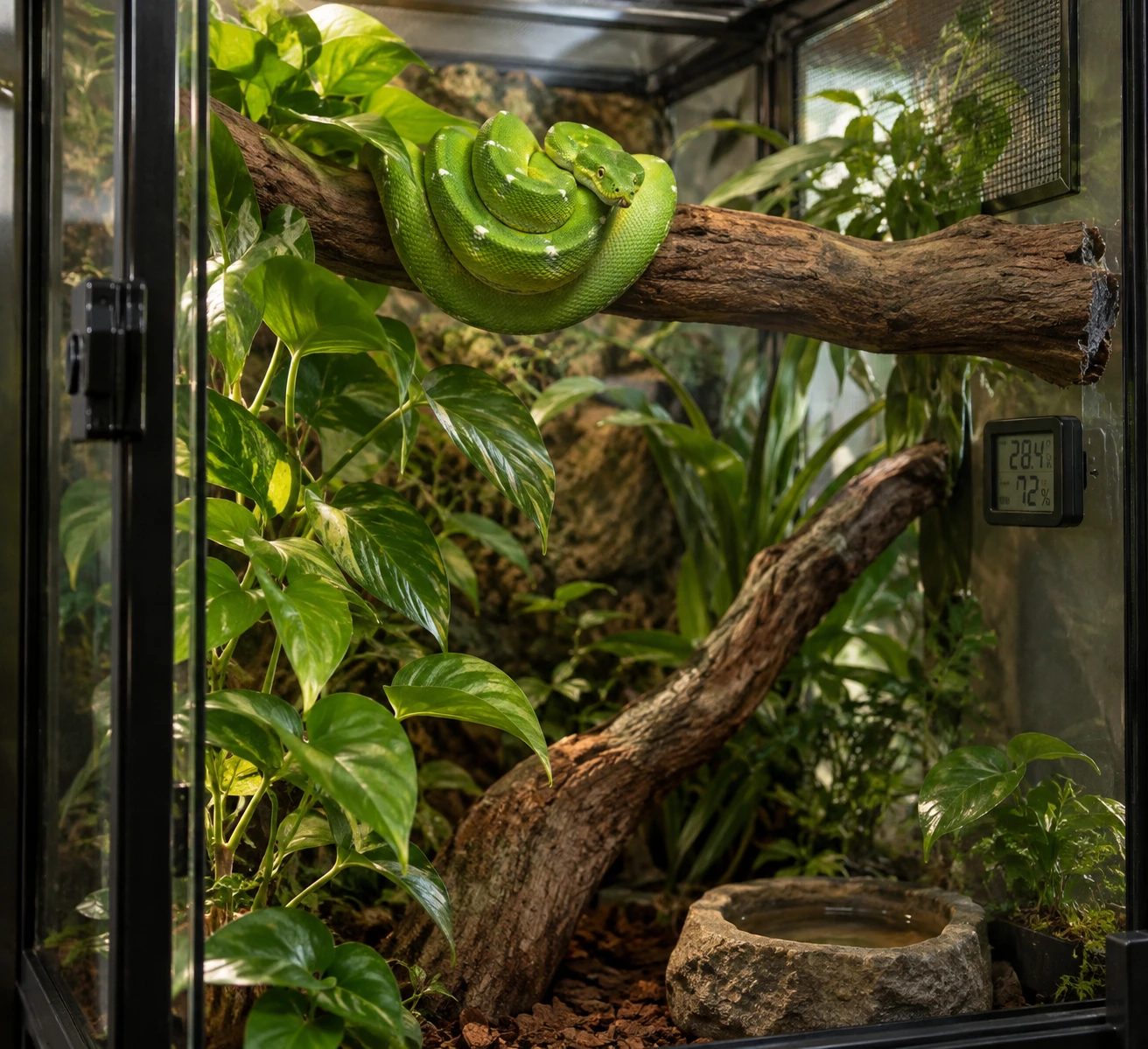
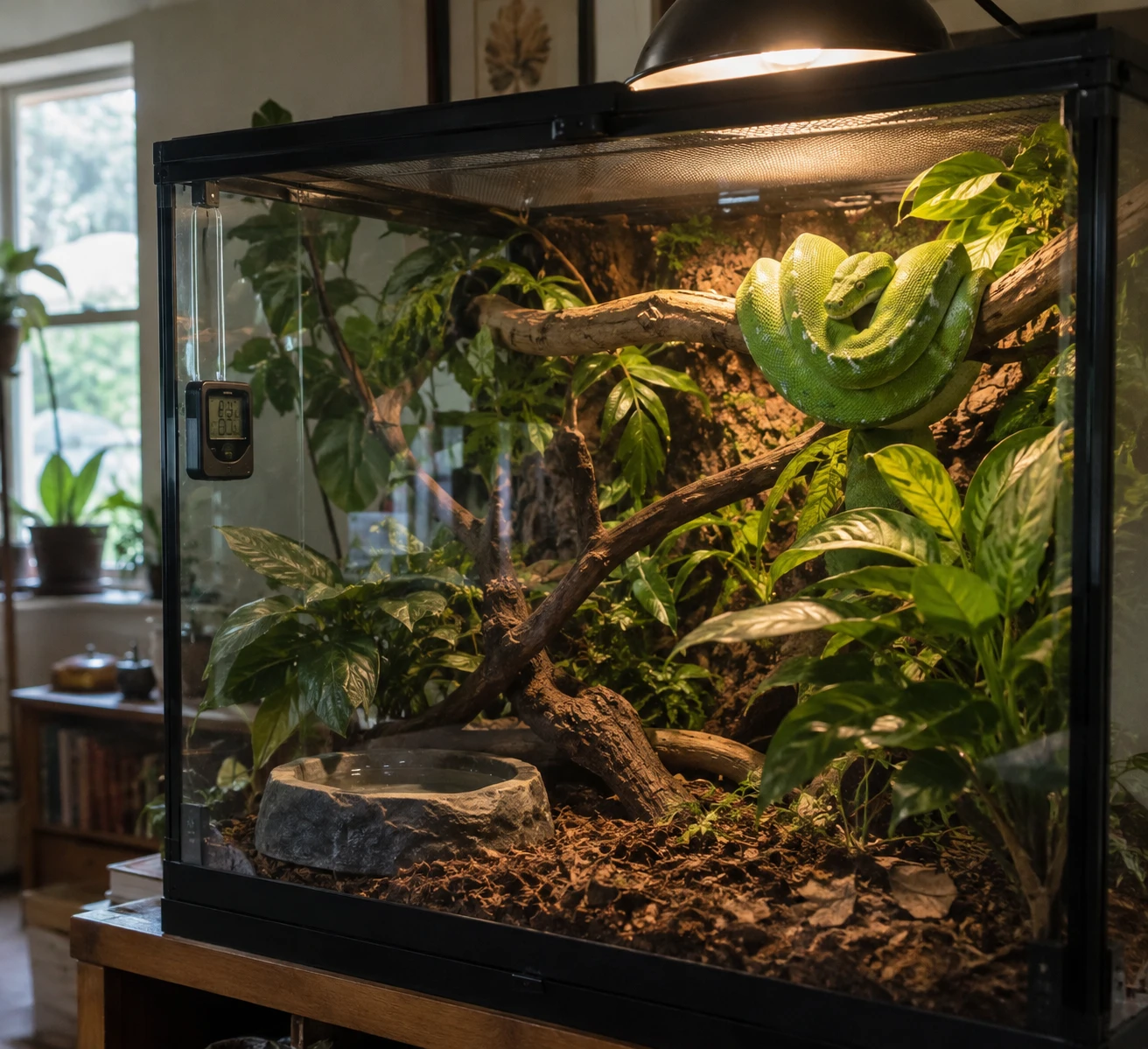
Green tree pythons need a tall, arboreal (tree-living) enclosure. An adult does well in about 3x2x2 feet (L x W x H) with horizontal perches at several heights. Keep days at 75-85°F with a basking spot near 88°F, nights in the 70s, and humidity at 50-70%.
Size is the easy part. Humidity is where most keepers struggle. Let’s build the setup, then talk honestly about whether this snake fits your life.
Enclosure Size by Age: Smaller Than You Think
Do green tree pythons need a huge enclosure? No. They sit on one perch for days, so a right-sized, well-planted cage beats a giant empty one. Small spaces also hold humidity better and make the snake feel safe.
Here are typical sizes. Treat them as starting points, because a big Biak-locality female outgrows a hatchling tub faster than a small Aru animal.
Age
Typical enclosure (L x W x H)
Notes
Hatchling (first year)
Shoebox-size tub, or 12x12x18 inches
Bare-bones: paper towel, water dish, plastic perch
Juvenile (1-3 years)
About 18x18x24 inches
Add cover and a second perch
Adult
3x2x2 feet is ideal
A 2-foot cube is the bare minimum
Why Babies Start Small
Hatchlings are fussy eaters and feel exposed in open space. A small tub with a perch, a water dish and paper towel makes it easy to watch for eating, pooping and regurgitating (throwing up food). It also cleans in seconds.
Some experienced breeders move snakes up in steps over several years. Others go straight from a small tank to a juvenile cage around the one-year mark. Either works if the snake stays secure.
Why Adults Don’t Need Giant Cages
Plenty of breeders report that adults prefer 20 to 24 inch cubes over bigger cages. Many sit on one favorite perch for months. A 3x2x2 foot enclosure gives a large female room without wasting space. Taller is better than wider, because these snakes use height.
What Is the Best Enclosure Type for a Green Tree Python?
The best enclosure holds heat and humidity, opens from the front, and lets air move through. PVC and front-opening cabinets usually win. Glass can work, but it takes more effort to keep stable.
Why front-opening? Green tree pythons are easily stressed by hands coming from above, which looks like a predator. A front door feels less threatening.
PVC Cabinets
PVC (a rigid plastic) holds humidity well and keeps heat steady. It is lightweight and easy to wipe down. Expect to pay roughly $250 to $500 for an adult-size cage, depending on brand and options. This is my pick for most keepers.
Glass Terrariums
A tall glass tank with a front door looks great and shows off the snake. The catch is that glass loses heat fast and the screen top lets humidity escape. You can cover part of the top to help. Expect more misting and more tweaking.
Tubs and Racks for Babies
Plastic tubs are cheap, warm and easy to keep humid. Use them for hatchlings and juveniles. Drill ventilation holes and add a vine or plastic perch.
Humidity Is the Real Challenge: The Mist-and-Dry Cycle
Humidity is the hardest part because it has to be high but not constant. Aim for 50-70% humidity, with a wet period and a dry period each day. Air that stays soaked with no fresh airflow invites respiratory infections.
Many beginners treat humidity like a thermostat setting. Set it, forget it. That is the wrong idea! In the wild, rain and dew arrive, then the air dries out. Your enclosure should copy that rhythm.
How the Cycle Works
Evening mist: Spray the walls, leaves and perches until you see droplets. Green tree pythons often drink drops off their own coils or leaves.
Humidity peak: Readings may climb to about 70% or a bit higher for a short time after misting.
Drying down: Over several hours, moisture evaporates and humidity drifts back toward 50%.
Morning check: The substrate should feel damp, not soggy, and the glass should be mostly dry.
Most keepers mist once or twice a day. A small cage may need less, and a leaky screen top may need more. Watch your hygrometer (humidity gauge) and adjust.
Ventilation: The Part People Skip
Ventilation means air moving in and out. Without it, wet air sits and bacteria grow. Look for vents low on one side and high on the other, so fresh air flows through. If the glass stays foggy all day or the substrate smells sour, you need more airflow, not less water.
Automatic Misters
A timed misting system saves effort and keeps the cycle steady. Many keepers set two short misting sessions a day. The trade-off is cost, often $100 to $250 for a basic setup, plus checking the nozzles so they don’t clog. Do it by hand if you are home daily.
How to Set Up a Green Tree Python Enclosure, Step by Step
Ready to build yours? Follow these steps in order. Run the whole setup for several days before the snake moves in, so you know the numbers stay steady.
Pick the cage. Choose a tall PVC or glass enclosure, about 3x2x2 feet for an adult or a smaller one for a young snake. Check the vents.
Add substrate. Spread 2 to 3 inches of cypress mulch or coconut husk. Both hold moisture without turning to mud.
Install perches. Place horizontal branches or sturdy dowels at three heights. Closet rod or PVC pipe works fine. Pick a diameter a bit thicker than the snake’s body.
Add a resting branch. Put a shaped perch, often a hammock-style one, near the warm spot. This is where your snake will probably live most of the day.
Add plants and cover. Use live pothos or ferns, or sturdy fake vines. Thick leaf cover helps the snake feel hidden.
Set up heat and light. Mount a heat source above the basking perch, ideally with a thermostat.
Add water and gauges. Place a water dish, a thermometer at the basking perch and one low in the cage, and a hygrometer.
Test for 3 to 7 days. Adjust until the numbers hold, then add the snake.
Perches That Make the Snake Feel Safe
Why does the perch layout matter? A single perch, or a floor-focused cage, ignores how this snake lives. Use several horizontal perches at different heights. Then the snake can move up to warm up and down to cool off.
Skip slippery or thin branches. Wide, rough perches are easier to grip. Wash and dry any wood before use.
Live Plants: Worth the Effort?
Live plants raise humidity and give cover. Pothos is hard to kill. Keep leaves off the heat source so they don’t burn. Fake plants are fine if you wipe them down often.
Temperature, Lighting and the Basking Spot
Green tree pythons need a gradient, meaning a warm end and a cooler end. Keep daytime air at 75-85°F with a basking area near 88°F. At night, let it drop to the 70s, and never let it fall below about 70°F.
Basking perches should be placed high, because heat rises and these snakes climb up to warm. Cool air settles lower.
Heat Sources That Work
A basking bulb or a radiant heat panel on a thermostat works well. Put the heat source above the perch with a guard so the snake cannot touch it. A thermostat is not optional. Without one, a hot bulb can burn your snake.
Many keepers avoid ceramic heat emitters because they dry the air fast. At night, a low-wattage panel or a dim red or infrared bulb can hold the 70s.
Light and Day Length
Run a steady day-and-night cycle of roughly 12 hours on and 12 off. A bright white LED helps you see the colors and supports live plants. Some keepers add low-level UVB. It is not required for pythons, but it is not harmful at low strength.
Check temperatures with a probe thermometer or infrared temperature gun at the perch itself. Air readings alone can fool you!
Feeding, Handling and Color Change
Green tree pythons eat rodents, and young ones usually take small mice. Feed hatchlings about every 7 to 10 days, and adults about every 2 to 3 weeks. Offer prey about as wide as the thickest part of the snake’s body, or a bit smaller.
Why so little? These snakes are inactive and gain weight easily. An overfed green tree python gets fat and unhealthy. Use feeding tongs or a gentle approach, and don’t handle the snake right after a meal.
Prey Size and Schedule
Stage
Prey
Frequency (typical)
Hatchling
Pinky or fuzzy mouse
Every 7-10 days
Juvenile
Small to adult mouse
Every 10-14 days
Adult
Adult mouse or small rat
Every 2-3 weeks
Weigh your snake monthly. If it keeps gaining fast, stretch the gap between meals.
Temperament and Handling
Most green tree pythons are better to watch than to hold. They can be nippy, and their personalities vary by locality. Handle only for needed tasks, like cage cleaning or a vet visit. Keep sessions short, and support the whole body.
Be careful with the tail. It is fragile, especially in hatchlings.
Color Change as They Grow
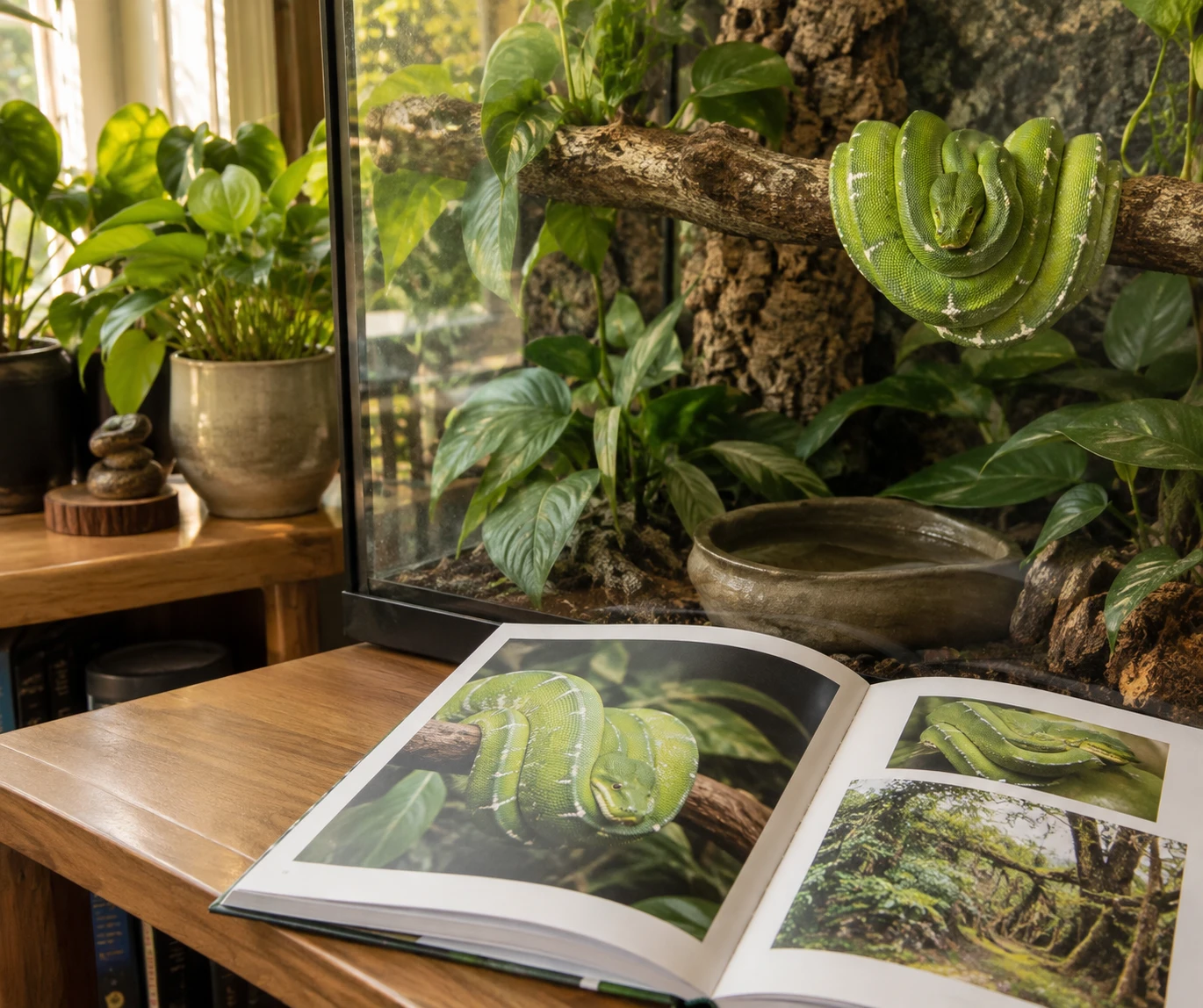
Babies are born bright yellow or red-orange. Over months to a couple of years, they turn green, a change called ontogenetic color change. Don’t panic if your snake looks patchy. It is normal. Keep the setup steady during the change.
Health Problems to Watch For
Most health trouble traces back to humidity and airflow. Respiratory infections are the big one. Signs include wheezing, bubbles at the nose or mouth, and open-mouth breathing. If you see these, contact an exotic-animal vet quickly.
Other issues include stuck shed (too dry) and mouth rot (too wet and dirty). Both link to the same habit: letting conditions drift.
Early Warning Signs
Clicking or wheezing sounds when breathing
Mucus around the mouth
Refusing several meals in a row
Stuck shed on the eyes or tail
Hanging low in the cage instead of perching
Catching a problem early gives you a good chance of fixing it. Fix the cage first, then see a vet. Call before you try home treatments.
Quarantine and Sourcing
Buy a captive-bred snake that is already feeding well. Wild-caught animals often carry parasites and stress. Ask the seller to show the snake eating before you pay.
Is a Green Tree Python Right for You? An Honest Checklist
Are green tree pythons easy to care for? No. They are beautiful, but they are not beginner snakes. They stress easily, and humidity needs steady attention every single day.
You are probably not ready if you answer yes to any of these:
You travel often and have nobody who can mist the cage.
You can’t check temperature and humidity daily.
You want a snake to hold and show friends.
You live somewhere very dry or cold, with no plan for a humid enclosure.
You don’t have a budget for an exotic vet visit.
You are unwilling to feed frozen rodents.
Ready? Then practice first. Keep a tall, humid test enclosure running for two weeks, and see if the numbers hold. If they do, you have a good shot. If you want more help with snake enclosure setups, Pet Terrarium has build guides to walk you through it.
Frequently Asked Questions
How big of an enclosure do green tree pythons need?
An adult does well in about 3x2x2 feet, and a 2-foot cube is the minimum. Hatchlings do better in a tub or a 12x12x18 inch tank. Bigger isn’t better, because these snakes stay put on one perch.
What temperature and humidity does a green tree python need?
Keep days at 75-85°F with a basking spot near 88°F, and nights in the 70s. Humidity should run 50-70%, with a mist-and-dry cycle instead of constant wetness.
How often should you mist a green tree python enclosure?
Most keepers mist once or twice a day, usually in the evening. Spray until you see droplets, then let the cage dry down. Adjust based on your hygrometer and how fast the air moves through.
What do green tree pythons eat and how often?
They eat mice, and large adults may take small rats. Feed hatchlings every 7 to 10 days and adults every 2 to 3 weeks. Overfeeding is a common mistake.