Your fish are basically swimming in their own bathroom water unless the filter is doing its job right. A fish aquarium filter isn’t one thing — it’s a category, and picking the wrong type is the fastest way to end up with cloudy water, dead plants, or a stressed-out betta hiding behind a rock. If you’re coming from the reptile or terrarium side of the hobby, this gets even trickier, because turtle tanks and paludariums throw extra curveballs at standard aquarium gear.
The good news: once you understand the four or five main filter types and how they match up to bioload, this decision gets fast. Most tanks under 40 gallons can be sorted out with a single solid filter in the $20 to $80 range.
Which Filter Type Actually Fits Your Setup
The right filter type depends on tank size, bioload, and how much water disturbance your animals can handle. There’s no single “best” filter — a hang-on-back (HOB) filter that’s perfect for a 20-gallon community tank would be overkill or just wrong for a shrimp nursery or a basking turtle tank.
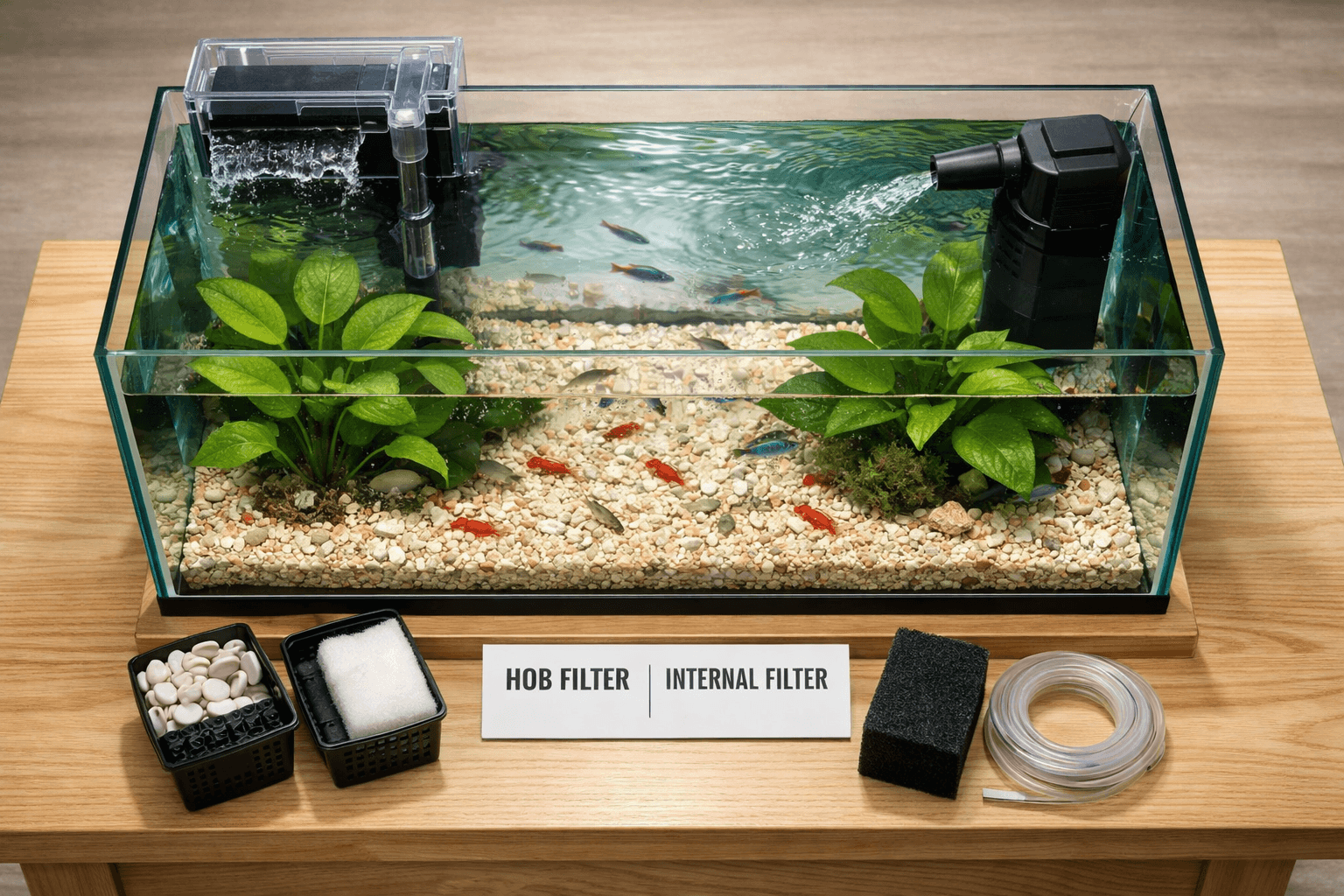
Hang-On-Back and Internal Filters
HOB filters clip onto the back of the tank and pull water up through a media cartridge before dumping it back in. They’re the most common starter option because they’re cheap, easy to clean, and easy to find at any pet store. Internal filters sit underwater and work well in smaller tanks, nano setups, or paludariums where you don’t have room for anything hanging off the back edge.
Canister and Sponge Filters
Canister filters sit outside the tank, usually under the stand, and push water through multiple media stages for heavier bioloads — think 50-gallon-plus tanks or turtle enclosures where waste output is high. Sponge filters are the quiet workhorses of the fry and shrimp world: gentle flow, huge surface area for bacteria, and nearly impossible to injure a baby fish with. Undergravel filters still exist but I rarely recommend them anymore — they’re hard to clean without disturbing substrate, which matters a lot if you’re running a planted or bioactive-style setup.
Matching GPH Flow Rate to Tank Size and Bioload
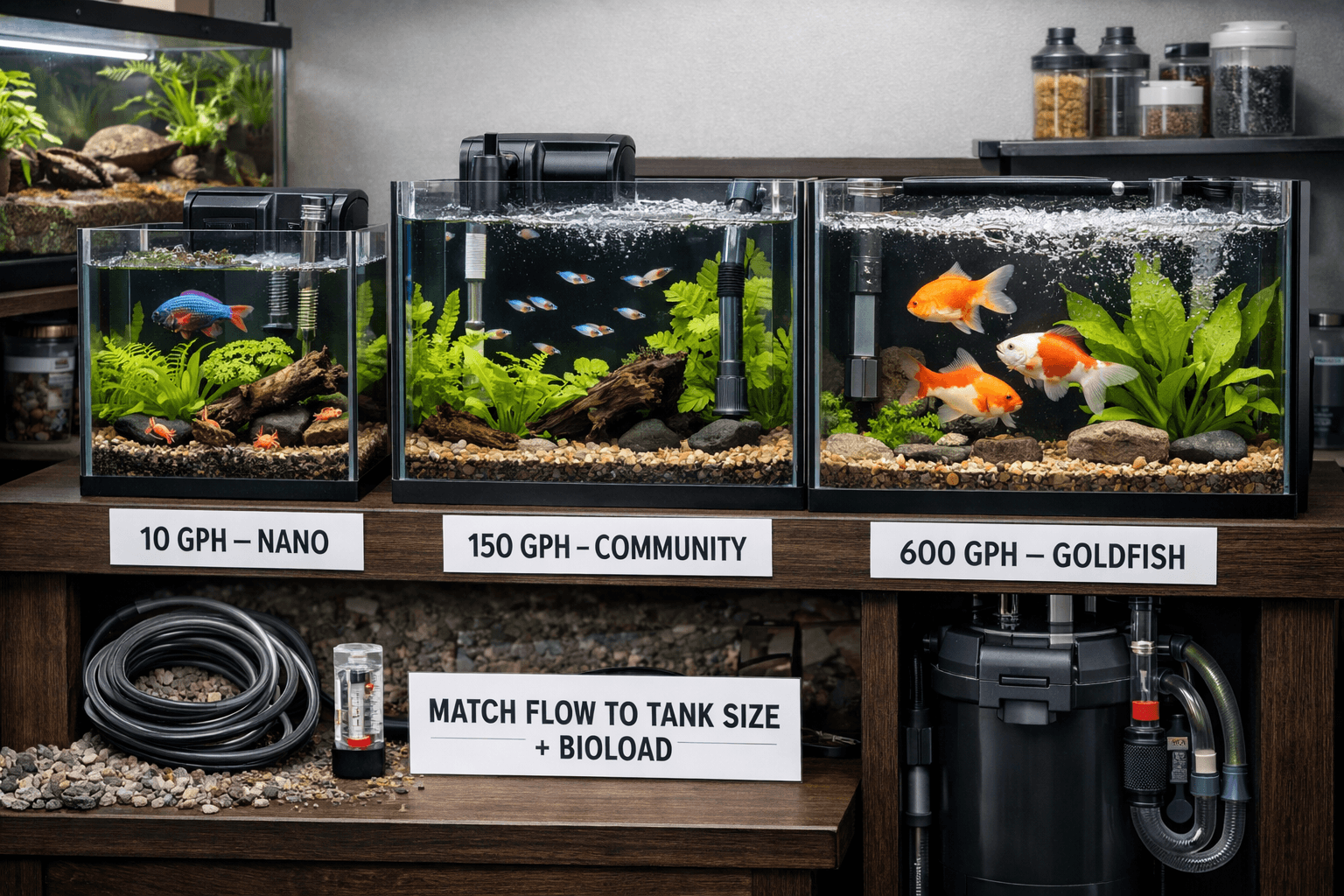
Flow rate, measured in gallons per hour (GPH), should roughly turn over your tank’s total water volume 4 to 6 times per hour — but bigger isn’t automatically better. A 20-gallon tank wants something in the 80-120 GPH range, not a 300 GPH canister that turns your betta into a kite.
Bioload matters more than gallon count alone. A 30-gallon tank with six goldfish needs way more filtration than the same tank holding a handful of neon tetras and some java fern, even though the tank size is identical.
Tank Size
Typical GPH Range
Good For
10 gallons
40-60 GPH
Bettas, shrimp, single small species
20 gallons
80-120 GPH
Community tanks, light bioload
40 gallons
160-240 GPH
Cichlids, moderate stocking
55+ gallons
220-330 GPH
Turtles, heavy waste producers
If you’re keeping low-flow fish like bettas or wild-type guppies, drop toward the bottom of the range or add a flow diffuser. Fast-water species like danios or hillstream loaches can handle — and often prefer — the higher end.
The Three Filtration Stages, and Why Skipping One Backfires
Every good filter runs mechanical, biological, and chemical filtration, and skipping the biological stage is the number-one reason new tanks crash. Mechanical filtration traps debris with sponges or floss. Biological filtration grows nitrifying bacteria on bio-balls, ceramic rings, or sponge material, converting ammonia into less toxic nitrate. Chemical filtration, usually activated carbon, pulls out dissolved toxins and tannins.
Water passes through a coarse sponge or pad to catch large debris first.
Finer floss or fine sponge material grabs smaller particles the coarse stage missed.
Water moves across biological media, where beneficial bacteria colonies convert ammonia to nitrite, then nitrite to nitrate.
Activated carbon or other chemical media polishes the water, pulling out discoloration and odor.
Clean water returns to the tank, ready to cycle through again within the hour.
Here’s the mistake that wrecks more tanks than anything else: replacing all your filter media at once. Doing that wipes out the bacteria colony you spent weeks building during the nitrogen cycle, and you’ll watch ammonia spike right back up. Rinse sponges in old tank water and only swap chemical media like carbon — leave the biological media alone unless it’s physically falling apart.
Cross-Use for Turtle Tanks, Paludariums, and Semi-Aquatic Frog Setups
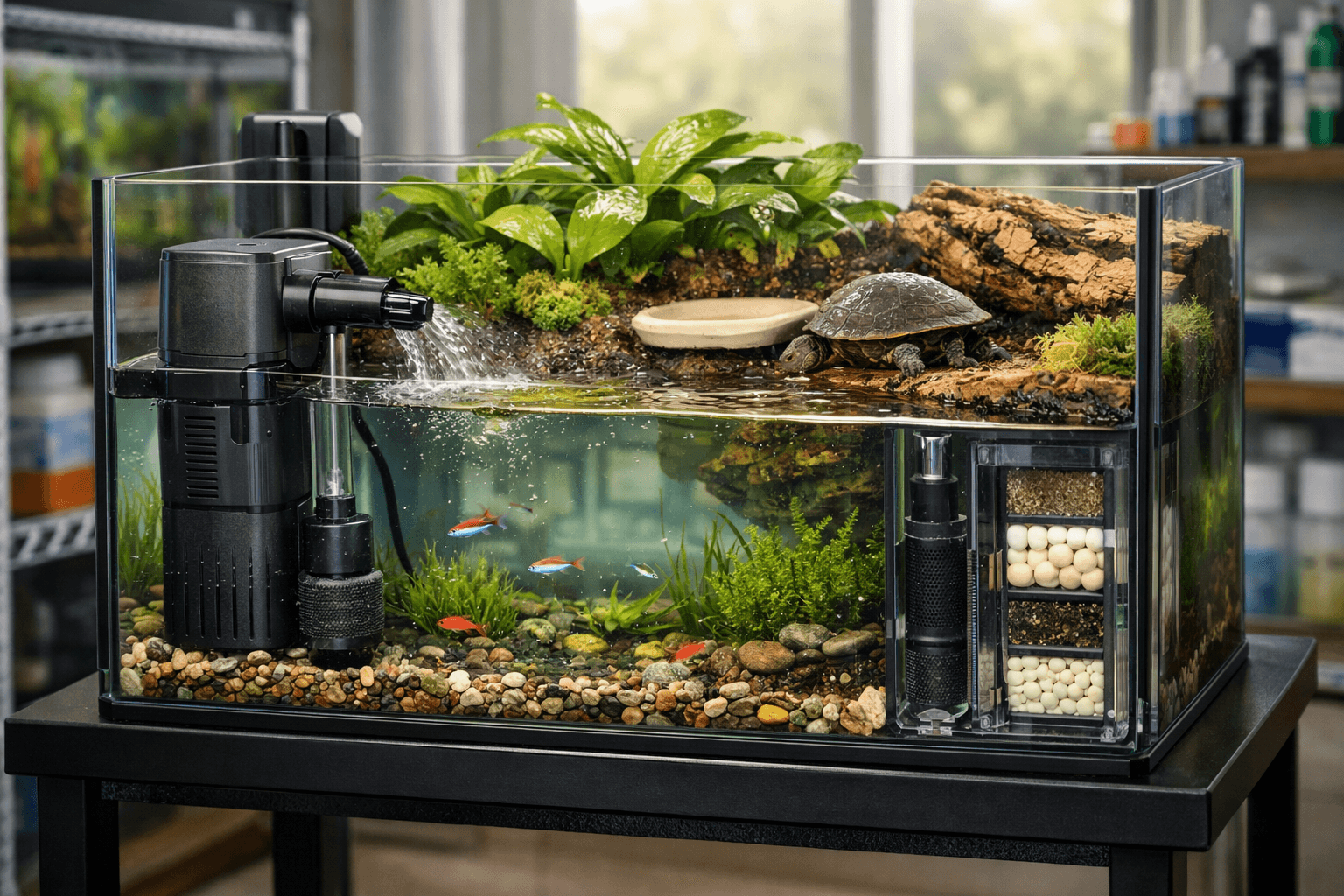
Standard aquarium filters can absolutely double for turtle tanks and paludariums, but only if you size up for bioload and think about placement around land areas. Turtles produce far more waste than fish of similar size, so a canister filter rated for double your actual water volume is a smart baseline, not overkill.
For paludariums and semi-aquatic frog setups, the challenge is water level and land zone protection. An internal filter with an adjustable intake works better than a HOB unit, since HOB filters often need more water depth than a half-water, half-land tank can offer. Position the outflow so it doesn’t blast directly at a basking platform or a frog’s preferred perch — that alone causes more stress than the filtration itself.
Noise and vibration matter more in these mixed setups too, since reptile and amphibian keepers often place tanks in bedrooms or living rooms rather than a dedicated fish room. A rattling canister filter motor sitting three feet from your bed gets old fast. Sponge filters and quality internal filters run quieter, and setting the canister on a small foam pad cuts vibration noise dramatically.
Water conditioning matters just as much as filter choice in these builds, since chlorine and heavy metals stress amphibians even faster than fish — a full walkthrough of conditioning steps lives elsewhere on petterrarium.com if you want to dial that part in before your filter goes live.
Frequently Asked Questions
How long does a new fish aquarium filter take to fully cycle?
Expect 4 to 6 weeks for a full nitrogen cycle using fishless cycling methods, though bottled bacteria products can shorten that to roughly 2 weeks. Test ammonia and nitrite weekly until both read zero before adding a full stocking load.
Can I use a regular fish filter in a saltwater tank?
Not usually — saltwater setups need filters and media rated for saltwater use, since standard freshwater carbon and some plastics degrade faster under salt exposure. Reef tanks also typically need protein skimmers alongside standard filtration.
Is a sponge filter strong enough for a 20-gallon tank?
Yes, a large sponge filter rated for 20-40 gallons works fine, especially for shrimp, fry, or low-bioload community setups. Just add a second one or pair it with a small internal filter if you’re stocking heavier fish like larger cichlids.