Your bearded dragon can look totally healthy while its UV light is basically useless. That bulb might still glow bright white, but the invisible UVB rays it’s supposed to produce can drop to almost nothing after a few months. This is how metabolic bone disease sneaks up on owners who did everything else right.
The fix isn’t just buying a bulb and screwing it in. It’s knowing which bulb type to buy, where to put it, and how to actually check it’s still working months down the road.
UVB vs UVA vs Heat: Why Bearded Dragons Need All Three
A bearded dragon needs three separate light jobs done, and no single bulb does all of them. UVB is the non-negotiable one — it lets your dragon’s skin make vitamin D3, which is what actually lets their body absorb calcium.
UVA is the light that affects mood, appetite, and breeding behavior. It’s less critical than UVB, but it’s why full-spectrum bulbs matter more than a plain household bulb. Heat is a totally separate need, handled by a basking bulb, not your UVB tube.
This is where people mix things up. A heat lamp warms the basking spot but produces zero UVB. A UVB bulb, meanwhile, might barely warm anything at all. Treat these as two different tools doing two different jobs, not one bulb pulling double duty.
Skip vitamin D3 synthesis, and calcium supplements in food barely matter. Without UVB, your dragon can’t use that calcium anyway, and that’s the root of most metabolic bone disease cases.
T5 HO, T8, Coil, or Mercury Vapor: Which Bulb Actually Works
The short answer: go with a T5 High Output (T5 HO) linear tube for most setups. It gives strong, even UVB across a wide basking area and holds its output longer than the alternatives.
T5 HO vs T8 Tubes
T5 HO bulbs run hotter and brighter than T8 tubes, and they push UVB further into the enclosure — useful in taller tanks or ones over 40 gallons. T8 tubes are cheaper, often $15-25, but their UVB drops off fast with distance, so they only work well in smaller, shallower setups.
Why Coil Bulbs Are a Bad Idea
Skip compact coil UVB bulbs entirely. They’ve been linked to eye and skin irritation in bearded dragons, likely from uneven UV output and hot spots concentrated in a small area. A linear tube spreads that same UVB output over a much wider, gentler range.
Mercury Vapor Bulbs: Powerful but Risky
Mercury vapor bulbs combine heat and UVB in one bulb and can cover a large tank with strong output. They’re convenient, but they run hot, and a bad one can spike temperatures dangerously if it’s too close to the basking branch. I’d only recommend these in larger enclosures where you’ve got room to keep the bulb 12-16 inches from the basking spot.
Bulb Placement, Screen Blockage, and the Decay Problem Nobody Checks
Here’s the part most care sheets skip: your bulb can look completely normal while producing almost no usable UVB. This is the real danger zone, not bulb selection.
Distance From the Basking Spot
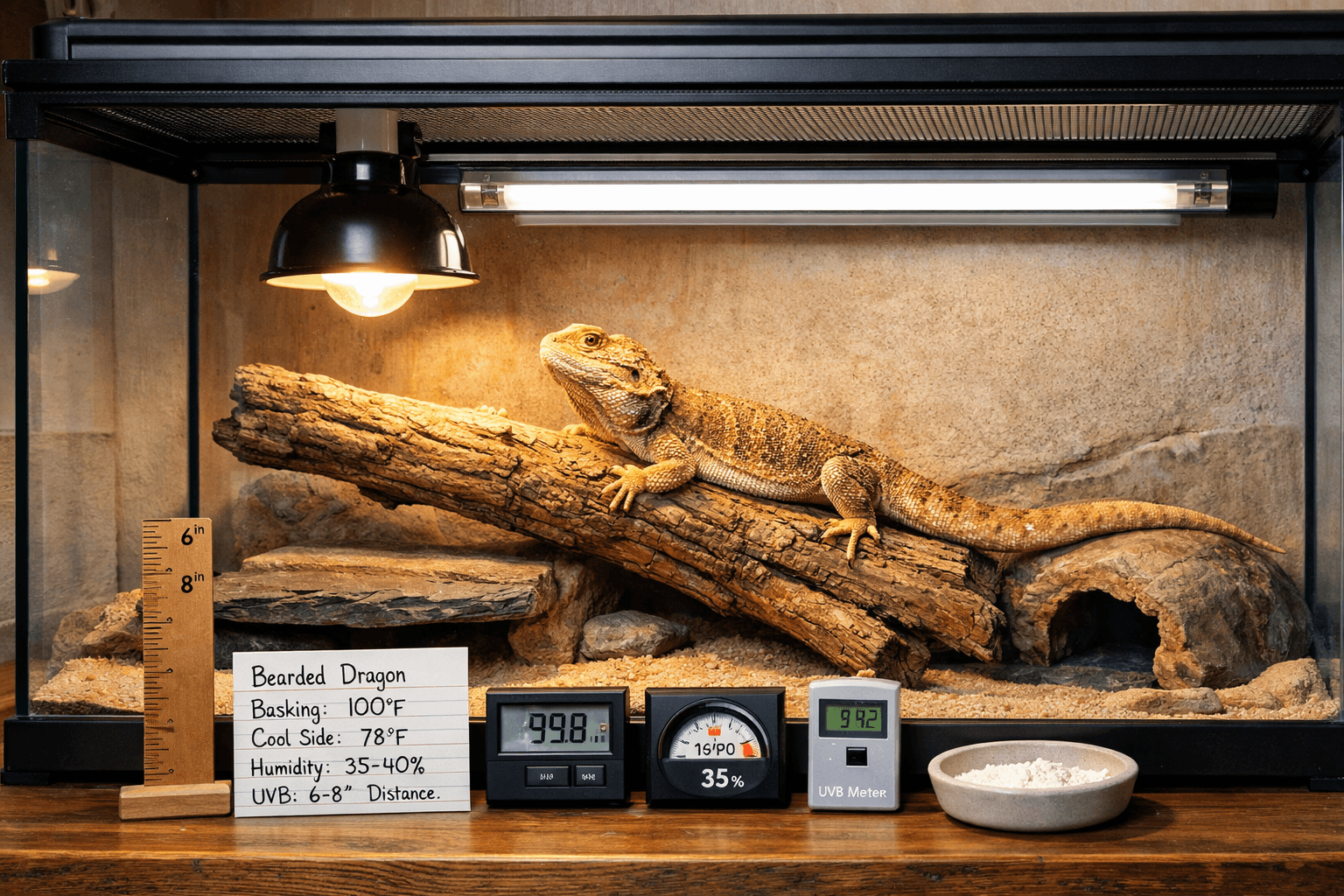
For a T5 HO bulb, aim for roughly 10-12 inches between the bulb and the top of the basking branch, with no glass or thick mesh in between. Even a fine mesh screen top can block 30-50% of usable UVB, so a bulb that would test as strong bare might barely register once it’s filtered through the lid.
Bulb Decay Is Real and Silent
UVB output degrades steadily, even though the visible light stays just as bright. A tube can look brand new at month eight while outputting a fraction of the UVB it did on day one. That’s exactly why a bulb can’t be trusted based on looks.
How to Actually Verify Output
The only real way to know is measuring it. A Solarmeter 6.5 UV Index meter is the standard tool hobbyists and reptile shop owners use to check actual UVB reaching the basking spot, and it’s worth the roughly $150-180 cost if you keep reptiles long term. Bearded dragons generally do best with a UV Index of 3.0-6.0 at the basking spot, measured with the meter held right where your dragon actually sits.
Bulb Type
Typical UVB Reach
Best Tank Size
Replace Every
T5 HO Linear
Strong, even spread
40+ gallons
10-12 months
T8 Linear
Moderate, drops with distance
Under 40 gallons
6-8 months
Compact Coil
Uneven, hot spots
Not recommended
N/A
Mercury Vapor
Very strong, combines heat
55+ gallons
12 months
If you don’t own a meter, follow the manufacturer’s replacement schedule strictly, and lean toward replacing early rather than late.
Setting the Schedule: Photoperiod and Replacement Routine
Bearded dragons need a day/night cycle, not constant light. Never leave UVB running 24/7 — it disrupts their sleep cycle and offers no extra benefit, since their bodies can only process so much D3 synthesis per day anyway.
A solid routine looks like this:
Turn on UVB and basking lights around the same time each morning, roughly a 12-14 hour “day” in spring and summer.
Dim to a 10-12 hour day cycle in fall and winter to mimic seasonal shifts.
Turn off all UVB and heat lighting at night — a ceramic heat emitter can keep warmth up without any light if your room runs cold.
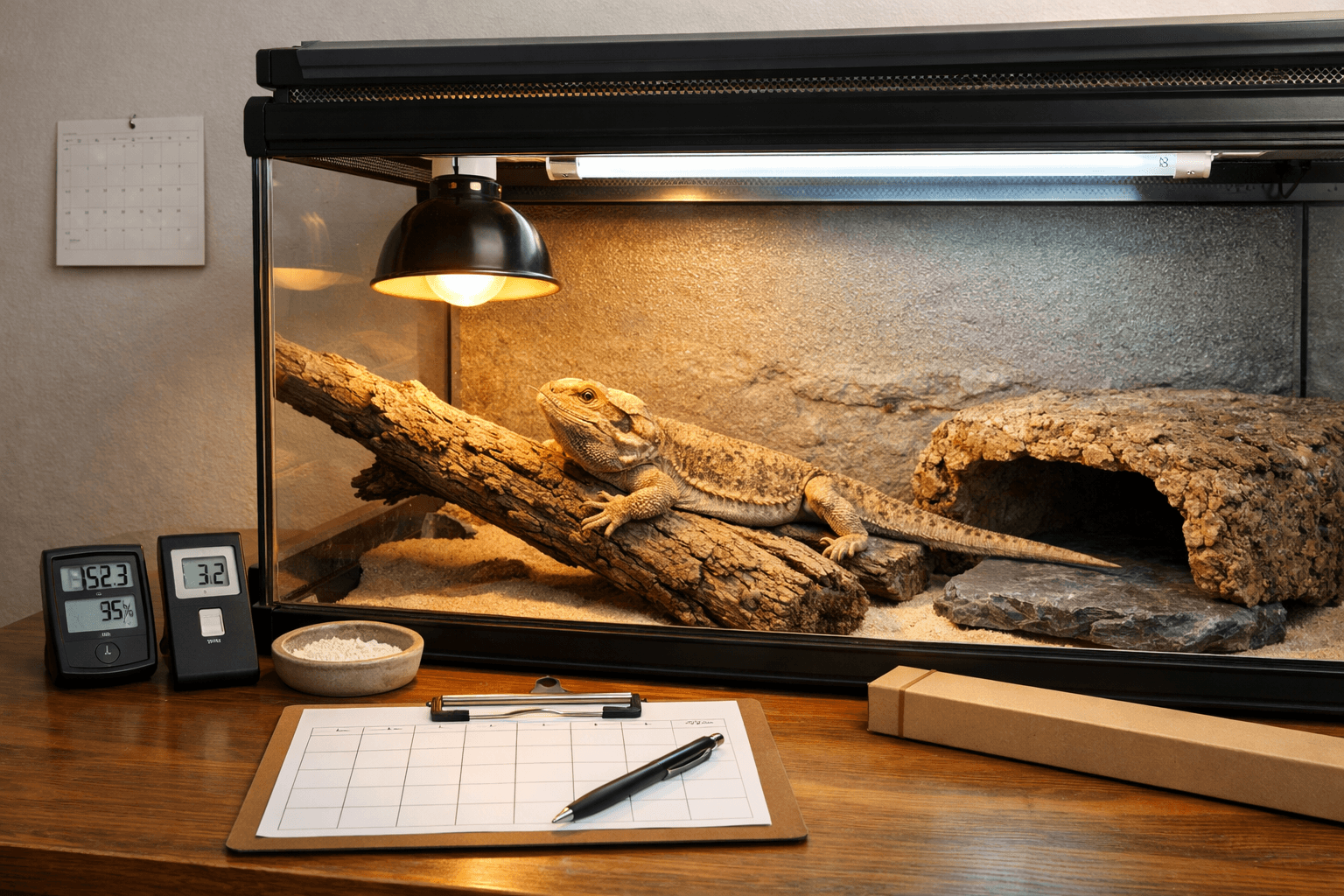
Mark your bulb’s install date on the tank or a calendar app the day you put it in.
Replace T5 HO bulbs at 10-12 months and T8 bulbs at 6-8 months, even if they still light up fine.
Retest with a UV meter, or reference a full care guide like the ones on petterrarium.com, whenever you rearrange the enclosure or swap bulb brands.
Log basking spot temps and UV index together monthly if you’re keeping multiple dragons or running a shop setup.
Consistency here matters more than perfection. Missing a day of the cycle now and then won’t hurt, but running an expired bulb for months absolutely will.
Frequently Asked Questions
How do I know if my UVB bulb still works?
Visible brightness tells you nothing. Use a Solarmeter 6.5 meter to check the actual UV Index at the basking spot, or replace on schedule (10-12 months for T5 HO, 6-8 for T8) regardless of appearance.
Can I put the UVB bulb outside the mesh screen top?
No — mesh screen blocks 30-50% of UVB even when it looks thin. Mount the bulb inside the canopy or as close to the mesh as safely possible, and compensate with a stronger bulb if needed.
Is a heat lamp the same as a UVB light?
No, and this mix-up causes real harm. Heat lamps only produce warmth, not UVB, so a dragon under just a heat bulb gets zero vitamin D3 synthesis and is at direct risk for metabolic bone disease.