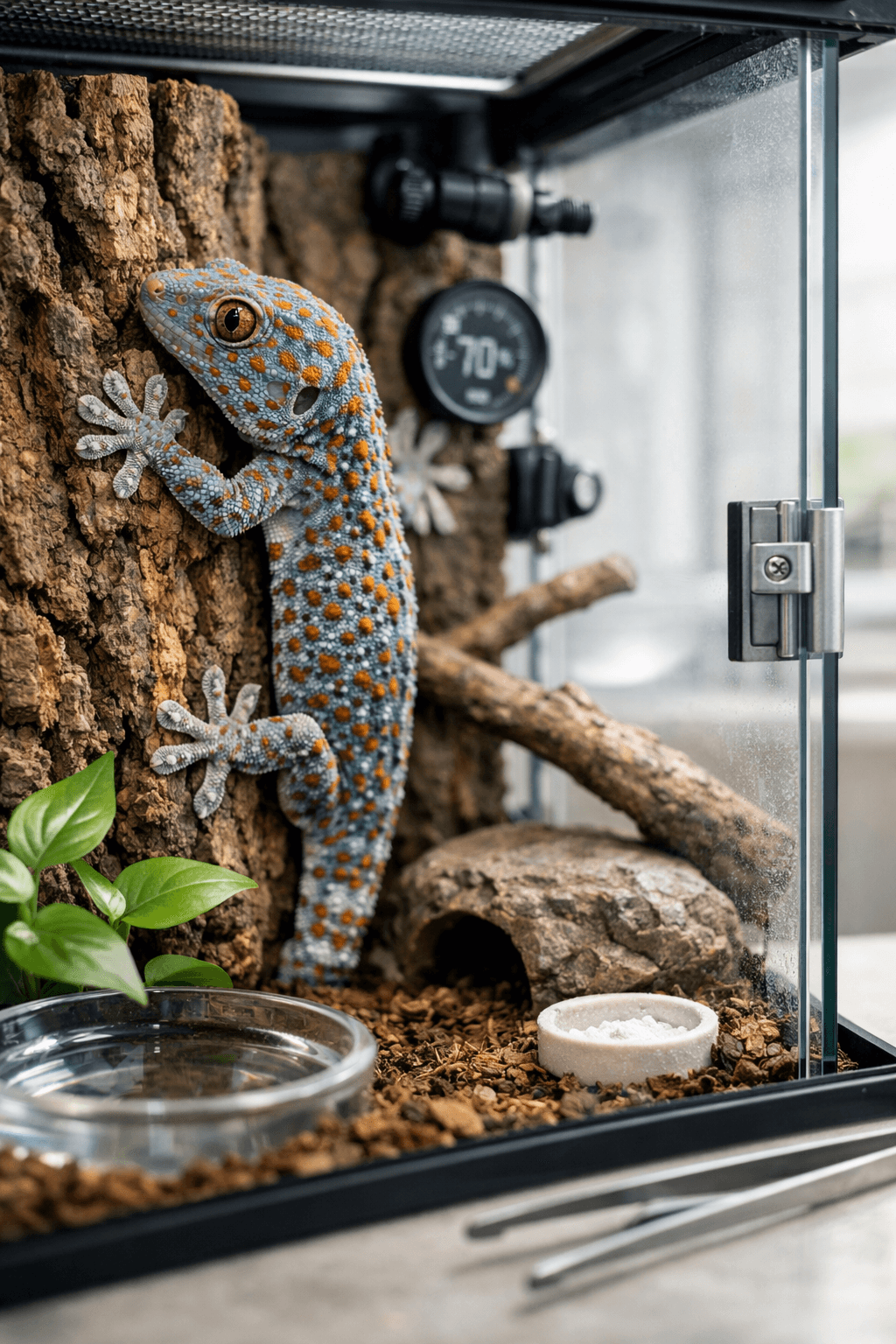
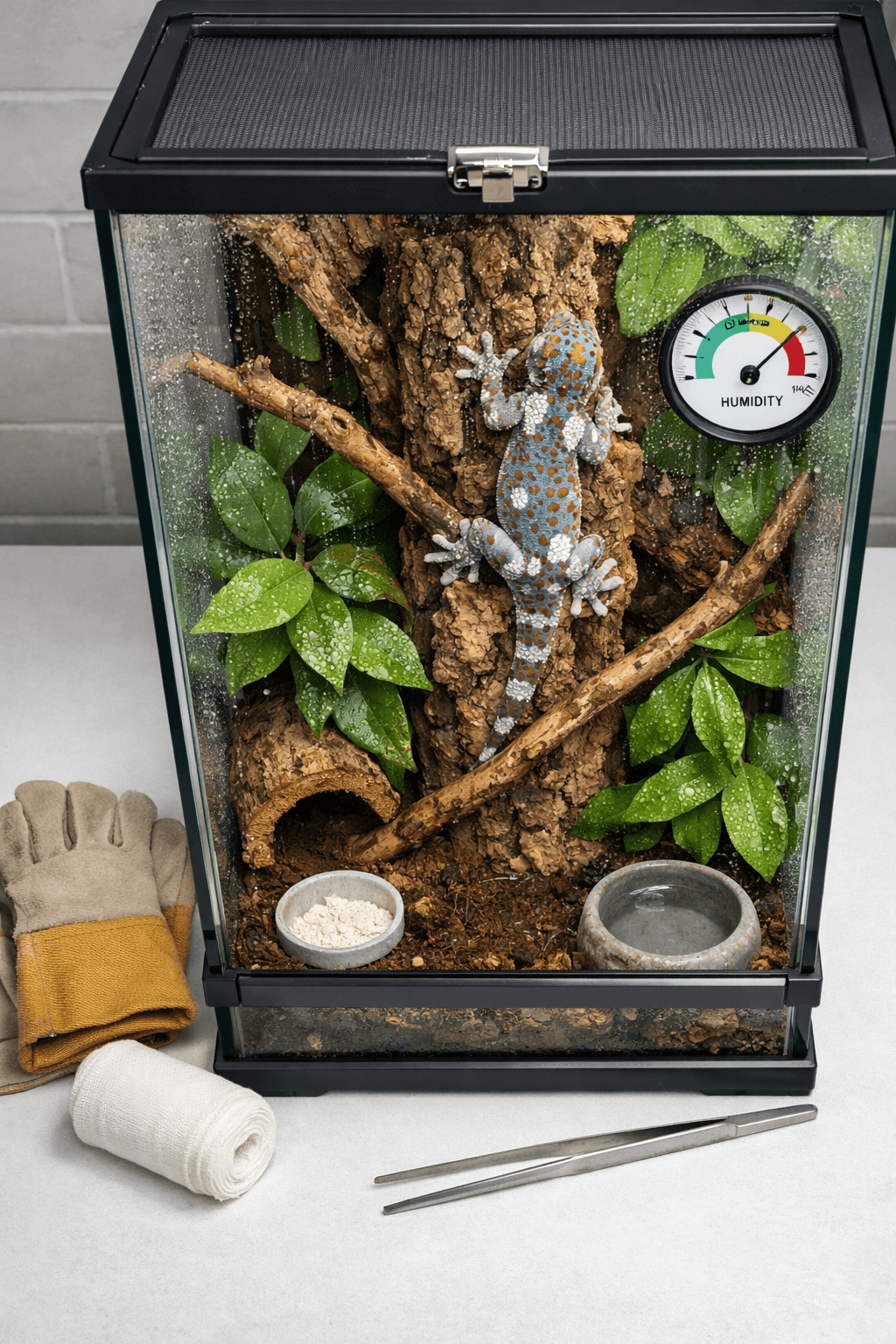
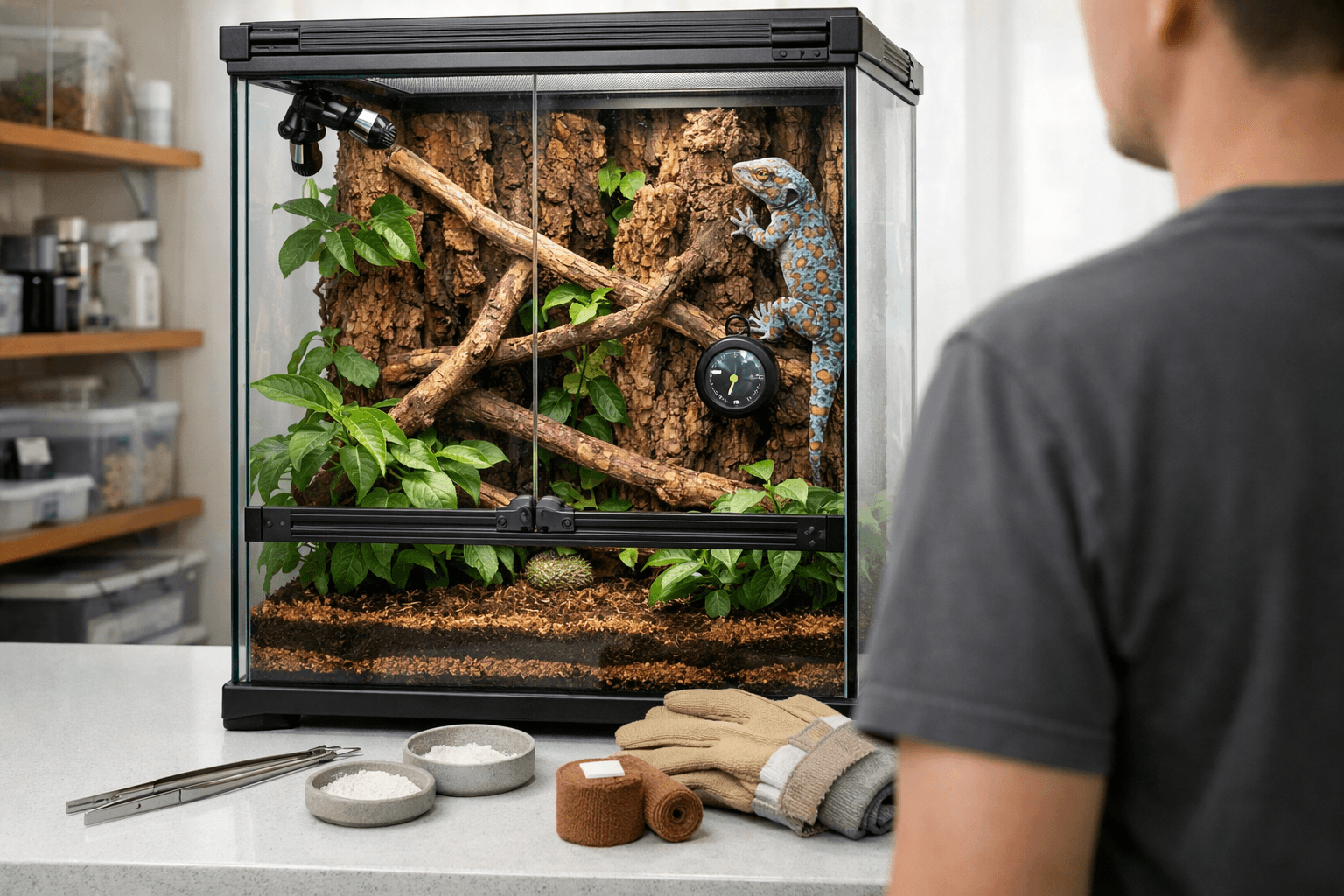
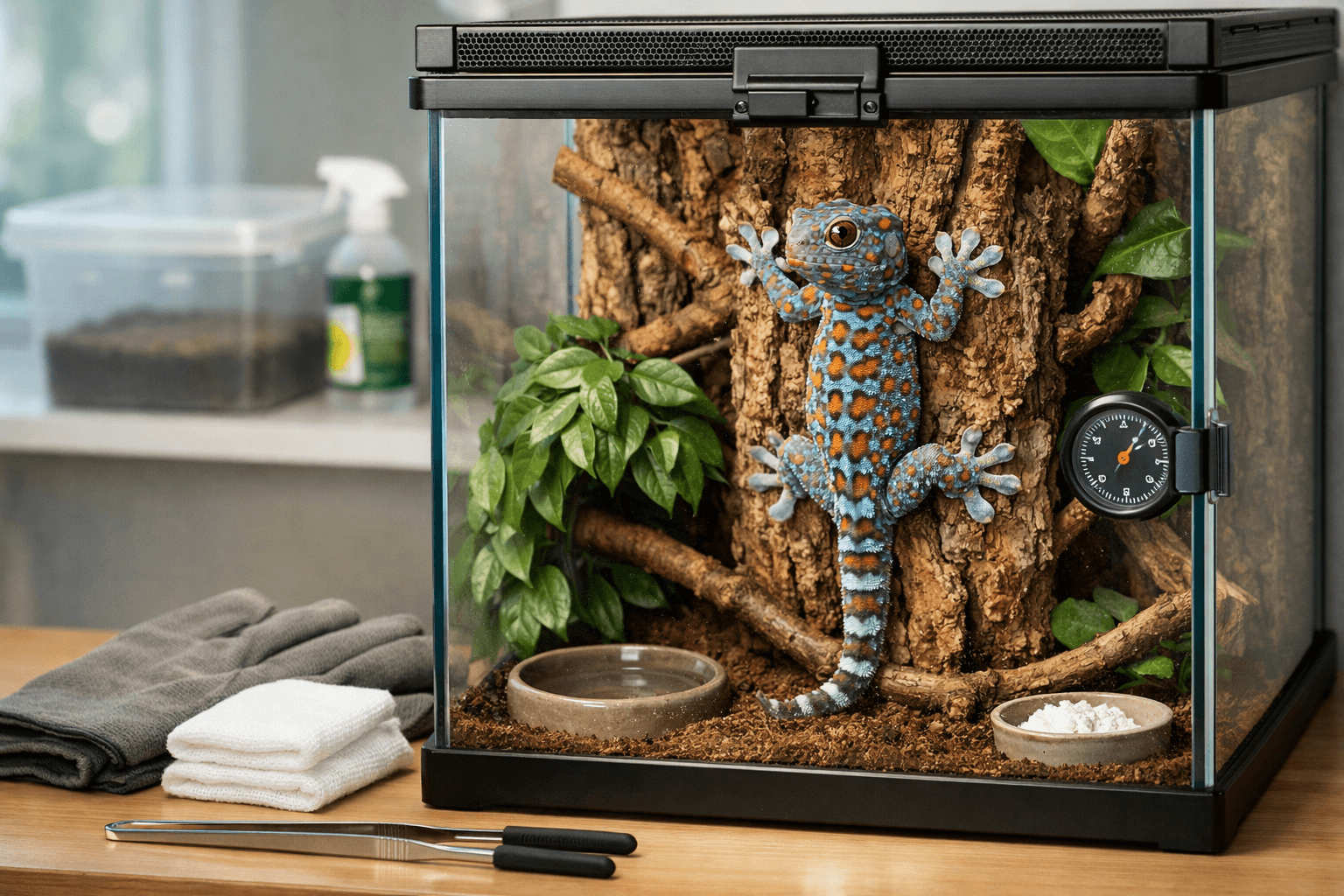
A reptile shop owner once told me a customer came in asking for “an easy first gecko” and walked out with a tokay gecko because the color pattern caught her eye. Three weeks later she was back, hand wrapped in gauze, asking how to rehome it. That’s the tokay gecko in a nutshell: gorgeous, loud, and absolutely not a beginner lizard, no matter what the price tag at the pet store suggests.
If you already own one, or you’re seriously considering it, you need a setup built around two things: keeping the gecko secure and calm, and keeping your fingers intact. This guide covers both.
Why Tokay Gecko Housing Is Different From Standard Gecko Setups
The short answer: tokay geckos need bigger, taller, more secure enclosures than most gecko species because they’re strong climbers, territorial, and capable of a genuinely painful bite. Treating their tank like a beginner leopard gecko setup is the single biggest mistake new owners make.
Leopard geckos are ground-dwelling and pretty mellow once settled in. Tokay geckos (Gekko gecko) are arboreal, meaning they live and hunt vertically, on branches, cork bark, and tank walls. They’re also famously territorial and can deliver a bite strong enough to draw blood and hang on. This isn’t fearmongering — it’s just biology you need to plan around.
That difference changes almost every part of the setup. You’re not just building a comfortable habitat. You’re building one that limits stress-triggered aggression, gives the animal enough vertical space to feel secure, and locks down tight enough that a strong, motivated climber can’t find a gap.
The good news: none of this is complicated once you know what to prioritize. A tokay gecko that has enough height, cover, and consistent humidity is usually a calmer tokay gecko. Most of the “aggression” people report actually comes from cramped, exposed enclosures where the animal feels like it has nowhere to hide.
Think of the build less like a “cute lizard house” and more like a secure vertical terrarium with defense in depth. Every layer, from the substrate to the lid latch, should assume the gecko is stronger and faster than you expect.
Once that mindset clicks, the rest of this guide is really just filling in the details.
Tank Size and Enclosure Dimensions That Actually Work
A single adult tokay gecko needs a minimum of an 18x18x24 inch vertical enclosure, and bigger is genuinely better here. Horizontal “starter” tanks marketed for leopard geckos are the wrong shape entirely for this species.
Minimum vs. Ideal Dimensions
An 18x18x24 setup is a workable floor for one adult, but a 24x24x36 or larger vertical enclosure gives a tokay room to establish separate basking, hiding, and patrol zones. Adult tokays can reach 12 to 15 inches nose to tail, so cramped housing means constant contact with glass and decor, which raises stress.
Height matters more than floor space for this species. A tall, narrow enclosure with lots of branches beats a wide, short one every time, because tokays naturally climb up rather than range across the ground.
Glass vs. PVC vs. Screen
Front-opening glass terrariums (the kind marketed for reptiles, often in the 40-gallon-and-up range) work well because they hold humidity and give clear viewing. PVC enclosures hold heat and humidity even better and resist warping, though they cost more, often $150 to $300 depending on size.
Screen or mesh cages are a poor fit for tokays. They dry out too fast for a species that needs consistent humidity, and determined climbers can sometimes work at seams over time. If you already own a screen enclosure, use it for quarantine or as a backup only, not as the primary home.
One detail people skip: leave enough clearance around the enclosure for a rack of misting equipment and cords, since most tokay setups need a mister or fogger running on a timer.
Substrate, Humidity, and Misting: The Shedding Problem Nobody Warns You About
Tokay geckos need humidity in the 60 to 80 percent range, and getting this wrong is the most common reason owners deal with stuck shed and toe or tail-tip loss. This species comes from humid tropical forests across Southeast Asia, and dry air is a bigger daily threat than most owners realize.
Substrate Choices
A mix of coconut fiber (eco earth) and sphagnum moss holds moisture well and lets you keep the lower enclosure damp without turning it into a swamp. Some keepers layer in orchid bark for texture and drainage. Avoid loose sand or gravel entirely — it doesn’t hold humidity and can cause impaction if accidentally ingested during feeding.
A bioactive setup with live plants and a cleanup crew of isopods or springtails works well for tokays specifically because the constant humidity that plants need matches what the gecko needs anyway. It’s more setup work upfront, usually a weekend project, but it cuts down on manual cleaning later.
Misting Schedule and Tools
Manual misting twice a day, morning and evening, is the minimum for most rooms. In a dry climate or a heated house in winter, that often isn’t enough, and this is where owners get caught off guard.
An automatic misting system or a fogger on a timer solves the consistency problem completely. Set it for two to three cycles a day and you stop relying on your own memory, which is honestly where most humidity failures happen. Digital hygrometers (the $10 to $15 kind with a probe) should be placed at both the top and bottom of the enclosure, since humidity readings can vary a lot by height in a tall tank.
Watch for shed stuck around the toes and tail tip. That’s the clearest sign humidity has been running low for a while, and it’s fixable within days once misting frequency goes up.
Heating, Lighting, and UVB: What a Nocturnal Climber Actually Needs
Tokay geckos need a warm side around 85 to 90°F and a cooler side in the mid-70s, plus low-level UVB despite being mostly nocturnal. Skipping UVB because “they’re active at night” is a common but outdated assumption.
Recent thinking in reptile husbandry (and plenty of keeper experience) supports giving crepuscular and nocturnal geckos a low-output UVB bulb anyway, since many still get incidental exposure at dawn and dusk and seem to benefit metabolically. A 5.0 UVB tube running the length of the enclosure, on for about 10 to 12 hours a day, is a reasonable standard.
Basking Spots and Temperature Gradient
Use a ceramic heat emitter or a low-wattage basking bulb positioned near the top of the enclosure, since that’s where a climbing species will actually spend warm-up time. A digital thermostat is worth the $25 to $40 it costs, because tokay geckos are sensitive to overheating and a stuck thermostat can cook an animal in a tall glass tank faster than you’d think.
Don’t rely on the stick-on dial thermometers that come bundled with beginner kits. They’re notoriously inaccurate. A digital probe thermometer placed at both the basking spot and the cool side gives you real numbers to work from.
Day-Night Cycle
Run lights on a timer for a consistent 12-hour on, 12-hour off cycle. Tokays are more active at night, so don’t be surprised if you barely see yours during the day — that’s normal behavior, not a sign something’s wrong.
Hides, Climbing Structure, and Escape-Proofing (The Part Most Guides Underrate)
This is the section that actually separates a good tokay setup from a dangerous one. Because tokay geckos climb glass, bark, and even smooth vertical surfaces with startling ease, and because they’re strong enough to push against loose lids, escape-proofing has to be treated as a core design requirement, not an afterthought.
Climbing Decor and Hides
Cork bark tubes and flats, stacked at different heights, give a tokay multiple vertical routes and, more importantly, multiple places to disappear into when it wants to feel hidden. Live or artificial plants like pothos or sansevieria add cover along the climbing paths, which matters a lot for a species that calms down when it feels concealed. Aim for at least two solid hides, one near the top and one lower down, so the gecko can pick a temperature and a comfort level at the same time.
Bamboo poles and horizontal branches placed at multiple heights recreate the layered forest structure this species evolved for. More surface area to climb usually means less pacing and less glass-surfing, which is often mistaken for the gecko being “bored” when it’s actually the enclosure being too plain.
Locking the Lid Down for Good
Standard clip-on screen lids fail with tokay geckos more often than owners expect, because these lizards are strong enough to push a loose-fitting lid up from underneath. Use enclosures with a locking front door or a top that can be secured with actual clips or a small latch, not just a lid that rests on top by gravity.
Check every seam, vent, and cord pass-through for gaps wider than the width of the gecko’s head. Tokays can compress their bodies more than you’d guess, and a “small enough” gap is often not small enough.
Here’s a practical order of operations for locking down a new or existing enclosure:
Inspect all seams and corners for gaps, especially where glass panels meet the frame.
Add mesh or fine screen behind any ventilation cutouts larger than a quarter inch.
Replace clip-only lids with a locking or latching top if the enclosure allows it.
Test the lid and door under gentle upward and outward pressure by hand.
Recheck the setup after adding any new decor, since branches placed near the lid give extra leverage for pushing.
Do a final nighttime check with a flashlight, since that’s when a tokay is most likely to test for weak points.
Skipping this step is how tokays end up loose in a house, and recapturing an escaped tokay gecko from behind a dresser or inside a wall void is a stressful multi-hour job you really don’t want.
Feeding Schedule, Diet, and What “Handling” Really Means for This Species
Feed juvenile tokay geckos every day and adults two to three times a week, using appropriately sized live insects, and plan on very limited hands-on handling given their temperament. This is the section where new owners most often carry over leopard gecko expectations that don’t apply.
Diet and Feeding Routine
Crickets and roaches (like dubia roaches) make a solid staple diet, dusted with a calcium supplement most feedings and a vitamin D3/multivitamin powder once or twice a week. Occasional treats like hornworms or superworms add variety, but shouldn’t be the daily staple since they’re higher in fat.
Feed in the evening when tokays are naturally waking up and hunting. Use feeding tongs rather than dropping insects in by hand, both to gauge appetite accurately and to keep your fingers out of striking range during a feeding response, which is when bites most often happen.
Handling and Temperament
This is the correction most guides skip: tokay geckos are not a handling pet. Unlike leopard geckos or crested geckos, tokays are known for being defensive, fast, and willing to bite hard enough to break skin and hang on rather than let go. Some individuals calm down somewhat with slow, consistent, low-stress interaction over months, but plenty never become “cuddly,” and that’s fine. You’re keeping this animal to observe and appreciate, not to carry around.
If you must handle one, for a tank clean or a vet visit, use thick gloves and a clear container or a gentle herding technique rather than grabbing. Never grab a tokay by the tail. They can drop it as a defense mechanism, and while it will regrow, it’s stressful for the animal and not something you want to cause routinely.
Tank Mates, Cleaning Routine, and Common Health Problems to Watch For
Tokay geckos should be housed alone as adults, since cohabitation almost always ends in serious injury or death from territorial aggression. Beyond that big rule, a solid cleaning schedule and knowing the warning signs of common health issues rounds out a safe, comfortable setup.
Why Cohabitation Almost Never Works
Adult tokay geckos, males especially, will fight other tokays on sight, and even male-female pairs kept together outside of deliberate, supervised breeding attempts often result in one animal injuring or killing the other. This isn’t a “maybe with a big enough tank” situation. Two adult tokays in the same enclosure is a recipe for a vet bill or a dead gecko, and shop owners see this mistake constantly from customers who assume more space solves social problems it doesn’t.
If you’re set on keeping more than one, you need separate enclosures, full stop, with visual barriers between them so they aren’t stress-displaying at each other through the glass all day.
Cleaning and Maintenance Schedule
Spot-clean waste and uneaten insects daily. Do a deeper substrate refresh or partial substrate change every 4 to 6 weeks in a bioactive setup, or more often in a non-bioactive one where a cleanup crew isn’t handling waste for you. Wipe down glass or acrylic walls weekly, since tokays leave visible smudges and scent markings that build up fast.
Common Health Issues
Watch for retained shed around the toes (usually a humidity problem), respiratory infections from temperatures that run too cold or too damp without airflow, and metabolic bone disease in animals kept without any UVB or calcium supplementation over time. Mouth rot can also show up if enclosure hygiene slips for too long. Most of these are preventable and, caught early, very treatable with a reptile vet visit and a husbandry fix rather than anything drastic.
The table below is a quick comparison of typical setup ranges for a single adult tokay gecko, since specifics tend to get muddled across different sources.
Setup Factor
Typical Range
Notes
Enclosure size
18x18x24 in (min) to 24x24x36 in
Vertical height matters more than floor space
Basking temperature
85–90°F
Positioned near the top of the enclosure
Cool side temperature
Mid-70s°F
Lower portion of the tank
Humidity
60–80%
Drops below 50% often cause stuck shed
Feeding frequency (adult)
2–3 times per week
Appropriately sized live insects
Substrate depth
3–4 inches
Coconut fiber and sphagnum moss mix
If you’re planning the build from scratch, a custom terrarium guide (petterrarium.com has several) can help you work out ventilation and lid security specific to your enclosure’s shape before you buy anything.
Frequently Asked Questions
Can you tame a tokay gecko so it can be handled like a leopard gecko?
Some individuals become more tolerant of slow, quiet handling over months, but most tokay geckos never become reliably safe to handle freely. Plan around observation, not regular hands-on interaction, and use gloves or containers for any needed handling.
What size enclosure does a single adult tokay gecko need at minimum?
An 18x18x24 inch vertical enclosure is the workable minimum for one adult, with 24x24x36 inches or larger being better. Vertical height matters more than floor area since tokays are heavy climbers.
Do tokay geckos really need UVB lighting if they’re active at night?
Yes. Even though tokays are mostly nocturnal, a low-output 5.0 UVB bulb run 10 to 12 hours a day supports calcium metabolism, and many keepers see incidental dawn and dusk activity that benefits from it.
Is it ever okay to house two tokay geckos together?
Not for casual keeping. Adults are territorial enough that cohabitation, even male-female pairs outside deliberate breeding attempts, frequently results in serious injury. Keep adult tokays in separate enclosures.