You’re looking at your new goliath bird eater tarantula enclosure and wondering if you’ve got the setup right. Theraphosa blondi is the world’s largest tarantula by mass, and it has specific needs that generic spider care advice gets wrong. Get the microclimate right and this animal thrives for decades. Get it wrong and you’ll lose the spider to a failed molt or dehydration inside a year.
The real setup work here isn’t about how the tank looks. It’s about engineering the right conditions underground, in the substrate, where this spider actually spends most of its time.
Quick-Reference Specs: Goliath Bird Eater Terrarium at a Glance
Here’s the fast version before we get into the details.
Parameter
Target Range
Enclosure footprint
24″ x 18″ minimum (adults)
Enclosure height
12–14″ max
Substrate depth
8–12 inches
Temperature
78–82°F
Humidity
80–90%
Water dish diameter
3–4 inches
Prey size
No larger than the spider’s abdomen
Feeding frequency (adult)
Every 10–14 days
These numbers apply to adult females, which can reach a leg span of around 10–11 inches. Juveniles can start in smaller enclosures but hit adult parameters faster than most keepers expect.
Tank Size and Dimensions: Floor Space Beats Height Every Time
Floor space is the priority for a goliath bird eater tarantula, not vertical volume. This is a terrestrial burrower. It moves along the ground, digs down, and rarely climbs. A taller enclosure doesn’t give it more room to use — it gives it more height to fall from.
Why Vertical Space Is a Risk, Not a Bonus
A fall from even 8 inches can rupture a tarantula’s abdomen. That’s not an exaggeration. The abdomen is soft, fluid-filled, and not built to absorb impact. A terrestrial species kept in a tall enclosure will eventually climb the glass out of stress or curiosity, and a fall from the top of a 20-inch tank is almost always fatal.
Keep the interior height low enough that the spider can’t build up serious falling distance. Once you account for 8–12 inches of substrate, you realistically want no more than 4–6 inches of open air above the substrate surface. That puts your total enclosure height in the 12–14 inch range.
The Minimum Footprint That Actually Works
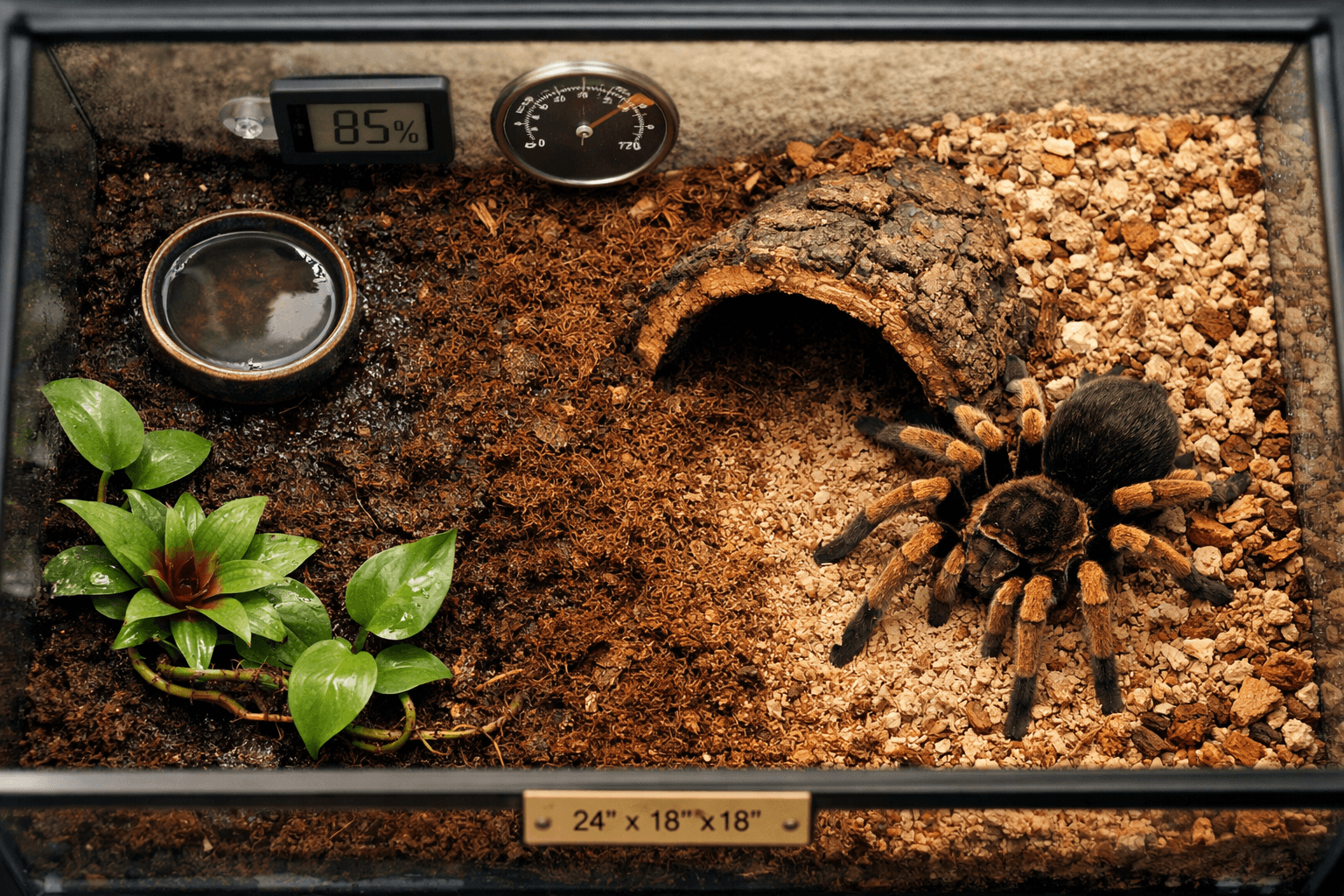
For an adult goliath bird eater tarantula, a 24″ x 18″ footprint is the practical minimum. A 40-gallon breeder tank from a brand like Zilla or Exo Terra hits close to this shape and works well. The 40-gallon breeder measures roughly 36″ x 18″, which gives you extra room without adding unnecessary height.
Avoid tall “display” style tanks sold for arboreal species. A 20-gallon tall tank (24″ x 12″ x 16″) is actually worse than a 20-gallon long (30″ x 12″ x 12″) for this spider, even though they hold the same volume.
Juveniles under 4 inches can start in a 10-gallon long (20″ x 10″ x 12″) with the same substrate depth principles applied. Move them up to adult sizing once they approach 6 inches of leg span.
Building the Substrate Layer: The Moisture Gradient Is the Real Setup
The substrate layer is where most keepers go wrong, and it’s the single biggest factor in whether a goliath bird eater tarantula survives long-term in captivity. Dry substrate causes dehydration and failed molts. A proper moisture gradient (wet at the bottom, drier at the top) gives the spider the ability to self-regulate by moving up or down in its burrow.
What to Use and How Deep to Go
Use these substrate materials in combination:
Coconut fiber (coco coir): forms the moisture-holding base layer
Topsoil (plain, no fertilizer or perlite additives): adds density and burrow stability
Sphagnum moss: placed at the surface to slow moisture evaporation
Clean play sand: mixed into lower layers at roughly 30% to improve structure
Leaf litter: optional top layer that mimics forest floor conditions
Go 8 inches deep at minimum. Twelve inches is better for adults, giving the spider room to burrow fully out of sight.
Wet Bottom, Drier Top: How to Layer It Correctly
Pour your coco coir and topsoil mix into the bottom third of the enclosure, then saturate it until water pools slightly when you press down hard. That’s your wet zone. Add your sand-mixed mid-layer next, packing it moderately. The top 2–3 inches should be drier coco coir or a thin layer of sphagnum moss.
Don’t mix the layers together. The point is a gradient, not a uniform moisture level throughout.
Signs Your Substrate Moisture Is Off
Watch the spider’s behavior. If it’s pressing itself against the glass walls or sitting in its water dish for extended periods, the substrate is too dry. If you see mold spreading across the surface within a few days of setup, you’ve overdone the moisture at the top layer. Let it dry slightly before adding the sphagnum.
A healthy setup holds surface moisture for about a week after a light misting before needing attention again.
Temperature, Humidity, and Ventilation: Hitting the Right Microclimate
The goliath bird eater tarantula needs 78–82°F and 80–90% relative humidity to stay healthy. These aren’t loose guidelines. Outside that range, molting problems and respiratory stress become real risks. Ventilation matters too, but too much airflow is just as dangerous as too little.
Keeping 78–82°F Without Cooking the Enclosure
Most keepers in a home kept at 70–75°F need a supplemental heat source. A low-wattage radiant heat panel mounted to the side of the enclosure (never the bottom, since it disrupts the moisture gradient) works better than a heat mat under the tank. Brands like Reptile Systems make panels in the 15–25 watt range that hold temperature without overheating a small space.
Avoid heat lamps entirely. They dry the enclosure out fast and create hot spots the spider can’t escape. Use a digital thermometer with a probe placed near the substrate surface. That’s where the spider actually lives, not at the top of the tank.
Humidity at 80–90%: Why Screen Lids Work Against You
A full screen lid will tank your humidity within hours in most homes. Tropical species like Theraphosa blondi need an enclosure that retains moisture, and a mesh top fights that at every step. Use a glass or acrylic lid with drilled side vents instead. Side ventilation near the top of the enclosure lets stale air out without pulling moisture from the substrate the way a screen top does.
Aim for two rows of small vent holes (around 1/8 inch diameter) on opposite sides of the enclosure. That’s enough cross-ventilation to prevent stagnant air and mold without collapsing your humidity. A digital hygrometer placed mid-enclosure gives you a real reading. Guessing doesn’t work here.
Hides, Water Dishes, and Decor That Serve a Function
Every item in this enclosure should do something. Decoration for its own sake wastes space and creates maintenance problems. The goliath bird eater tarantula needs a hide and a water dish. Everything else is optional.
Choosing and Placing the Hide
One hide is enough, and it should be half-buried in the substrate near a corner. Cork bark tubes work well. A 6-inch diameter tube gives an adult goliath bird eater tarantula enough room to turn around inside. Place it horizontally so the spider doesn’t have to climb to use it.
Cork bark is a good choice because it holds surface moisture without rotting quickly. Avoid plastic hides with smooth interiors. The spider can’t grip them, and they don’t contribute to the humidity microclimate the way natural materials do.
Water Dish Size and Placement
Use a shallow dish 3–4 inches across, placed in the cooler corner of the enclosure away from the heat source. Depth matters: keep water no deeper than 1/2 inch to prevent drowning risk, especially for juveniles. A plain ceramic or terracotta dish works fine and won’t leach anything into the water.
Refill it every few days. A dry dish in a humid enclosure is still a problem. The spider drinks more than most keepers expect.
Feeding Your Goliath Bird Eater: Prey Size and Schedule
Feed adult goliath bird eater tarantulas every 10–14 days. Juveniles under 3 inches can eat every 5–7 days. Prey size is the part most keepers get wrong, and oversized feeders cause real injury.
How Often and How Much
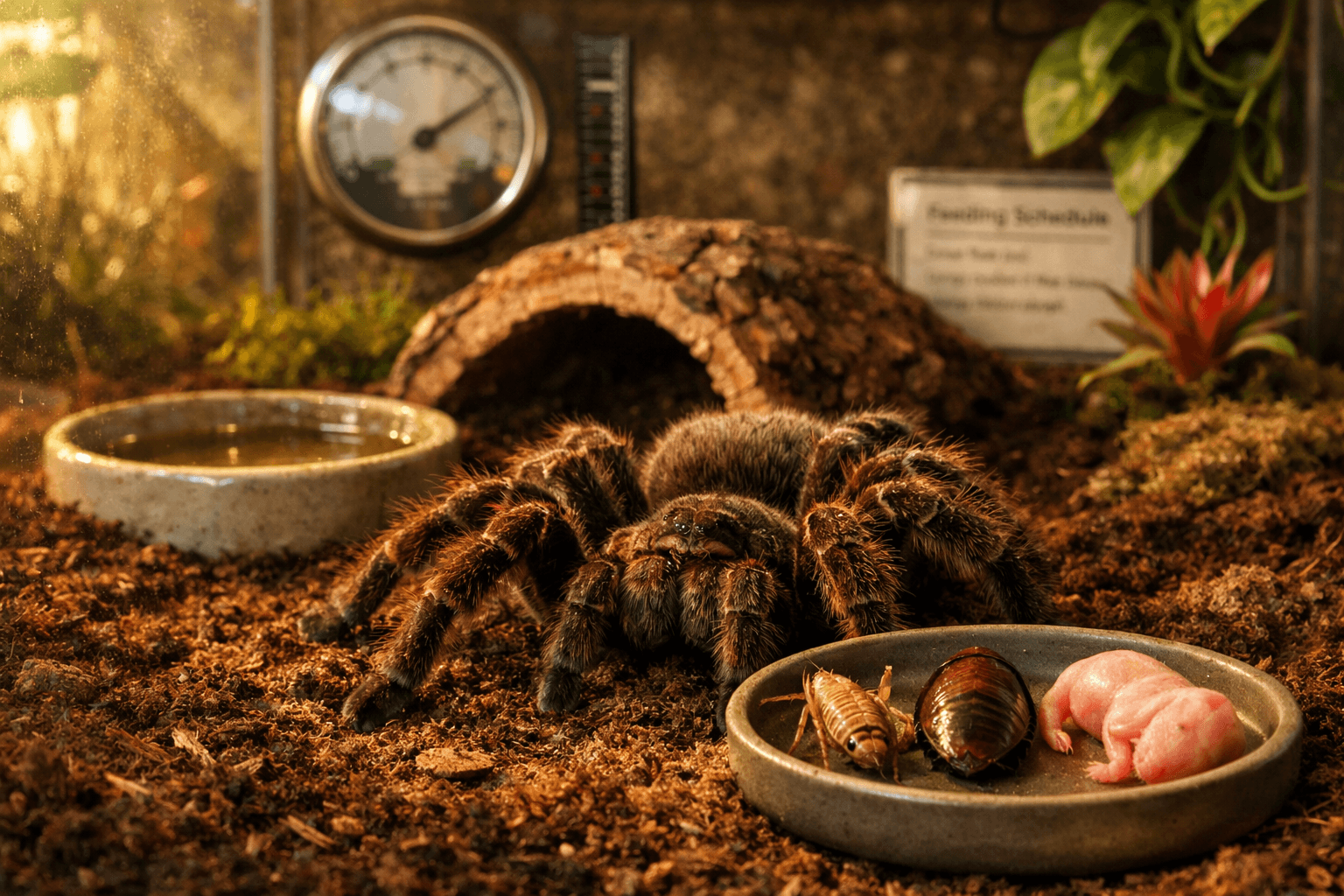
Prey should be no larger than the spider’s abdomen, not its full body length. For a large adult female, that typically means a large Acheta domesticus (house cricket) or a medium dubia roach. One prey item per feeding is enough. Leaving multiple live feeders in the enclosure overnight stresses the spider and can result in the feeder biting the tarantula during a vulnerable period.
Remove uneaten prey within 24 hours. A goliath bird eater tarantula that ignores food for a week or two isn’t sick — it’s likely approaching a molt.
What to Do Around Molting Time
Stop feeding completely once you see premolt signs: a darkening abdomen, reduced activity, and the spider sealing itself into its burrow. Feeding during premolt is risky. A live feeder left with a molting tarantula can kill it.
After a molt, wait at least 2 weeks before offering food again. The new exoskeleton needs time to harden fully, and the spider’s fangs won’t be functional for the first several days post-molt.
Handling Safety and Urticating Hairs: What You Need to Know Before You Reach In
Don’t handle a goliath bird eater tarantula casually. This species is defensive by nature, and its primary defense isn’t a bite. It’s urticating hairs, barbed fibers it kicks from its abdomen toward threats. Contact with those hairs causes intense skin irritation, and eye contact can cause serious inflammation that lasts days.
Wear nitrile gloves and safety glasses any time you work inside the enclosure, even for routine maintenance. The hairs don’t need direct contact with the spider to cause problems. Shed hairs accumulate in the substrate and on enclosure walls over time.
If you get hairs on your skin, rinse the area immediately with cool water. Don’t rub. Rubbing drives the barbs deeper. Eye exposure needs a proper eyewash and a call to a medical professional, not a wait-and-see approach.
Minimize open-enclosure time to reduce exposure. Use long tongs for feeding and moving decor. The goliath bird eater tarantula is best observed, not handled.
Setting Up a Bioactive Terrarium for a Goliath Bird Eater
A bioactive setup for a goliath bird eater tarantula can work, but it needs to be built around the spider’s needs first, not the aesthetics of the planted tank.
The foundation is the same moisture-gradient substrate described earlier: coco coir, topsoil, and sand. On top of that, a cleanup crew of Porcellio scaber (isopods) and springtails handles waste breakdown and mold control. Springtails especially earn their place in a high-humidity enclosure like this one, where uneaten prey remnants break down fast.
Choose low-maintenance plants that tolerate low light and high moisture. Pothos (Epipremnum aureum) is hard to kill and grows well in these conditions. Avoid anything with thorns or stiff stems. The spider moves through the enclosure more than you’d expect, and sharp plant material is a real hazard.
Skip overhead lighting unless the plants need it. A simple 6500K LED strip on a timer for 10-12 hours covers plant growth without heating the enclosure. Petterrarium.com has additional guides on bioactive builds if you want to go deeper on plant selection for tropical setups.
Frequently Asked Questions
Can a goliath bird eater tarantula live in a 10-gallon tank?
Only as a juvenile under 2 inches. A 10-gallon tank gives an adult nowhere near enough floor space and can’t hold the substrate depth this species needs. Adults need at least a 20-gallon footprint — roughly 24 x 12 inches of floor space.
How long do goliath bird eater tarantulas live in captivity?
Females live roughly 15–25 years under good care. Males have much shorter lifespans, typically 3–6 years, and often die within months of reaching sexual maturity. If you want a long-term pet, a female is the better choice.
Do I need a UVB light for a goliath bird eater tarantula?
No. Theraphosa blondi is a burrowing, nocturnal species with no documented UVB requirement. Standard ambient room light is fine. If you add lighting for a bioactive setup, keep it low-intensity and on a timer to avoid heating the enclosure.
What’s the biggest mistake new keepers make with this species?
Keeping the substrate too dry. Dehydration and failed molts are the most common causes of captive death in this species. If you’re unsure whether the enclosure is moist enough, it probably isn’t — pour water slowly into one corner every week and let the gradient do the rest.